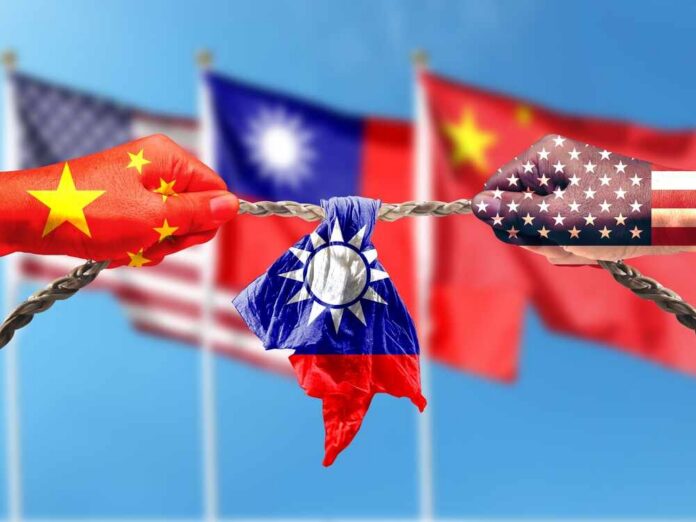
Trump’s Beijing summit is shaping up as a high-stakes test of whether America can win real economic relief without giving Beijing an opening on Taiwan.
Story Snapshot
- President Trump’s state visit to China is underway in Beijing, with trade, fentanyl controls, rare earths, Iran, and Taiwan all on the agenda.
- U.S. business leaders are watching for “tangible wins,” while analysts warn that even small shifts in Taiwan language could carry major strategic consequences.
- Reports suggest the talks are tightly choreographed, reflecting both the opportunity for deals and the risk of costly misstatements.
- With the U.S.-Iran conflict pressuring global oil markets, some experts argue China arrives with added leverage at the negotiating table.
Beijing Talks Put “America First” Promises Under a Microscope
President Donald Trump’s multi-day summit with Chinese leader Xi Jinping began in Beijing around May 12–13, drawing intense attention from markets, allies, and voters at home. Coverage of the trip has emphasized practical outcomes: trade stability, purchases of U.S. goods, and steps that could ease supply-chain pressure. At the same time, the meeting is unfolding amid wider geopolitical strain, including a U.S.-Iran conflict that has raised energy concerns globally.
For Americans frustrated by years of inflation and high household costs, the economic angle is straightforward: any reduction in trade friction could help prices, particularly for consumer goods and industrial inputs. For conservatives wary of globalism, the harder question is whether short-term economic gains come with long-term strategic compromises. The public evidence so far points to careful message control rather than sweeping breakthroughs, underscoring how limited expectations can coexist with outsized consequences.
What “Tangible Wins” Would Look Like for Workers and Consumers
Analysts tracking the trip have pointed to several benchmarks that would be measurable at home: clearer trade rules, commitments for Chinese purchases, cooperation against fentanyl flows, and improved access to critical materials like rare earths. Rare earth supply matters because U.S. manufacturing and defense supply chains remain exposed to overseas chokepoints. Technology and AI also hover over the talks, with U.S. firms seeking predictability after years of tightening export controls and “chip war” restrictions.
Business involvement has been a prominent theme, with reporting describing interest from major U.S. corporate leaders in expanded market access and restored commercial ties. That corporate push can cut both ways politically. On one hand, exports and stable supply chains support jobs and investment. On the other, voters across the spectrum increasingly distrust elite dealmaking that appears to prioritize multinational profits over national resilience, especially if it dulls U.S. leverage on security questions.
Taiwan Signals Are the Trip’s Most Dangerous Flashpoint
Taiwan remains the issue where wording matters most. Reporting and commentary around the summit highlight concern that even a subtle rhetorical shift by U.S. leadership could be interpreted as a change in resolve, potentially affecting deterrence in the region. Security-minded observers have argued that Beijing watches closely for cues that the U.S. might restrain support for Taiwan or slow arms-related commitments. Because U.S. policy has long relied on careful ambiguity, off-script remarks can carry outsized risk.
To manage that risk, accounts of the visit describe a heavily stage-managed environment, including close staff oversight intended to prevent misstatements. That choreography can be read in two directions. Supporters see disciplined diplomacy designed to secure concrete gains while avoiding traps. Critics see it as proof that the U.S. system has become so brittle—so worried about narrative and optics—that clear, principle-based communication is harder than it should be when facing an authoritarian rival.
Iran, Oil Pressure, and China’s Claimed “Upper Hand”
The broader backdrop includes the ongoing U.S.-Iran conflict and its impact on energy markets, a factor that some experts believe strengthens China’s negotiating posture. If oil flows and shipping stability become bargaining chips, Beijing can attempt to trade cooperation on one front for concessions on another. Trump has publicly downplayed the need for Chinese help on Iran, but the simple reality is that global energy disruption tends to ripple into U.S. prices—an issue voters notice quickly.
Trump's China Trip Could Change EVERYTHING for the U.S. | Redacted w Clayton Morris https://t.co/zUqYU6Wk24
— Minister Peacefulpoet🇺🇸 (@MinPeacefulPoet) May 13, 2026
For Americans who believe the federal government too often fails at basic priorities, the summit highlights a familiar tension: Washington wants lower prices and smoother trade, but it also must defend national interests that are harder to quantify. The most responsible interpretation of the available reporting is that big outcomes were not guaranteed going in, and none are confirmed yet. The trip’s real significance may be whether it produces narrow, verifiable wins without weakening deterrence or deepening public distrust.
Sources:
trumps-china-visit-watched-us-signs-stability-and-tangible-wins
five-outcomes-that-would-make-trumps-trip-to-china-a-success
at-the-trump-xi-summit-china-will-have-the-upper-hand
what-to-expect-trump-xi-summit-china-us