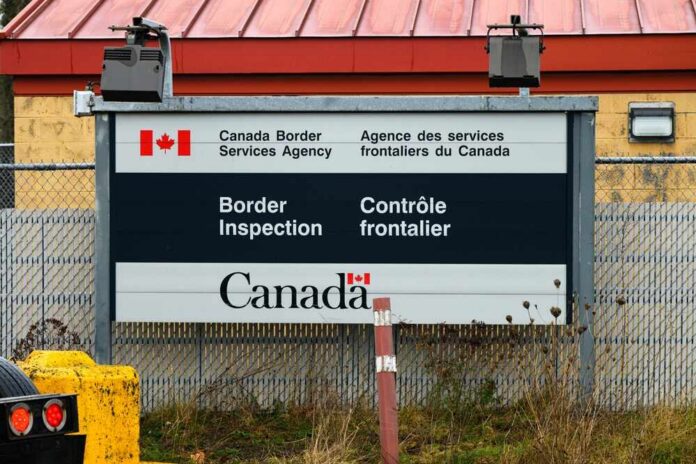
A major weapons smuggling operation at the US-Canada border exposed how easily firearms and prohibited military-grade devices flow from America into foreign hands, raising serious questions about border enforcement while politicians debate security theater.
Story Snapshot
- Canadian authorities seized 48 firearms smuggled from the US, along with 30 prohibited auto sears capable of converting weapons to full-auto
- The bust included 175 magazines, 17,000 rounds of ammunition, and firearm manufacturing tools shipped via US mail to a single Windsor address
- US-to-Canada gun smuggling has tripled since 2021, exposing a “reverse flow” that contradicts Washington’s border security narrative
- Border seizures reveal bureaucratic failures on both sides as weapons pour northward while officials focus on political talking points
Border Agencies Intercept Weapons Pipeline
The Canada Border Services Agency intercepted four packages shipped from the United States all containing gun parts and manufacturing equipment destined for a Windsor, Ontario residence. CBSA officers in Windsor and Montreal flagged the suspicious parcels, triggering a joint investigation with Windsor Police. Authorities executed a search warrant that uncovered 48 smuggled firearms, 30 auto sears designed to convert semi-automatic weapons into machine guns, and a cache of 17,000 ammunition rounds. Windsor resident Hengwei Zhong, 30, faces over ten charges including smuggling prohibited devices and illegal weapons possession.
Explosive Growth in Cross-Border Gun Trafficking
CBSA seizure data reveals a disturbing trend that government officials have been slow to address. Firearms confiscations at the border jumped from approximately 700 in 2021 to 942 by fiscal year 2023, with 684 weapons intercepted in just the first three quarters. The Windsor-Detroit corridor, home to North America’s busiest international crossing, has become a primary smuggling route. This surge follows Canada’s implementation of strict gun control measures including a 2020 handgun freeze and 2022 assault-style weapons ban, creating a lucrative black market where firearms sell for two to three times their US prices.
Mail-Based Smuggling Exploits Enforcement Gaps
Criminals have adapted to tightened land border security by exploiting parcel delivery systems, a vulnerability that highlights bureaucratic incompetence on both sides of the border. University of Ottawa criminologists predict a 20 percent annual increase in mail-based smuggling as traffickers leverage e-commerce platforms to ship weapon components. The prohibited auto sears seized in the Windsor bust exemplify this trend, as these small devices easily pass through mail screening while transforming legal firearms into illegal machine guns. CBSA officials acknowledge the “exponential” growth in gun parts shipped via mail, yet coordinated enforcement with US authorities remains inadequate despite the obvious national security implications.
The political irony is hard to ignore. While Washington debates tariffs on Canadian goods over fentanyl concerns, a reverse pipeline funnels American weapons into Canada with far less scrutiny. Border security analysts note this contradiction undermines the credibility of both governments’ claims to prioritize public safety. The Windsor case resulted in seizure of four 50-round drum magazines and 104 other prohibited magazines, weapons accessories that serve no legitimate sporting purpose. Yet the flow continues largely unabated, with CBSA recording over 22,000 prohibited weapons seizures in fiscal 2025 alone, suggesting the Windsor bust represents a fraction of total trafficking activity.
Government Failure Transcends Political Borders
This case exposes a reality both American gun rights advocates and Canadian gun control supporters should find troubling: government agencies on both sides fail to enforce existing laws effectively. The seized weapons originated in the United States, where lax export controls allow firearms to disappear into black markets despite federal prohibitions on unlicensed international transfers. Meanwhile, Canadian authorities intercept only a fraction of smuggled weapons, as evidenced by the 48 guns reaching a single address before detection. Both nations’ citizens face the consequences of bureaucratic dysfunction while officials focus on political messaging over practical solutions that might actually secure the border and protect communities.
Sources:
Nearly 50 guns smuggled from US seized in Windsor bust
Canada Border Services Agency – Enforcement Actions and Seizures