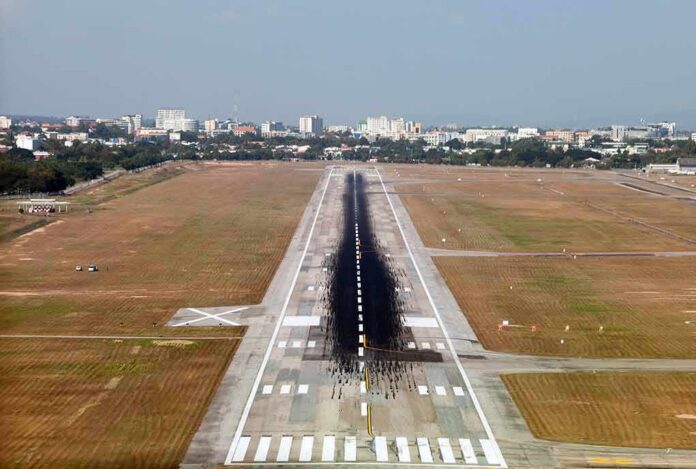
The U.S. Air Force moved to revive four island airfields for more than 6,000 flights a year to harden Pacific operations against attack.
Story Snapshot
- The Department of the Air Force launched an environmental review to use four airfields on Saipan, Tinian, and Rota.
- The plan targets about 6,000 annual aircraft operations for dispersed training and logistics.
- Tinian’s World War II North Field features in the proposal amid ongoing refurbishment.
- The move fits Agile Combat Employment, which trades big hubs for many smaller sites.
What the Air Force Proposed for the Northern Marianas
The Department of the Air Force announced plans to study year-round training at Saipan International, Tinian International, Tinian North Field, and Rota International. The notice of intent starts a federal environmental impact statement. The effort would support runway operations, cargo moves, refueling, and emergency drills. The Air Force outlined an annual flight tempo above 6,000 operations across the four fields, signaling a steady presence near Guam and key sea lanes in the northwest Pacific.
The use of multiple smaller runways matches the service’s push to avoid over-reliance on large bases that are easy to target. A dispersed footprint can make it harder for a rival to shut down airpower with one strike. The Air Force frames this as routine training that also builds real-world options. The proposal does not create a new permanent base. It uses existing airports and a restored World War II field to practice quick moves, refueling, and repairs.
Why These Islands, and Why Now
Saipan, Tinian, and Rota sit within the Commonwealth of the Northern Mariana Islands, a United States territory. The islands provide reach across the Philippine Sea and toward the first and second island chains. Tinian North Field, once home to long-range bombers in World War II, has seen refurbishment tied to this plan. Using these sites allows aircraft to spread out, operate from austere ramps, and complicate any enemy targeting in a crisis or conflict scenario.
The proposal also reduces pressure on Andersen Air Force Base in Guam. That base is vital but vulnerable to missiles. Dispersing aircraft and support functions gives commanders more choices. It can also test skills like rapid runway repair, mobile command, and expeditionary maintenance. The plan’s scale—about 6,000 operations a year—suggests recurring rotations and regular exercises, not occasional visits. That tempo would aim to build habits and muscle memory for aircrews and ground teams.
The Strategy Behind Dispersed Operations
The Air Force’s Agile Combat Employment concept drives this shift. Agile Combat Employment spreads aircraft to many locations, moves them often, and uses light support packages. Analysts at the RAND Corporation note that dispersal improves survivability against missiles. They also warn that sortie rates can drop if maintenance, fuel, and parts do not move with the jets. Success depends on logistics that can keep pace with the aircraft under stress.
Planners must prove they can deliver fuel, munitions, and spare parts to several small islands at once. They must also ensure secure communications and trained teams for runway repair. These steps cost money and demand practice. The benefit is resilience: more airfields mean more places to land, load, and launch. The tradeoff is complexity. The Air Force appears ready to accept that trade if it means keeping combat power in the air when it matters most.
Local History and Today’s Practical Concerns
The Northern Marianas carry deep World War II history. Tinian served as a major launching point for long-range bombing runs late in the war. The National Park Service notes the island’s role in the air campaign that reached mainland Japan, underscoring why runways there still matter for reach and deterrence today. The current plan uses that legacy but adapts it to modern threats and mobile tactics rather than fixed massed bomber fleets.
Year-round activity will raise local questions about noise, safety, tourism, and jobs. Some studies show that host communities can face strain from constant military use, while also seeing economic gains from contracts and wages. The environmental review will test how training can fit with civilian life, nature, and heritage sites. That process is required, and it can shape flight paths, hours, and support infrastructure to reduce harm while meeting training needs.
What This Means for Voters Who Worry Washington Misses the Basics
Many Americans doubt that federal leaders can plan ahead, spend wisely, and protect the homeland. This move shows planning for a real threat: precision missiles that can hit big bases. The Air Force is trying to fix a known weak spot by spreading out and practicing the hard parts now. The plan still has hurdles, like logistics and local impact. But it confronts a core problem with a practical step that can be checked and measured through public review.
Sources:
airforcetimes.com, militarytimes.com, nationalinterest.org, rand.org, cambridge.org