

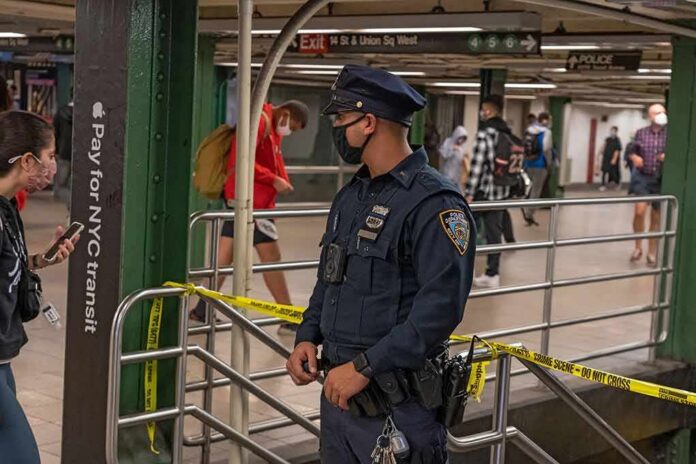
Police say a 10-year-old girl was struck in the head with a wooden stick on a Queens subway line at midday, and a 67-year-old man was arrested at the scene.
Story Snapshot
- Police arrested James Livingston, 67, after an alleged subway assault involving a wooden stick.
- The child suffered a head injury and was taken to a hospital in stable condition.
- Reported charges include assault, child endangerment, and weapon possession; an added charge applies because the victim is under 11.
- Officials say overall subway crime has fallen in recent years, even as single violent cases spark public fear.
Police Account Of The Queens Subway Incident
New York City Police Department officers responded around midday Sunday to the 33rd Street–Rawson Street station in Queens. Police said a man struck a 10-year-old girl in the head with a wooden stick during a ride on a Manhattan-bound No. 7 train near the station. Officers arrested James Livingston, age 67, at or near the scene soon after the incident. The department reported the arrest and the basic facts to local media on Monday.
Emergency medical workers took the child to a nearby hospital for evaluation. Reports said she suffered a head injury and was in stable condition. Police described the object as a wooden stick recovered in connection with the case. Authorities stated that Livingston faced multiple charges based on the alleged conduct aboard the train and the child’s age. Officials did not release the child’s name, consistent with protections for minors.
Charges Tied To The Child’s Age And Alleged Weapon
Police described a charging theory that includes assault, endangering the welfare of a child, and criminal possession of a weapon. Local outlets also reported an added charge because the victim is under 11 years old. New York law creates enhanced penalties when a defendant, age 18 or older, assaults a child under 11 under certain conditions, raising the stakes for prosecutors and the defense in court.
Officials have not yet released the full criminal complaint or an arraignment transcript. That means the public record does not show the exact statute numbers, sworn statements, or bail terms at this time. Media summaries often reflect early police information and can be updated after court filings appear. The lack of a posted complaint does not change the arrest report or the injuries police described to reporters.
What Early Reports Establish—And What They Do Not
Local outlets presented details that match across key points: the suspect’s name and age, the time around 12:27 p.m., the location at or near 33rd Street–Rawson Street, and the claim that a wooden stick struck the child’s head. Reports differ on whether the blow happened on the train, on the platform, or inside the station. That location gap can matter for video review and legal arguments, and it may be resolved when official records are released.
Outlets did not publish body camera footage, platform video, or named eyewitness statements. That is common in the first 24 to 48 hours of a case. The core account relies on police statements given to reporters. The hospital’s name appears in some coverage, and the condition is described as stable. No medical records are public, which is expected in a case involving a child.
Safety Fears, Single Shocking Cases, And Systemwide Trends
This case triggers a deep public concern shared across party lines: children should be safe on public transit. Parents hear “10-year-old” and “head injury” and feel anger and fear. That reaction is human and fair. At the same time, city and state officials report that major subway crime fell in 2025 compared to 2024, with the transit system posting its lowest levels in years. One violent case can still shape feelings far more than charts and averages do.
Woman, 73, shoved onto Queens subway tracks in unprovoked attack https://t.co/glKppgZGrV
— Gregory W. Chupa (@gregory_chupa) November 21, 2026
Leaders on the right and left often disagree on why violence happens and how to stop it. Many conservatives blame lenient policies, while many liberals point to gaps in mental health care and social services. A growing share of Americans from both camps also believe government is failing at basic duties. They see leaders talking past one another while riders want simple things: safer stations, visible patrols, faster court action, and steady consequences for serious harm.
What To Watch Next In The Case
Prosecutors will file the complaint and present the case in court. That filing should clarify the exact charges, where police say the strike happened, and whether investigators recovered a weapon. Defense counsel may challenge identification, intent, or the nature of the injury. If camera footage exists, it will likely be central evidence. The public will want to know whether the court orders detention, supervised release, or bail, and how fast the case moves.
Balancing Compassion, Order, And Accountability
New Yorkers riding the No. 7 line want two truths to hold at once. Vulnerable people should get real help before they spiral into harm. Children and families must be protected with firm, fair enforcement when violence occurs. Data can say the system is safer than before. A single attack on a 10-year-old can still feel like a line crossed. Government earns trust by acting fast, telling the truth, and backing words with results that people can see.
Sources:
townhall.com, 6abc.com, yahoo.com, nyc.gov, mta.info