
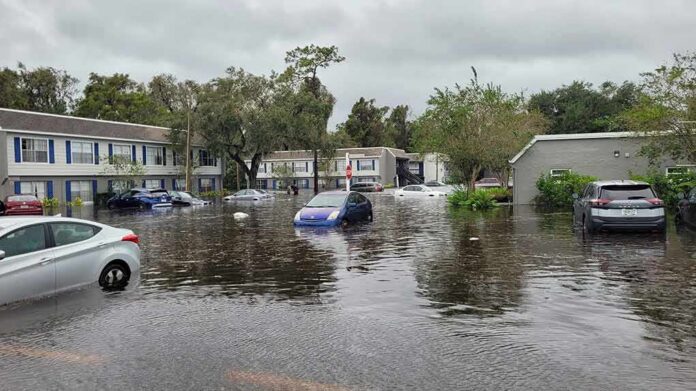
President Trump approved a major disaster declaration for Florida’s late-October floods, unlocking federal aid for six hard-hit counties.
Story Snapshot
- FEMA confirmed a major disaster for severe storms and flooding that began October 31, 2026.
- Federal help is available to residents in six counties on Florida’s Atlantic coast.
- This action is separate from earlier Hurricane Isaias declarations in October.
- FEMA also reported nearly $400 million for Florida recovery projects this month, a broader figure.
What The Declaration Does And Where It Applies
Federal Emergency Management Agency (FEMA) officials said President Trump approved a major disaster declaration for Florida on November 24, 2026. The declaration covers severe storms and flooding that started on October 31 and are listed as Disaster DR-4956-FL. FEMA identified six counties where individuals can seek federal help: Brevard, Indian River, Martin, Okeechobee, Palm Beach, and St. Lucie. The designation opens the door to programs that support families and local governments after major damage.
FEMA records show the incident has a defined number and period, which helps tracking and funding. The incident period begins October 31 and continues, and the declaration date is November 24. Those markers guide how inspectors, grants, and cost shares are managed. They also signal to local leaders how to plan debris pickup, housing help, and emergency repairs using federal rules under the Robert T. Stafford Act.
How This Differs From Earlier Florida Storm Actions
FEMA listed this flood disaster as separate from the earlier Hurricane Isaias actions in October. The Isaias emergency and major disaster steps covered October 6–12 and were processed on October 9 and October 28, with an amendment on October 29. The late-October flood declaration addresses a different event and different dates. Keeping these actions distinct matters because each carries its own counties, timelines, and eligible costs.
People often want a single dollar figure for “the aid.” That is not how these programs work. A declaration authorizes several tools that move at different speeds and scales. Some help goes to families, like temporary housing. Some pays for public work, like road repairs and debris removal. Some supports future risk reduction. The total grows over time as projects get approved and work begins, which is why early totals can be unclear.
What Aid Might Look Like For Families And Towns
After a major disaster, residents may apply for help repairing homes, covering temporary housing, or replacing basic items. Local governments may seek funding to fix roads, protect public health, and remove debris. Hazard mitigation grants can fund drainage, pumps, or elevating structures to reduce future flood risk. Cost shares apply, and state and local partners often carry part of the bill. Exact program amounts for this flood event were not listed in the declaration.
FEMA’s Region 4, which includes Florida, also announced nearly $400 million for 144 recovery and resilience projects this month. That figure reflects broader Florida recovery work and is not the specific tally for the late-October floods alone. It shows the scale of ongoing federal spending in the state as communities rebuild and try to lower future disaster losses.
Why This Matters For Trust And Basic Services
Floods do not care about politics, but aid delivery often feels political. Homeowners want straight answers. Mayors want clear rules and fast reimbursements. Taxpayers want proof that money is well spent. This declaration is an important legal step, but it is the follow-through that counts. Families judge success by how soon inspectors arrive, how fast checks clear, and whether roads, schools, and clinics return to normal operations.
A second federal disaster declaration has been approved for Florida, bringing more relief to Central Florida communities still struggling with flooding — including the Catalina Drive neighborhood west of Cocoa, where water remains waist-deep more than a week after the storm. … pic.twitter.com/tAeWc6I4Vy
— News 6 WKMG (@news6wkmg) November 28, 2026
Many Americans on the left and the right say Washington reacts after storms but struggles to plan ahead. They point to slow repairs, rising insurance costs, and repeat damage in the same places. This Florida action shows the system at work: a defined disaster, named counties, and federal tools turned on. The next test is execution. Clear updates on approvals, timelines, and which communities get what help can show the government is serving people rather than itself.