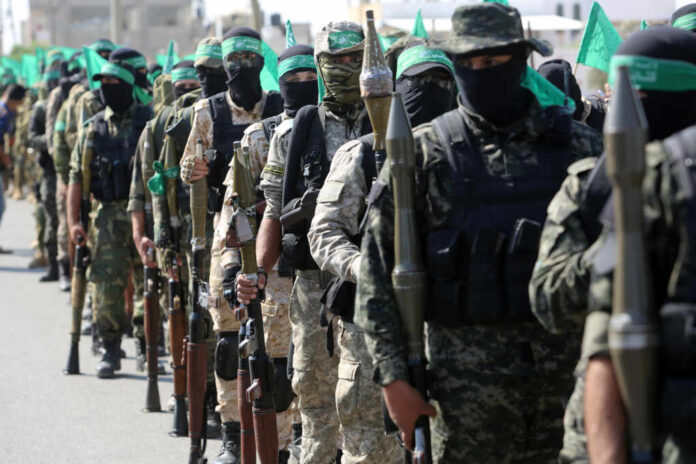
Hamas’s pledge to dissolve its governing authority in Gaza marks a pivotal moment in the Trump administration’s ambitious peace plan, potentially shifting the region’s geopolitical landscape. This move, part of a U.S.-brokered cease-fire deal, involves stepping aside for an independent Palestinian technocratic committee. While the transition signals a major step toward regional stabilization, its implementation faces challenges, including securing international approval for the new committee and navigating persistent, fragile violence on the ground.
Story Highlights
- Hamas plans to dissolve its Gaza government under a U.S.-brokered cease-fire deal.
- An independent Palestinian technocratic committee will assume control.
- The move is contingent on the cease-fire holding and international approval.
- The U.S.-led “Board of Peace” will oversee the transition and security.
Hamas’s Commitment to Cease-Fire Agreement
Hamas has announced its readiness to dissolve its governing bodies in Gaza, stepping aside for an independent Palestinian technocratic committee. This decision is part of a U.S.-brokered peace plan, dubbed the “Gaza peace plan,” contingent on a lasting cease-fire. The plan, led by President Donald Trump, aims to stabilize the region by replacing Hamas’s rule with non-partisan technocrats, whose names are yet to be approved by Israel and the U.S.
The transition is framed as a test of the Trump-led initiative, which includes Hamas disarmament and the deployment of an international security force. Despite the cease-fire officially being in effect since October 10, incidents of violence persist, with both sides accusing each other of violations, threatening the fragile peace.
Hamas prepared to dissolve Gaza government if cease-fire deal sticks https://t.co/xF3uqtG273 pic.twitter.com/XyeEgLDPMf
— New York Post (@nypost) January 11, 2026
Challenges and Uncertainties in Implementation
While Hamas has issued internal directives to prepare for the handover, the technocratic committee is not yet formed. Names of potential members have not been publicly announced, and their approval by Israel and the U.S. remains a critical hurdle. The “Board of Peace,” an international body headed by President Trump, is tasked with overseeing this transition, monitoring disarmament, and ensuring security.
Despite these ambitious plans, the implementation faces significant delays. The U.S. has reported little progress on key components like disarmament and the deployment of international forces. The Board of Peace’s incomplete membership further adds to the uncertainty, impacting the governance and security transitions.
Regional and International Implications
The potential dissolution of Hamas’s government in Gaza could mark a historic shift in the region’s political dynamics. However, ongoing violence and political mistrust pose significant challenges to the plan’s success. The cease-fire remains fragile, with recent incidents of Israeli gunfire resulting in Palestinian casualties, highlighting the tense atmosphere.
Regional players, including Egypt, Qatar, and Turkey, continue to mediate talks to finalize the technocratic committee. The Trump administration, committed to enforcing the Gaza peace plan, sees this as a foreign policy success, emphasizing the importance of stabilizing Gaza and reshaping its governance structure.
Watch the report: Hamas says it will dissolve its Gaza government when new Palestinian body takes over
Sources:
- Hamas to dissolve Gaza government after Palestinian body takes over
- Hamas says it will dissolve its Gaza government when new Palestinian body takes over
- Hamas declaration of ending governmental entities in Gaza
- Hamas says it will dissolve its Gaza government