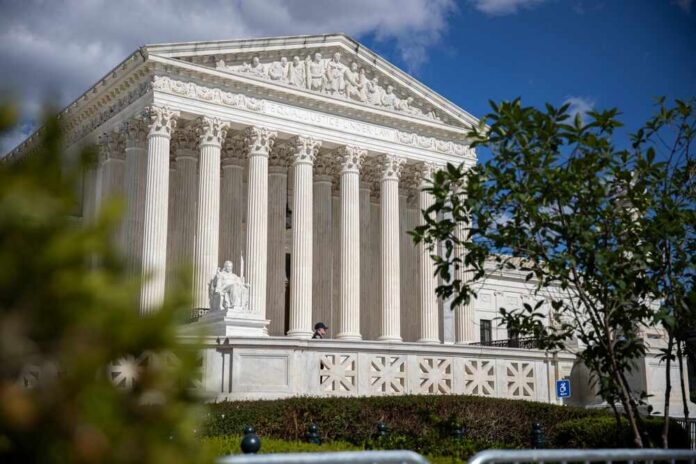
Supreme Court strikes down racially gerrymandered district, potentially handing Republicans 12 more House seats and strengthening their control amid Democratic outrage.
Story Highlights
- Supreme Court’s 6-3 ruling invalidates Louisiana’s majority-Black Sixth District as overly race-based.
- Governor Wes Moore claims Republicans gain 12 seats in Louisiana, flipping national House balance.
- Ruling sets precedent for redistricting in Florida, Georgia, Alabama, and Mississippi.
- Democrats label decision “political redlining,” but conservatives see restoration of fair maps.
Supreme Court Rejects Race-Driven District
The U.S. Supreme Court issued a 6-3 decision striking down Louisiana’s Sixth Congressional District. Chief Justice John Roberts called the district “a snake that stretches more than 200 miles” to connect communities based primarily on race. The conservative majority ruled it violated constitutional standards by relying too heavily on racial considerations. This action upholds principles of equal treatment under law, rejecting forced racial quotas in representation. The district, held by Democrat Cleo Fields, now faces redraw without race as the dominant factor.
Governor Moore’s Partisan Attack
Maryland Governor Wes Moore slammed the ruling during a Valuetainment podcast with Patrick Bet-David. Moore claimed the decision “hands the House to the Republicans” and delivers 12 additional seats in Louisiana alone. He described it as “one of the largest forms of political redlining” and an “assault on democratic values.” President Obama echoed this, tweeting the ruling guts the Voting Rights Act. These critiques reflect Democratic frustration as GOP majorities solidify under President Trump’s second term.
Electoral Shifts Favor Republicans
Moore highlighted Democrats holding 24 seats across Louisiana, Florida, Georgia, Alabama, and Mississippi, potentially reduced to 12 for Republicans. The ruling builds on prior Supreme Court precedents legalizing partisan gerrymandering while curbing race-based maps. States now have clearer guidelines to draw compact districts reflecting voter distributions. This development bolsters Republican control of Congress, frustrating liberal efforts to obstruct the America First agenda through minority-focused engineering.
In 2026, with Republicans commanding Senate and House majorities, this precedent counters deep state tactics that weaponized race for political gain. Conservatives view it as a victory for colorblind governance, aligning with founders’ intent for representation by compact communities, not arbitrary racial lines.
Broader Implications for Fair Representation
The Voting Rights Act aimed to protect minority voting access, but Louisiana’s map twisted it into racial gerrymandering. The Supreme Court clarified states cannot pack voters by race excessively, promoting districts based on shared interests and geography. Critics like Moore fear diminished minority voices, yet the ruling preserves self-determination. Bipartisan frustration grows over elite manipulations that prioritize power over people, echoing shared distrust in federal overreach.
This decision reinforces limited government by rejecting judicially imposed racial balancing acts. Americans on both sides tire of politicians engineering outcomes instead of competing on merits. As redistricting advances, expect maps closer to natural voter patterns, challenging entrenched incumbents.