When hearings become theater and facts take a back seat, the public loses sight of whether Congress is actually protecting them.
Story Snapshot
- Rep. Jasmine Crockett accused Republicans of avoiding hearings on white supremacy while citing specific mass-casualty attacks [1].
- Crockett linked her critique to claims that Republican rhetoric enables extremist violence and distracts from public-safety failures [1][5].
- Republicans and allies framed her remarks as political spectacle amid a broader fight over immigration and crime priorities [2][6].
- The available record lacks a full hearing-by-hearing audit to verify or refute her “no hearings” charge [1][5].
Crockett’s Charge: Hearings Ignore White Supremacist Violence
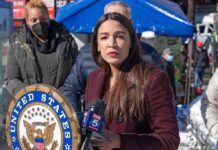
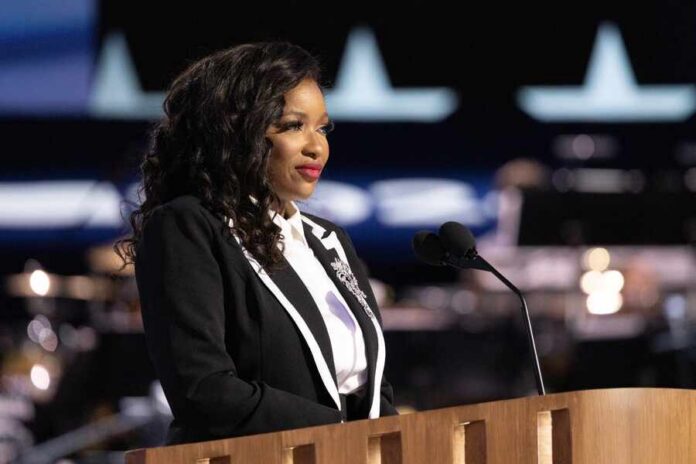
Rep. Jasmine Crockett used a House hearing to argue Republicans have not held comparable hearings on white supremacy and are minimizing the threat. Crockett directly called the Proud Boys and neo-Nazis white supremacists and tied her critique to the January 6 attack and partisan treatment of extremist violence [1]. She cited the Charleston church massacre, the El Paso Walmart shooting, and the Buffalo grocery-store shooting as examples of white-supremacist mass killings that warrant focused oversight and policy attention [1].
Crockett’s comments went beyond labels to claim that Republican rhetoric empowers violent extremists and that committee priorities have drifted from the most dangerous domestic threats [1]. In a separate appearance, she pressed federal law-enforcement leadership on whether communities targeted by racist violence are adequately protected, stating she does not feel safe and questioning prioritization choices [4]. Her office formalized the argument in a press release asserting Republicans use public-safety hearings to deflect from cuts and policy failures [5].
What the Evidence Shows—and What It Does Not
The video record and press materials confirm Crockett made the claims, named specific attacks, and linked them to oversight priorities [1][5]. The hearing footage with a later Federal Bureau of Investigation (FBI) exchange shows her framing white-supremacist violence as an urgent domestic threat and criticizing law-enforcement direction [4]. However, the available sources do not include a comprehensive review of committee calendars, transcripts, or agendas that would verify her assertion that Republicans have not held hearings on white supremacy across relevant panels and sessions [1][5].
That evidentiary gap matters. Crockett’s allegation is empirically testable, but neither side in the provided record supplies a hearing-by-hearing audit to settle it. Without a dated inventory—titles, witness lists, and transcripts—claims about selective outrage remain interpretive rather than conclusive. The lack of primary documentation on whether committees addressed the Proud Boys or neo-Nazis in substantive hearings similarly limits precision. As a result, the strongest parts of her case are the on-record statements and the cited attacks; the weakest is the unverified absolute [1][3][5].
Republican Counter-Frame: Policy Priorities, Not Evasion
Republican-aligned coverage casts Crockett’s remarks as a “rant,” positioning the dispute as political theater within broader battles over immigration enforcement and crime [2][6]. The cross-pressures are visible in the FBI exchange, where Crockett challenges resource shifts toward immigration while insisting domestic extremism deserves emphasis [4]. That context supports the counter-argument that the fight is about agenda-setting—what problems get oxygen in scarce hearing time—rather than a categorical refusal to discuss white supremacy. Still, this does not, by itself, disprove her “no hearings” charge [4][5].
Republicans and allies argue Democrats deploy the white-supremacy critique as a messaging tactic to brand GOP oversight as a distraction from cuts or failures. Crockett’s own press release, which labels Republican hearings as deflection from public-safety shortcomings, feeds that interpretation [5]. Yet the counter-position in the record relies on framing and tone rather than producing concrete committee evidence showing sustained hearings on white-supremacist violence. Absent that, the rebuttal remains an assertion about priorities rather than a documented refutation [2][5][6].
Why This Matters Beyond the Partisan Clash
Congressional hearings increasingly double as media stages, rewarding viral confrontation over methodical evidence. When members trade accusations without supplying verifiable records, citizens are left choosing sides on vibes, not facts. Voters across the spectrum—frustrated by crime, inflation, immigration chaos, and a sense that elites protect themselves first—are justified in asking for basic accountability: show the calendars, witnesses, and transcripts; show the threat assessments; show how resources align with danger [1][4][5].
Rep. Jasmine Crockett starts ranting during a House hearing on the SPLC:
"This president, on day one, his priority was not around racism. It was around doing things like letting them go, and now putting money in their pockets. We haven't had one hearing on white supremacy!" pic.twitter.com/xL7s9wwHTy
— The Post Millennial (@TPostMillennial) May 20, 2026
Practical steps can cut through the noise. A full, public inventory of relevant House and Senate hearings would test Crockett’s claim. Side-by-side data on domestic extremist violence versus other public-safety threats would clarify priorities. Primary judicial and law-enforcement records for Charleston, El Paso, and Buffalo would anchor the examples in official findings. Until that groundwork appears, both the accusation and the rebuttal rest more on political positioning than on transparent, checkable oversight [1][3][4][5].
Sources:
[1] YouTube – Proud Boys, White Supremacy, and Republicans Playing Dumb
[2] Web – House Democrat erupts during DEI hearing: ‘There has been no …
[3] YouTube – Rep. Jasmine Crockett: White Supremacy, Political Theater & the …
[4] YouTube – Jasmine Crockett torches Patel in explosive House hearing
[5] Web – Ranking Member Crockett’s Opening Statement at Subcommittee …
[6] Web – Texas Dem Senate primary fractures over race rhetoric as ‘mediocre …