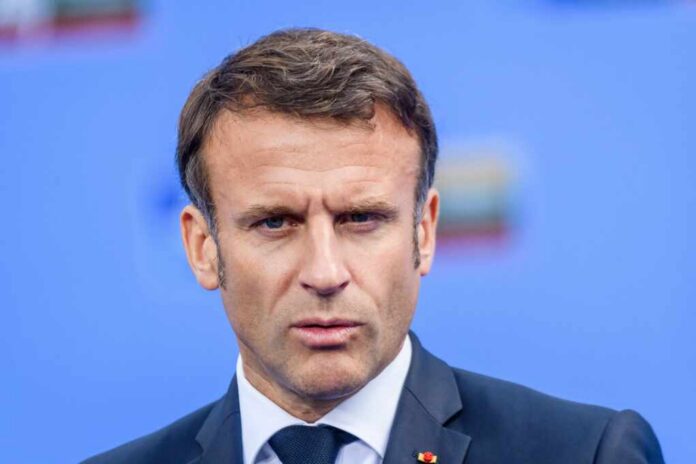
French President Emmanuel Macron delivered a clear, diplomatic rebuke to U.S. interest in acquiring Greenland, using the territory’s own Inuit language to emphasize that the strategic Arctic island is “not for sale.” In a meeting with Greenland’s and Denmark’s prime ministers in Paris, Macron framed the issue as one of self-determination and international law, signaling a coordinated European posture to assert sovereignty and security in the rapidly developing Arctic region.
Story Highlights
- French President Emmanuel Macron addressed Greenland’s leaders in Greenlandic, Danish, and French during a Jan. 28, 2026 meeting in Paris.
- Macron said Greenland is “not for sale” and cannot be taken by force, framing the issue as self-determination and international law.
- Greenland’s prime minister and Denmark’s prime minister appeared alongside Macron, signaling European unity on Arctic sovereignty.
- Macron’s messaging follows renewed U.S. interest under President Trump and France’s plans for increased joint military exercises with Denmark.
Macron’s Greenlandic Remarks Signal a Cultural-and-Political Message
President Emmanuel Macron hosted Greenland Prime Minister Jens-Frederik Nielsen and Danish Prime Minister Mette Frederiksen at the Élysée Palace in Paris on January 28, 2026. Macron delivered short remarks in Greenlandic (Kalaallisut), then Danish, then French—an uncommon move for a non-local leader. Macron’s central point was direct: Greenland is “not for sale,” and its future is for Greenlanders to decide, not outside powers.
For American audiences, the language choice matters because it aims past diplomats and straight to the Greenlandic public. Greenland has about 56,000 residents and an Inuit majority, and the island’s identity politics are inseparable from sovereignty questions. Macron’s multilingual approach effectively tells Greenlanders, “Europe sees you,” while telling Washington that Europe intends to be a gatekeeper in Arctic affairs, not a bystander.
President Macron said the following in Greenlandic: 🇬🇱
“Greenland is not for sale and cannot simply be taken over.”
“The future of Greenland is decided solely by the Greenlandic people.” pic.twitter.com/6DN2LVFZc6
— Orla Joelsen (@OJoelsen) January 28, 2026
Why Greenland Is a Global Flashpoint: Minerals, Routes, and Security
Greenland’s value is not theoretical. Melting Arctic ice is opening shipping routes, and Greenland’s mineral potential—often discussed in the context of rare earths—has drawn international attention. U.S. interest in Greenland also dates back to the strategic logic of World War II-era basing and North Atlantic defense. Those realities help explain why President Trump has repeatedly floated the idea of acquiring Greenland, even as Denmark and Greenland reject the premise.
Greenland is also not a typical “territory for sale” scenario because its governance structure includes self-rule. Greenland has been within the Kingdom of Denmark since 1953, and its self-government framework expanded under the 2009 Self-Government Act. That setup leaves Denmark with ultimate sovereignty while Greenland manages many internal affairs, making any outside acquisition concept politically explosive and legally complex—especially in the modern era of democratic expectations and border norms.
Europe’s Coordinated Response: Diplomacy Backed by Military Exercises
Macron’s Paris meeting did not happen in a vacuum. Earlier in January 2026, Macron announced that France would increase “land, air, and sea” forces for exercises connected to Greenland alongside Denmark. That matters because it pairs moral language—self-determination and law—with tangible capability and presence. Even without new treaty announcements, the pattern is clear: Europe is trying to deter pressure by showing that Greenland is tied into wider security cooperation.
From a conservative perspective, there’s a practical lesson in how other blocs play hardball. European leaders are using unified messaging, symbolism, and defense planning to protect what they view as strategic territory. That approach is not inherently anti-American, but it is undeniably designed to limit U.S. leverage on Greenland. Macron’s emphasis on “yesterday, today, and tomorrow” support for Denmark underscored that Paris wants the issue framed as European sovereignty, not a bilateral U.S.-Denmark negotiation.
What Greenland’s Leaders Said—and What We Still Don’t Know
Greenland Prime Minister Nielsen publicly welcomed Macron’s support and described the moment as a “strange time” that threatens democratic norms, aligning Greenland’s position with the idea that borders and self-government should not be bargained away. Denmark’s Prime Minister Frederiksen joined the Paris appearance, reinforcing that Copenhagen views Greenland as part of the Kingdom’s integrity. Those statements clarify the political posture: Greenland and Denmark reject any “sale” narrative outright.
What remains unclear is what concrete policy steps come next beyond exercises and statements, because the available reporting emphasizes the symbolism and the diplomatic rebuke more than any signed deliverables. The limited public detail also means outside observers cannot reliably measure whether this episode changes Greenland’s trade direction, investment posture, or independence debate in the near term. For now, the clearest verified development is a sharpened public line from Europe rejecting coercion or purchase talk.
Watch the report: Macron expresses support of Greenland in Greenlandic and Danish – video
Sources:
- France’s President Macron visited Greenland to show support for the territory
- Greenland standoff with US ‘a strategic wake-up call’ for Europe, Macron says – France 24
- Macron expresses support of Greenland in Greenlandic and Danish – video
- Greenland dispute a ‘strategic wake-up call for all of Europe,’ says France’s Macron | Euronews