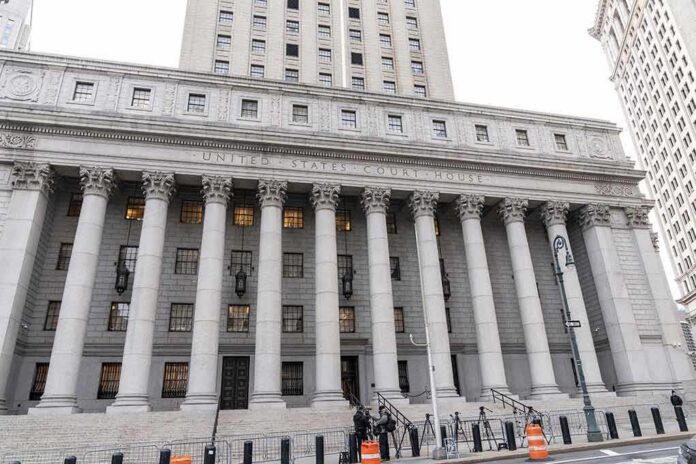
A federal judge just told New York it cannot tell federal immigration agents when they must show their faces.
Story Snapshot
- A federal court blocked New York’s new ban on federal immigration agents wearing masks or hiding their badges.
- The judge said the state law unconstitutionally tries to control federal officers, violating the Supremacy Clause.
- New York can still stop its own police from partnering with federal immigration enforcement, a win for state leaders.
- The fight highlights how states and Washington clash over immigration, safety, and who really runs the show.
Judge Blocks New York’s Mask and ID Rules for Federal Agents
On Monday, United States District Judge Mae D’Agostino ruled that New York cannot ban federal immigration agents from wearing face coverings or force them to display visible identification while on duty in the state. Her decision issues a preliminary injunction, which temporarily stops the state from enforcing those parts of its new law against federal officers while the case continues. The judge wrote that New York’s “face covering and identification” acts directly regulate federal officers and violate the Supremacy Clause of the United States Constitution.
The Supremacy Clause says federal law is the “supreme law of the land,” and states cannot control how federal agencies carry out federal duties. Judge D’Agostino found that only federal authorities, not state governments, can set policy for how immigration officers work in the field. Her ruling matches an earlier decision that struck down a similar law in California, showing a pattern in how courts handle state attempts to set rules for federal immigration enforcement. For President Trump’s administration, this is another courtroom win in its push to protect federal control over immigration policy.
What New York’s Law Tried to Do — And What Still Stands
Governor Kathy Hochul and Attorney General Letitia James backed a package of “community safety” laws aimed at immigration and law enforcement tactics in New York. One law banned law enforcement officers, including federal agents, from wearing face coverings while interacting with the public, with narrow exceptions for undercover work or medical needs. Another law barred state and local police from entering formal or informal cooperation agreements with federal Immigration and Customs Enforcement for civil immigration enforcement, often called 287(g) agreements.
Judge D’Agostino split the difference between those goals. She blocked New York from enforcing the mask and identification rules against federal immigration agents, but she upheld the state’s power to control its own police departments and prevent them from partnering with federal immigration enforcement. In a joint statement after the ruling, Hochul and James said keeping the 287(g) ban in place “shows the law is legal and will keep our communities safe,” and they vowed to keep fighting masked immigration operations. The result leaves federal agents free to follow federal rules on masks and identification, while local officers face strict limits on working with them.
Why Masks, IDs, and Federal Power Strike a Nerve
New York leaders say masked federal immigration operations scare communities and hide accountability when agents come to people’s homes or workplaces. Advocacy groups argue that when officers cover their faces and do not clearly show who they are, it feels more like secret police than American law enforcement. Legal experts note that federal regulations already require immigration officers to identify themselves “as soon as it is practical and safe to do so,” but do not demand visible badges at all times or ban face coverings. New York’s law tried to go further, forcing more openness than current federal rules.
New York’s anti-ICE mask ban was just halted in federal court, and New Jersey’s identical law will be next. I voted NO on the mask ban bill because it is WRONG and UNCONSTITUTIONAL!
Why states can't enforce these bans:
1. Supremacy Clause (Article VI) Under McCulloch v.…
— Greg Myhre (@VoteMyhre) August 4, 2026
The Department of Justice responded that New York’s rules were an “unconstitutional legislative overreach” that could even lead to demands like making federal agents “wear pink,” to show how far states could go if courts allowed this approach. A Justice Department spokesperson said laws banning federal agents from wearing protective masks are unconstitutional and stressed that the department “will not tolerate any violence directed toward law enforcement officials.” Many conservatives see the ruling as a needed check on blue states they feel are trying to block or shame immigration enforcement they campaigned for.
Federalism, Immigration, and Growing Distrust of Government
This clash fits a wider pattern: states on both coasts pass laws to limit aggressive immigration tactics, and Washington pushes back, saying only the federal government can set immigration rules. Courts often let states control their own police but stop them from ordering federal officers how to dress, identify themselves, or carry out arrests. For many Americans, this latest fight confirms a deeper fear that powerful officials spend more time battling each other in court than fixing broken systems that leave families unsure who is really in charge of their safety and rights.
Conservatives frustrated with years of “sanctuary” policies see the New York law as another attempt by elites to protect people who break immigration rules while tying the hands of those sworn to enforce them. Liberals upset with “America First” crackdowns worry masked immigration patrols erode trust, fuel racial profiling, and widen the gap between government and the communities it polices. Both sides increasingly share one core concern: the federal government and state leaders focus on power plays, symbolism, and legal turf wars instead of clear, fair rules that let ordinary people live without constant fear of the next raid, law change, or court order.
Sources:
zerohedge.com, abc7ny.com, news10.com, nytimes.com, justice.gov, youtube.com, nysenate.gov