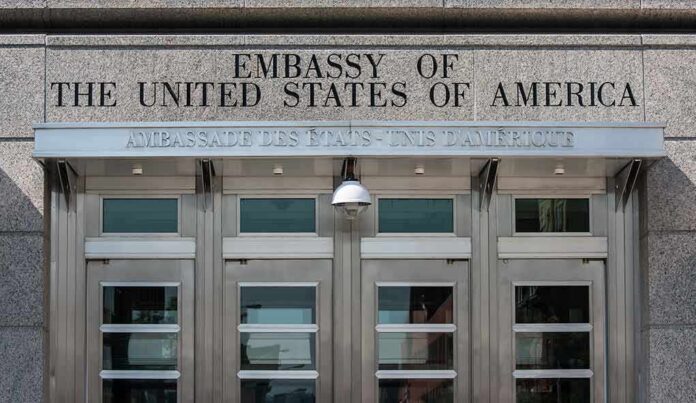
As Iran and the United States trade blows, U.S. embassies are now warning Americans across the Middle East to be ready to leave on short notice — or risk being trapped in a fast-moving war zone.
Story Snapshot
- U.S. embassies across the Middle East are urging Americans to be prepared to depart as fighting with Iran escalates.
- The State Department has ordered nonessential staff out of several embassies and is running emergency flights for civilians.
- Travel advisories now tell Americans to reconsider or avoid travel to many countries, with some rated “Do Not Travel.”
- Both conservatives and liberals see the chaos as another sign that Washington cannot keep citizens safe or provide clear answers.
Embassies warn Americans: be ready to leave
U.S. embassies and consulates across the Middle East have issued new security alerts telling Americans to exercise extreme caution and be prepared to depart if the situation with Iran worsens. The U.S. Embassy in Israel sent a regional alert saying the security environment is “complex and can change quickly” as tensions with Iran and questions about a fragile cease-fire continue. Americans were told to know the nearest shelter, avoid demonstrations, and consider alternative ways to leave if flights are disrupted.
The State Department has also warned Americans worldwide that Iran-linked groups could target U.S. citizens and interests, especially in the Middle East. This global alert urges Americans abroad to “take greater precautions” and follow instructions from local U.S. embassies. Some embassies, including those in Jordan, have issued extra warnings after local authorities responded to “specific and credible” threats, evacuating facilities such as airports and ports. Together, these steps show Washington expects more danger, not less, in the near term.
Ordered departures and shrinking diplomatic footprint
As security has worsened, the State Department has ordered nonessential U.S. government staff and families to leave a growing list of posts in the region. Officials have directed drawdowns at embassies in Saudi Arabia and the city of Adana in Turkey, a North Atlantic Treaty Organization (NATO) ally, after Iranian reprisals against U.S.-Israeli operations. In total, ten embassies and consulates in the region now operate with reduced staffing, and two have been fully closed. These moves send a clear message that the U.S. government believes its own people are at serious risk.
In some cases, embassies have shut down after direct attacks. One recent strike by suspected Iranian drones forced the closure of the U.S. Embassy in Saudi Arabia and the embassy in Kuwait “until further notice.” The State Department is now warning Americans to leave nearly the entire Middle East immediately. For private citizens, this creates a painful contradiction: the government says “get out now,” but war damage, closed airspace, and limited flights make escape difficult. Many see this as another example of Washington reacting late and leaving ordinary people to fend for themselves.
Emergency flights and rising criticism at home
To respond to the crisis, the State Department has expanded emergency evacuation flights for Americans departing Israel and other hot spots. Officials say they have helped more than 23,000 people with information or seats on charter flights back to the United States. At the same time, Americans in countries such as Lebanon are told to use whatever commercial options remain and to plan carefully in case borders close or airlines cancel routes. These warnings follow U.S. airstrikes on Iranian nuclear sites ordered by President Trump, which raised fears of Iranian retaliation against U.S. interests.
Travel advisories now tell Americans to reconsider travel to many Middle Eastern countries and to avoid others completely. Nations like Iran, Iraq, Lebanon, Syria, Gaza, and Yemen are listed at Level 4, “Do Not Travel,” while Bahrain, Israel, Jordan, Kuwait, Qatar, Saudi Arabia, Oman, and the United Arab Emirates are at Level 3, “Reconsider Travel.” Americans already in the region are instructed to keep a low profile, stay indoors in some places like Bahrain, and contact special State Department hotlines if they need help. For families watching from home, this looks like another sign that the U.S. system only truly mobilizes after a crisis explodes, not before.
Defensive moves or march toward a wider war?
At the same time these warnings go out, the Pentagon has ordered the largest U.S. military buildup in the Middle East since the 2003 invasion of Iraq. Tens of thousands of troops, multiple aircraft carriers, long-range bombers, and more than 150 aircraft have been deployed around Iran. Officials publicly describe these moves as “primarily defensive,” saying they are meant to shield American forces and bases from Iranian retaliation and to protect U.S. allies. They also say the deployments give Washington options if diplomacy with Tehran fails.
Analysts note that this mix of embassy drawdowns, travel warnings, and massive military surges fits a familiar pattern in U.S. crisis management. The government presents the buildup as defensive deterrence, yet the same forces can be used to pressure Iran and support offensive operations if leaders choose. For many Americans, both conservative and liberal, this raises deep questions. Is Washington truly focused on protecting citizens and avoiding a larger war, or is it again playing high-risk power games that mainly serve elites and defense contractors? With embassies closing and Americans told to “leave now,” frustration with a government seen as slow, reactive, and self-interested is likely to grow.
685 U. S. troops wounded and 18 killed. My prayers go out to their families.
I hope this resonates with my friends and family on Facebook when you vote during primaries and midterm elections. We must stop Trump’s war in the Middle East. We must end the madness by voting for— Bachie (@Bachie36371436) July 31, 2026
Sources:
mediaite.com, nytimes.com, reuters.com, atlanticcouncil.org, bbc.com, youtube.com, pbs.org, caspianpost.com, cnn.com