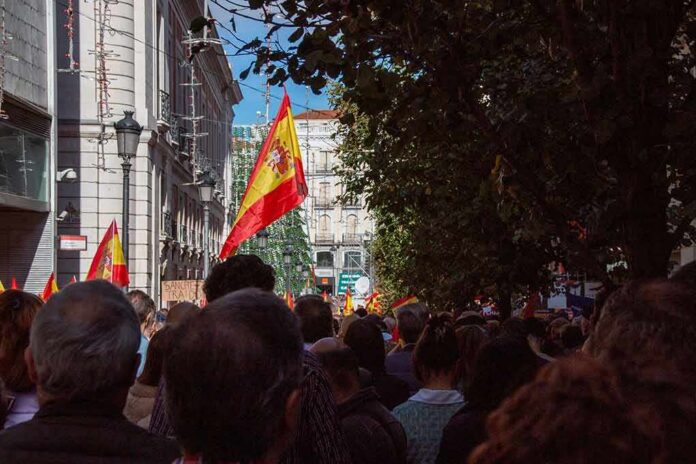
When Spain’s supporters turned the streets around Madison Square Garden into a red‑and‑gold procession before the 2026 World Cup final, they weren’t just making noise; they were demonstrating how modern World Cup fandom can temporarily remake a city’s public space and identity.
Key Points
- Hundreds of Spain supporters assembled outside Madison Square Garden in Manhattan on the eve of the 2026 World Cup final, creating a dense, highly visible fan zone.
- Multiple independent outlets and videos converge on the same core facts: a Spain-specific rally at MSG, a separate Argentina “banderazo” in Times Square, and Midtown streets effectively turned into team-coloured enclaves.
- The Spain gathering followed a recognizable World Cup fan tradition—organized pre-match marches, flags, drums, and chants—linking New York’s urban fabric to global football culture.
- While exact headcounts are imprecise, consistent estimates in the “hundreds” and around “500–600” mark, plus visual evidence, support treating the MSG rally as a substantial, not incidental, crowd.
- The episode illustrates how host cities and security agencies now manage large, semi-spontaneous fan congregations around major venues, balancing celebratory spectacle with crowd control.
Spain’s Red Wave at Madison Square Garden
On the day before Spain faced Argentina in the 2026 World Cup final at MetLife Stadium, the centre of gravity for Spanish supporters in New York tilted decisively toward Madison Square Garden. Contemporary reports from local television, international outlets, and Spanish-language media all describe hundreds of Spain fans converging on the plaza and adjoining streets outside the arena to stage what was, in effect, their own fan march and pep rally.
One on‑scene Spanish broadcast estimates “como 500–600 personas” gathered at the Garden’s doors, emphasizing that they were there specifically to animate the day prior to the final. CBS’s New York affiliate likewise spoke of “hundreds of Spain fans” holding a pep rally outside MSG. WION, covering the broader pre‑final atmosphere, reported that while thousands of Argentina supporters were flooding Times Square, “hundreds of Spain fans held their own pep rally outside Madison Square Garden,” underscoring a clear spatial division of team territories in Midtown.
What the Footage and Descriptions Actually Show
The character of the gathering is unusually well documented for an atmosphere story. Instagram posts, news clips, and agency video all show Spain supporters singing, drumming, and walking as a cohesive mass from MSG toward Mercado Little Spain, the José Andrés‑linked food hall that became an informal cultural anchor for Spanish fans during the tournament.
AFP’s footage describes “Spain fans sing and dance as they walk from Madison Square Garden to Mercado Little Spain,” visually confirming both the starting point and the processional nature of the event. An Instagram reel notes that Spain’s supporters “turned the plaza outside Madison Square Garden into a sea of red and gold… Fans waved flags, raised a replica trophy and filled Midtown with songs, drums and nervous energy.” A longer Spanish write‑up characterizes the day more broadly as “Nueva York amaneció hablando español,” then specifies that more than “medio millar” (over half a thousand) Spanish followers concentrated around Madison Square Garden and moved through Manhattan toward Little Spain, equipped with jerseys, scarves, painted faces, and family groups rather than a purely rowdy crowd.
Scale, Location, and the Limits of Crowd Evidence
As with most sports-fan scenes, the exact attendance figure is not instrument‑measured; it is inferred. The numbers reported cluster around two formulations: “hundreds” and “500–600.” In a dense Midtown environment where pedestrian traffic is already high, that distinction matters: a few dozen fans can be lost in the general flow, whereas five hundred coordinated supporters with flags and drums can dominate a city block. The consistent language across independent sources, plus wide shots in agency video, support treating this as a substantial discrete gathering rather than incidental clustering.
Location, by contrast, is unusually firm in this case. Multiple outlets, including CBS New York and ABC7, explicitly place the Spain rally “outside Madison Square Garden,” while differentiating Argentina’s separate takeover of Times Square. Social and wire footage includes recognizable MSG facades and adjoining streets, allowing any careful viewer to confirm the geography. That alignment—MSG for Spain, Times Square for Argentina—recurs across coverage and functions as an organizing metaphor for how New York hosted competing fan zones in the same city.
How This Fits into World Cup Fan Tradition
To understand why hundreds of people would spend the afternoon chanting in front of a basketball arena miles from the actual World Cup stadium, you have to see the event as part of the broader culture of pre‑match gatherings. World Cup fandom has long included choreographed marches, “banderazos” (flag rallies), and colour‑saturated walks that temporarily repaint city streets in national palettes.
Guides for hosting World Cup watch parties and fan festivals emphasise flags, chants, coordinated attire, and pre‑game congregation as core ingredients of the experience, even when the match itself is watched on screens rather than in the stadium. Coverage of global fan traditions highlights phenomena such as the Dutch Oranje Fanwalk, where thousands of supporters turn urban routes into a “sea of bright orange” before matches. Spain’s red‑and‑gold rally in front of Madison Square Garden and Argentina’s sky‑blue‑and‑white banderazo in Times Square sit squarely within that lineage: they are portable fan rituals transplanted into the architecture of a host city.
New York as Stage: Dividing the City by Colours
The 2026 tournament, with its final staged in the New York–New Jersey metro area, turned Manhattan itself into a broadcast set. Reports consistently describe Times Square as the informal hub for Argentina supporters, while Spain’s fan base found its focal point at MSG and the route to Mercado Little Spain. An ABC7 social post captured the essence succinctly: “A sea of blue and white flooded Times Square rooting for Argentina, while fans decked out in red and yellow dominated the street in front of Madison Square Garden in support of Spain.”
France24’s narrative of New Yorkers “bidding farewell to World Cup carnival” details Argentine jerseys saturating Penn Station and the wider area around Times Square. Parallel to this, Spanish reports and New York coverage identify MSG’s environs as where Spain fans “swarmed,” some carrying replica trophies and many joining in sustained chanting. For several hours, then, Midtown wasn’t just busy; it was partitioned—Times Square as Buenos Aires in miniature, MSG and the path to Little Spain as Madrid and Valencia transplanted onto West 33rd Street.
Managing Spontaneous Spectacle: Security and City Policy
Large fan congregations around Madison Square Garden are not new; Knicks playoff runs in recent years have produced semi‑spontaneous street parties outside the arena, prompting the NYPD to reassess how much unmanaged celebration it was willing to tolerate. Ahead of a high‑profile Game 4 in the NBA Finals, the department announced that it would restrict spontaneous gatherings outside MSG, allowing only fans attending the game or those with “business specific to that area,” and instead authorising a capped, permitted watch party of about 1,000 people.
That context matters for reading the World Cup scene. While the Spain rally appears to have unfolded without major incident—there is no evidence in the record of clashes or crackdowns—the existence of prior NYPD limits on spontaneity shows that city authorities now see large, unmanaged crowds at MSG as a problem to be managed, not just colourful backdrop. Even celebratory gatherings fit into a matrix of permits, messaging, and crowd control. For host cities, World Cup fan culture is both an economic opportunity and an operational challenge.
Evidence, Exaggeration, and Why This Story Holds Up
The evidentiary record around the Spain fans at MSG is better than many sports atmosphere stories, but it still has familiar gaps. There is no official attendance count, no named organisers, and no full‑length, continuous video from a single vantage point; instead, we have multiple short clips, press descriptions, and rough numerical estimates. This is exactly how many fan narratives congeal: social video circulates, secondary outlets echo the framing, and the scene hardens into accepted fact without forensic reconstruction.
In this case, however, the convergence across sources is unusually tight. Independent newsrooms, wire agencies, and social accounts all agree on the core facts: a Spain‑specific rally outside Madison Square Garden, in the hundreds, on the eve of the final, involving flags, drums, and marches toward Little Spain. Side‑B skepticism in the research record does not rest on contradictory evidence; it is essentially a reminder of methodological caution—that camera angles can distort scale and that repetition can create false certainty. Absent any counter‑footage or mapped disproof, the simplest reading is the correct one: Spain supporters really did turn the MSG perimeter into a concentrated fan zone.
What It Tells Us About Modern World Cup Host Cities
The Madison Square Garden rally illustrates how major football events increasingly play out in the streets of host cities, not just in their stadiums. Fans travel not merely to watch a match but to enact identity in public: to dress a landmark in national colours, to import songs and rituals, and to feel, if only for an afternoon, that a foreign city speaks their language.
New York’s role in the 2026 final made this dynamic particularly vivid. Times Square and MSG are not neutral spaces; they are globally legible symbols. When they are visually overtaken by Argentina’s celeste and Spain’s rojo y oro, millions of distant viewers instinctively grasp the stakes. The fans outside Madison Square Garden were not incidental extras; they were co‑authors of the World Cup’s imagery, turning a domestic arena into a temporary extension of La Roja’s home ground.
Sources:
facebook.com, russpain.com, euronews.com, wionews.com, youtube.com, espn.com, france24.com, nbcnewyork.com, bloomberg.com, cnbc.com, nypost.com, bbc.com