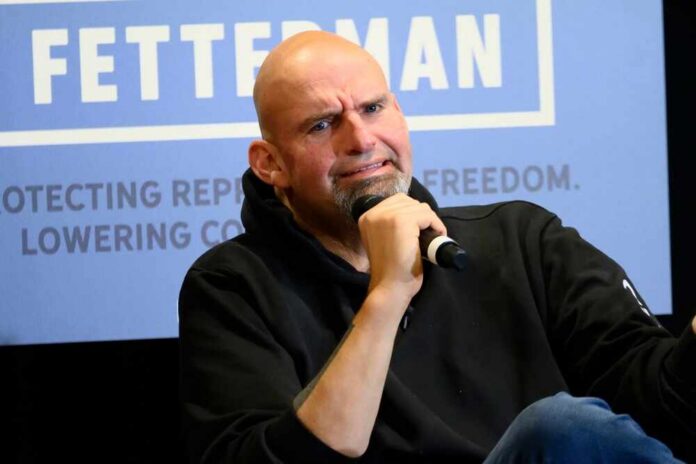
John Fetterman didn’t just cross the aisle after Trump’s win—he walked straight into the nominees’ waiting room and dared his own party to watch.
Quick Take
- Fetterman has met directly with multiple Trump nominees while most Senate Democrats keep their distance.
- He says confirmation votes should come from “an open-mind and an informed opinion,” not reflexive party warfare.
- He has already pledged support for Elise Stefanik and Marco Rubio, largely tied to shared views on Israel and UN accountability.
- His approach reflects the political math of Pennsylvania, a state Trump carried again, and a Democratic coalition under stress.
Fetterman’s New Role: The Democrat Who Shows Up Anyway
Sen. John Fetterman has made himself the most inconvenient Democrat in Washington: the one willing to meet President-elect Donald Trump’s nominees face-to-face. He sat down with Rep. Elise Stefanik for U.N. ambassador, Pete Hegseth for defense secretary, and Tulsi Gabbard for director of national intelligence, and he’s signaled more meetings to come. While colleagues posture, he frames the meetings as basic Senate work—listen, probe, then vote.
The attention isn’t just about meetings; it’s about the visuals and the message. Fetterman’s thumbs-up photos and blunt captions land like a flare shot into the Democratic caucus: he won’t treat every Trump pick as untouchable by definition. That forces a question Democrats have tried to dodge since the election: if voters handed Republicans control, does “resistance” mean refusing contact, or does it mean showing up and fighting for leverage?
What He’s Promising, and What He’s Not
Fetterman’s stated standard—“open-mind” and “informed opinion”—sounds like a civic textbook, but it carries a sharper subtext: he won’t outsource his judgment to party leadership or activist pressure. He has gone further with two nominees. He publicly backed Stefanik and advocated pushing U.N. accountability, including defunding UNRWA. He also pledged support for Sen. Marco Rubio as secretary of state. On Hegseth and Gabbard, he has not committed.
That mix matters. Public “hard yes” votes on prominent posts signal something beyond courtesy. They hint at a coalition that could form around specific national security and foreign policy priorities—especially on Israel—where Fetterman has broken with the progressive wing. Yet his lack of commitments on other nominees preserves his argument that meetings are due diligence, not surrender. If he votes no later, he can claim he did the work first.
The Pennsylvania Math Behind the Washington Theater
Pennsylvania isn’t a campus seminar; it’s a knife fight. Fetterman flipped a GOP Senate seat in 2022 in a state Trump had carried, and he did it with an outsider persona that never sounded like polished party talking points. After the 2024 results—Trump winning the state again and Republicans riding a broader sweep—Fetterman’s incentive structure hardened. A senator from a Trump-won battleground doesn’t get to govern as if only blue zip codes exist.
This is where common sense, and conservative realism, collide with Democratic messaging habits. Voters tend to reward visible governing and punish performative gridlock, especially on issues like border security and public safety. Fetterman has already shown a willingness to co-sponsor tougher immigration measures and criticize corruption inside his own party. Those moves don’t prove ideology; they prove he watches the same political scoreboard his constituents do—and he doesn’t pretend otherwise.
Israel, the UN, and the Issue That Splits Democrats Cleanly
Fetterman’s loudest point of alignment with Trump-world sits on Israel and skepticism toward parts of the United Nations system. That’s why Stefanik and Rubio drew his early support. After Oct. 7, he leaned into an unapologetic pro-Israel posture that infuriated progressive activists but resonated with many voters who prefer moral clarity over slogans. He has treated antisemitism and the legitimacy of Israel’s security concerns as non-negotiables, even when it costs him applause at home.
From a conservative-values lens, that posture reads less like “party betrayal” and more like refusing to bend to ideological intimidation. The strongest criticism of Fetterman is that he’s normalizing controversial nominees by granting them the respect of a meeting. The stronger counterargument is that senators exist to evaluate power, not to cosplay as protestors. If Democrats want to defeat bad nominees, they should interrogate them on the record—not boycott the room.
The Mar-a-Lago Meeting and the Signal It Sent
Fetterman also became the first Senate Democrat to meet Trump after the election, traveling to Mar-a-Lago and describing the conversation as positive and honest. Trump, for his part, praised him in the press as a “commonsense” figure, neither neatly liberal nor conservative. That praise makes many Democrats nervous for a simple reason: Trump uses validation strategically. A photographed handshake can become a political weapon aimed at the other side’s unity.
Still, refusing to meet doesn’t disarm that weapon; it just cedes the stage. The Senate confirmation process doesn’t disappear because one party refuses contact. A disciplined senator can meet, gather facts, and still vote no. Fetterman is betting voters prefer that posture: show up, ask tough questions, and don’t treat governance like a social-media purity test. Whether colleagues follow him depends on how scared they are of their own base.
What Happens Next: A Test for Other Trump-State Democrats
Fetterman’s real impact may come from imitation. Several Senate Democrats represent states Trump carried, and they face the same pressure: protect the party brand or protect their own viability. If even a handful start doing what he’s doing—meeting nominees, signaling conditional support, demanding concessions—the confirmation battlefield changes. Trump’s team gains pathways, but Democrats gain negotiating terrain. The alternative is simple and self-defeating: total opposition, zero access, and predictable losses.
Fetterman is not offering sainthood to Trump’s picks; he’s offering a process. In a polarized era, that sounds radical because it’s rare. People over 40 have seen this movie before: parties that refuse to adapt to electoral reality keep losing winnable fights. His approach may irritate Democrats in deep-blue districts, but it speaks the language of a swing-state senator: do the job, take the meeting, and then own the vote.
Sources:
John Fetterman, Trump and Democrats in Pennsylvania