
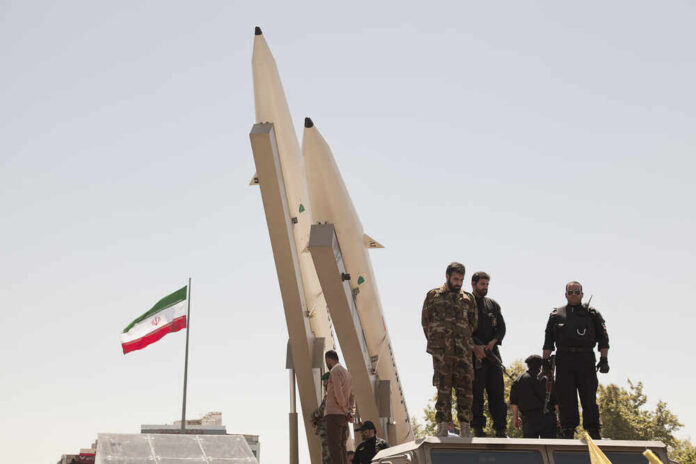
Claims that Iran’s regime is admitting defeat clash sharply with the reality on the ground, where the Islamic Revolutionary Guard Corps continues crushing dissent despite devastating U.S.-Israeli strikes that killed Supreme Leader Khamenei and other top officials.
Story Snapshot
- IRGC maintains iron grip through security forces despite Trump and Netanyahu’s failed hopes for mass uprising
- Analysts warn regime views capitulation as more dangerous than absorbing military strikes, defying pressure instead of yielding
- War drags on with air superiority achieved but no regime collapse, raising questions about costly military engagement without clear exit strategy
Regime Endures Despite Leadership Decapitation
U.S.-Israeli strikes successfully assassinated Ayatollah Ali Khamenei on February 28, 2026, and Supreme National Security Council Secretary Ali Larijani on March 17, marking unprecedented decapitation of Iran’s leadership structure. President Trump and Prime Minister Netanyahu immediately called for Iranians and IRGC members to seize power, offering immunity and promises of support. Despite eliminating top regime figures and achieving air superiority over western Iran and Tehran by early March, no mass uprising materialized. The IRGC’s paramilitary Basij forces and security apparatus maintained control through intimidation, crackdowns, and overwhelming firepower against unarmed opposition groups.
Why Authoritarian Regimes Resist Capitulation
Security analysts explain that authoritarian leaders like Iran’s remaining regime figures view concessions as existentially more threatening than military strikes. War on the Rocks analysis demonstrates that capitulation undermines domestic authority and IRGC loyalty, making regime survival paradoxically dependent on defiance rather than yielding. The IRGC controls vast economic resources and maintains tight security through decades-old networks, enabling sustained coercion despite external pressure. This dynamic helps explain why January 2026 mass protests were crushed through blackouts and killings, and why current leadership continues resisting despite air campaign damage to nuclear sites at Fordow, Natanz, and Isfahan.
Failed Regime Change Strategy Raises Concerns
Mossad Chief David Barnea presented a decapitation-and-uprising strategy to Netanyahu and Trump officials in January 2026, betting that leadership strikes would trigger internal overthrow. The plan’s failure became evident when Secretary of Defense Hegseth downplayed regime change rhetoric by late March, claiming the “regime sure did change” simply through assassinations rather than popular revolution. Atlantic Council experts warned against pursuing regime change, noting the mistake of confusing regime weakness with imminent collapse. Netanyahu acknowledged on March 20 that ground action would be necessary, contradicting earlier optimism about airstrikes alone producing regime fall.
Costs Mount Without Victory in Sight
The White House warned around March 25 that attacks would continue absent a peace deal, signaling prolonged conflict without clear resolution. Iranian civilians suffer ongoing crackdowns while the opposition remains unarmed against IRGC firepower, creating humanitarian concerns without advancing strategic objectives. Former military official Lawrence Wilkerson warned that U.S. strategic defeat in Iran could end MAGA politically, emphasizing the need for ground troops to achieve regime change—an option that would dramatically escalate American casualties and costs. This echoes frustrations among Trump’s base who expected promises to avoid new wars, not deeper entanglement in Middle Eastern regime change operations that risk overextension without guaranteed success or exit strategy.
The gap between regime change aspirations and ground reality exposes fundamental miscalculations about Iran’s resilience under pressure. Air superiority and leadership assassinations demonstrate military capability but not strategic victory when the IRGC security state remains intact and functional. Conservative supporters questioning this war’s necessity recognize patterns from previous Middle Eastern interventions where removing leaders failed to produce stable outcomes or protect American interests, instead consuming resources while threatening constitutional priorities at home through continued government overreach and spending on foreign entanglements.
Sources:
For Iran’s Regime, Better to Take a Beating than Capitulate – War on the Rocks
White House Warning on Iran Attacks – Fox News
Regime Change in Iran: Here’s Why the US Should Avoid the Temptation – Atlantic Council
Iran Update Evening Special Report March 2, 2026 – Institute for the Study of War