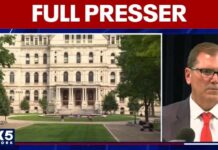
Philadelphia’s top prosecutor told a crowd that President Trump’s planned White House ballroom will be “blown up” in a future ceremony — and said he wants to keep a piece as a paperweight.
Story Highlights
- Philadelphia District Attorney Larry Krasner used explosive language about a future “White House ballroom” during a public speech.
- Krasner tied his remarks to a local fight over the President’s House slavery exhibit in Philadelphia.
- The comments sparked fresh debate over political speech, threats, and where the First Amendment draws the line.
- Courts protect harsh political talk unless it is a true threat or likely to spark immediate violence.
What Krasner Said And Where He Said It
Philadelphia District Attorney Larry Krasner made the comments on Tuesday at the annual slavery commemoration at the President’s House site in Old City. He criticized President Trump’s plan for a White House ballroom, then said, “In an official ceremony, we’re going to blow it up,” and joked about keeping a chunk as a paperweight. Video of the speech and local coverage captured the remarks and the crowd’s reaction.
Reporters noted that Krasner’s speech linked the ballroom line to a long-running dispute over how the President’s House site presents the history of slavery. He argued taxpayer money should serve public memory, not vanity projects. The line about “blowing up” came in that policy context, with future-tense phrasing and no call for immediate action. News write-ups described it as rhetoric within a broader message rather than an operational plan.
How The Law Sees Heated Political Rhetoric
United States Supreme Court doctrine gives wide protection to political speech, even when it is angry or uses violent metaphors. The key limits are “true threats” and speech meant and likely to cause imminent lawless acts. This standard, rooted in cases like Brandenburg and the “true threats” line of decisions, looks at context, audience, and immediacy, not just sharp words on their own.
Legal guides explain that government can act when speech targets a person with a serious expression of intent to harm, or when words are aimed at and likely to spark immediate illegal acts. In practice, officials and courts weigh whether the remark was a literal threat, a joke, a metaphor, or political theater. That is why many fierce lines in politics remain protected, while direct, likely, and immediate threats do not.
Why This Touched A Nerve Across The Aisle
The scene hit raw public feelings about trust in leaders and how they talk. Conservatives hear a big-city prosecutor speak about “blowing up” something tied to the White House and see contempt for institutions and for taxpayer money. Liberals hear anger at a costly project and see a pointed metaphor about priorities and history. Both sides see leaders who perform for cameras instead of fixing what is broken.
Philadelphia DA Larry Krasner says Trump is “going to give the taxpayers their money back” over the White House ballroom.
Ummm… WHAT money? 🤦♀️
The taxpayers didn’t pay for the ballroom. The project was privately funded.
So exactly what taxpayer money does Krasner think Trump… pic.twitter.com/TuaidEMPep
— 🎹 Ames™ 🎹 (@Real_Ames) August 26, 2026
People across the spectrum worry about elites who play by different rules. When a district attorney uses extreme words, many ask whether rules still matter. When the target is a high-profile presidential project, others hear a symbolic strike at waste and ego. The tension is old: our politics rewards sharp lines and viral clips, while the country needs careful work on crime, costs, schools, and fairness.
What To Watch Next
City and federal officials could respond with criticism or calls for restraint, but no legal action is likely based on the current record. Krasner’s office may clarify the intent of the remarks, stressing the policy point and the local exhibit fight. Expect national figures to cite the clip to rally their own base. The underlying test remains the same: does the speech cross from harsh talk into a true threat or likely incitement? Current reporting places it on the protected side of that line.
How This Fits A Bigger Pattern
Media and politics often isolate the loudest line and miss the context around it. Courts do the opposite: they study the whole moment before judging speech. That gap feeds outrage and deepens mistrust. Voters who feel ignored by Washington read these episodes as proof that performance beats problem-solving. The longer leaders chase clicks, the more Americans worry that the system serves careers and headlines over duty and results.
Sources:
washingtonexaminer.com, nbcphiladelphia.com, youtube.com, whitehouse.gov