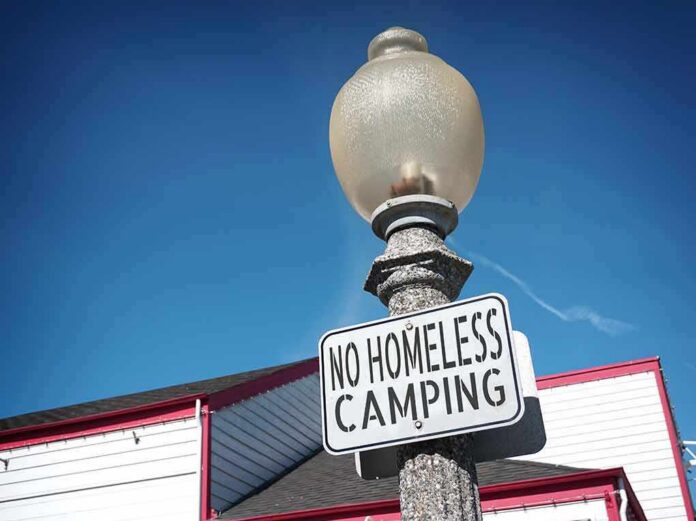
Santa Ana’s unanimous vote to ban public encampments shows how fast cities are moving from talk to tough rules in the name of safety and cleanliness.
Story Snapshot
- Santa Ana advanced a citywide encampment ban and related limits on sleeping and storing property in public.
- Mayor Valerie Amezcua tied the push to sanitation and safety complaints from residents and businesses.
- Orange County also approved faster arrests and fines on county land, tightening the regional net.
- Advocates and human rights groups warn criminalizing survival behavior does not reduce homelessness.
What Santa Ana Just Did and Why It Matters
Santa Ana officials moved to strengthen city code against camping and public sleeping after months of complaints about street conditions. The proposal targets encampments, sleeping on benches or in restrooms, and leaving personal property in public spaces. Local reporting says the City Council voted 7-0 to adopt an encampment ban, with penalties that can include citations and charges after a follow-up vote sets the effective date. Mayor Valerie Amezcua framed the effort as keeping neighborhoods clean and safe.
The timing follows a national shift after the Supreme Court’s Grants Pass decision, which opened the door to broader enforcement of anti-camping laws in Western cities. Orange County leaders also voted to allow immediate arrests or fines for camping on county property, from parks to flood channels. That means people living outdoors across the region now face tighter rules at the city and county level at the same time, with fewer gray areas about where tents can stay up.
How Supporters Defend the Crackdown
Supporters say residents deserve clean sidewalks, safe parks, and open bus benches, and argue that clear rules help police and outreach teams set boundaries. Amezcua and city staff point to a four-part strategy that includes cleanup, outreach, shelter placements, and services, not only enforcement. City materials note the police also say arrests alone are not a long-term fix, which is why Santa Ana pairs enforcement with referrals to beds, treatment, or family reunification when possible.
City leaders also cite local data and budgets to show they are not only “sweeping.” Santa Ana’s plan aims to reduce street impacts while funding shelter and programs through voter-approved revenue and grants. In public remarks, Amezcua has said the city helped about 1,000 people in 2025 through placements and reunifications, a claim meant to show results beyond citations. Officials argue this balanced approach answers both safety concerns and humanitarian needs more directly than either arrests-only or services-only models.
Why Critics Say It Misses the Point
Advocacy groups and researchers counter that bans on sleeping, sitting, or storing belongings punish survival behavior and shift people from corner to corner, not into stable housing. National groups say enforcement can damage trust, add criminal records, and make it harder to find work or rent later. Human Rights Watch has urged leaders to avoid policies that criminalize “existing in public space,” warning they are cruel and ineffective when housing is scarce.
This debate now echoes across many cities. Santa Ana’s step fits a wider pattern: when public pressure over disorder rises, local leaders lean on quality-of-life rules while also trying to expand placements. The shared concern on both left and right is clear: taxpayers fund programs, yet visible street misery remains. People see government missing basics—safety, dignity, and results—and fear policy choices are serving the system’s inertia more than the public’s needs.
What to Watch Next in Santa Ana and Beyond
Residents should track three things. First, enforcement outcomes: Do complaints, fires, and blocked sidewalks drop, and where do encampments go? Second, placements: How many people move into beds, treatment, or family settings, and for how long? Third, costs: Do arrests, cleanups, and storage outweigh gains if rehousing stalls? The city says it is blending rules and services; the proof will be measured in cleaner blocks and fewer people back on the street months later.
Sources:
nypost.com, voiceofoc.org, nbclosangeles.com, santanero.org, santa-ana.org, ktla.com, laist.com, newsantaana.com, citizenportal.ai, whitehouse.gov, leb.fbi.gov