

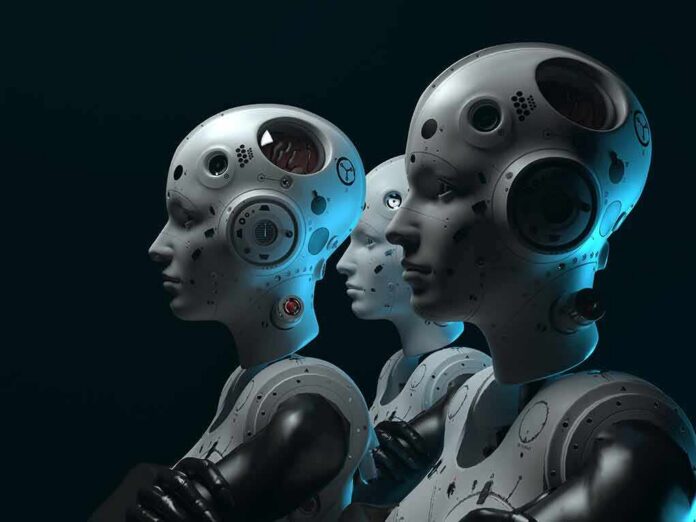
A humanoid robot worth $89,000 walked through a crowded New York City park this week, singing and dancing with strangers so it could learn how to one day watch their kids.
Quick Take
- A life-sized AI robot from California company Faraday Future appeared at Brooklyn Bridge Park on October 25.
- The robot sang, danced, and mingled with visitors while its operator, Chief Technology Officer Hong Rao, guided the session.
- The company says the goal is to teach the robot real-world social skills so it can one day work as a babysitter, teacher, or companion.
- The machine is still in its learning stage and relies on human interaction to build its intelligence.
Robot Mingles With Park Visitors
Visitors to Brooklyn Bridge Park on Sunday ran into something unusual: a life-sized humanoid robot walking among them. The machine sang to children, danced with people, and interacted directly with parkgoers of all ages. The New York Post identified the robot’s maker as Faraday Future, a California-based company, with Hong Rao serving as both chief technology officer and the robot’s operator during the outing.
The price tag alone makes this more than a curiosity. At $89,000, the robot sits far outside the reach of most families or even most schools, raising questions about who such technology will actually serve once it moves past the testing phase. For now, it remains a research project playing out in public rather than a product on store shelves.
Learning Through Real Human Contact
Rao told reporters the robot is deliberately placed around real people to learn how humans “interact” and “nurture” one another. The stated goal is ambitious: a machine that could eventually serve as a babysitter, teacher, or companion. Right now, though, the robot remains in an early development stage, building its abilities through direct exposure to everyday human behavior rather than lab simulations.
The company has been clear that the robot is still learning, not performing finished caregiving tasks. News outlets covering the demonstration, including the Economic Times, described the device as a way to “pick up on how people interact” in order to build social skills over time. That framing matters, because it separates Sunday’s park visit from any claim that the robot is ready to watch children unsupervised.
Why the Demonstration Doesn’t Prove Independence
Public demonstrations like this one are common in the humanoid robot industry, and they tend to follow a pattern. A robot performs convincingly in front of a crowd, but that performance alone doesn’t prove the machine can act on its own without help. Industry analysts have pointed out that many flashy robot demos rely on a human operator steering things behind the scenes.
In this case, Hong Rao was present as the robot’s operator during the park visit, a detail that fits that broader pattern. A robot can use its own sensors and software to react to people while still depending on a person nearby to guide or correct its actions. That combination makes it hard to judge, from a single outing, how close the machine actually is to working without supervision.
Bigger Questions Around Child Safety and Data
Pitching a robot as a future babysitter puts it in territory researchers have studied for years. Child development experts have warned that social robots built for kids raise real concerns about privacy, since these machines often collect personal data just by doing their job of watching and responding to children. Those concerns don’t disappear just because a robot can sing and dance well in a park.
Academic reviews of robot marketing claims have also found that companies sometimes promote caregiving abilities well before the science backs them up. One analysis of manufacturer claims for child-focused robots found many promises were not well supported by actual research. That gap between a product pitch and proven ability is exactly what outside experts say the public should watch for as companies like Faraday Future push toward caregiving roles.
What Comes Next
Faraday Future has not announced a timeline for turning this prototype into an actual childcare or teaching product. For now, the company’s own language keeps the robot in the “learning and development” category, built on real-world encounters like the one in Brooklyn Bridge Park. Parents, regulators, and robotics experts alike will likely be watching closely as the technology keeps moving from park demonstrations toward any real deployment near children.
The story captures a tension many Americans feel about fast-moving technology: genuine innovation paired with uncertainty about oversight. Whether a robot babysitter ever becomes real, Sunday’s park visit shows how close that idea already is to public streets and parks, long before clear rules exist to govern it.
Sources:
nypost.com, economictimes.indiatimes.com, scazlab.yale.edu, jaredwatkins.com, link.springer.com, robots.law.miami.edu