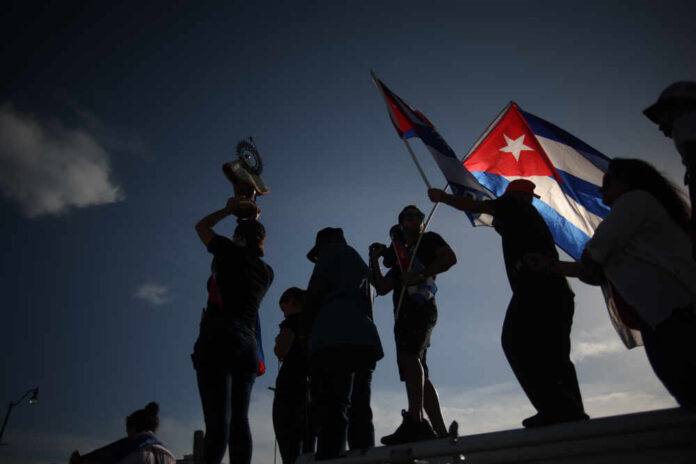
President Trump declared he would have the “honor” of taking control of Cuba as the island nation teeters on the brink of total collapse, signaling an unprecedented shift in U.S.-Cuba relations that could reshape the Caribbean and challenge decades of failed communist rule.
Story Snapshot
- Trump stated Cuba is a “failed nation” with “no money, no oil, no nothing” during remarks following the island’s nationwide electrical grid collapse
- The President suggested a “friendly takeover” while asserting he could “do anything I want with it,” leaving options open from liberation to regime change
- Cuba’s weakened state stems from tightened U.S. sanctions, loss of Venezuelan oil subsidies, and economic mismanagement under communist leadership
- White House policies include designating Cuba a state sponsor of terrorism and imposing tariffs on nations supplying oil to the regime
Trump Seizes Moment as Cuba Crumbles
President Trump’s remarks to reporters came on the same day Cuba’s entire electrical grid failed, plunging 11 million citizens into darkness and exposing the regime’s inability to provide basic services. Speaking with characteristic boldness, Trump described taking Cuba as a significant “honor” and emphasized the island’s vulnerability. His comments reflected confidence that decades of communist misrule have finally brought the Castro-aligned government to its knees, creating an opening for American influence that hasn’t existed since before the 1959 revolution. The timing underscores how sanctions and strategic pressure have accelerated Cuba’s descent into chaos, validating hardline approaches over diplomatic engagement.
Sanctions and Isolation Cripple Regime
The Trump administration’s multi-pronged strategy has systematically dismantled Cuba’s survival mechanisms. After reversing Obama-era détente during his first term, Trump reinstated Cuba’s designation as a state sponsor of terrorism in 2021 and expanded it further in 2025, citing non-cooperation on deportees and visa overstays. A January 2026 executive order imposed emergency tariffs on nations supplying oil to Cuba, cutting off lifelines from Russia and China. The collapse of Venezuela’s Maduro regime, facilitated by U.S. pressure, eliminated Cuba’s primary oil subsidy source. These coordinated actions transformed what critics once dismissed as Cold War posturing into effective economic warfare, forcing Havana into negotiations from a position of desperation rather than strength.
Friendly Takeover or Regime Change
Trump’s framing of a “friendly takeover” raises questions about his endgame, though his assertion that he could “do anything I want with it” suggests flexibility. Reports indicate the administration is pushing for the removal of President Miguel Díaz-Canel while potentially leaving remnants of the Castro family in symbolic roles to ease transitions. This approach mirrors strategies used in Venezuela and Iran, where regime change focuses on removing hostile leadership without triggering full-scale military confrontations. For Americans frustrated by decades of watching communist tyranny flourish 90 miles from Florida, Trump’s willingness to openly discuss taking Cuba represents a refreshing departure from bureaucratic timidity that allowed despots to survive through empty diplomatic channels and humanitarian exemptions.
National Security and American Interests
Beyond symbolic victory over communism, a U.S.-aligned Cuba would eliminate a strategic threat in the Western Hemisphere and open economic opportunities. The White House justifies its aggressive stance on national security grounds, pointing to Cuba’s harboring of terrorists, support for anti-American regimes, and potential as a platform for adversaries like China and Russia. Ending the embargo could create markets for American goods and energy exports while stemming refugee crises that burden Florida and Gulf Coast states. Critics warn of overreach and proxy conflicts, but supporters argue the government’s first duty is protecting American citizens, not preserving failed socialist experiments. Trump’s approach reflects common sense: when a hostile neighbor collapses under its own corruption, Americans have every right to ensure the outcome serves their security rather than empowering the next generation of tyrants.
Trump Says He’ll Take Cuba ‘Almost Immediately’https://t.co/dc0VaKnjah
— PJ Media (@PJMedia_com) May 2, 2026
The President’s comments have energized Cuban exiles and conservatives who view decades of engagement as appeasement, while raising alarms among those wary of interventionism. Whether Trump pursues military action, economic annexation, or facilitated regime change remains unclear, but his public declaration shifts Cuba policy from cautious diplomacy to active confrontation. As the island’s grid failures persist and 25 million Cubans endure worsening hardships, the world watches to see if 2026 marks the end of the hemisphere’s last major communist holdout. For Americans across the political spectrum tired of watching elites manage decline, Trump’s willingness to state what others whisper privately—that Cuba is collapsing and America should shape what comes next—resonates as a long-overdue reckoning with reality over ideology.
Sources:
Trump says he believes he would have the ‘honor’ of ‘taking Cuba’ – Fox News