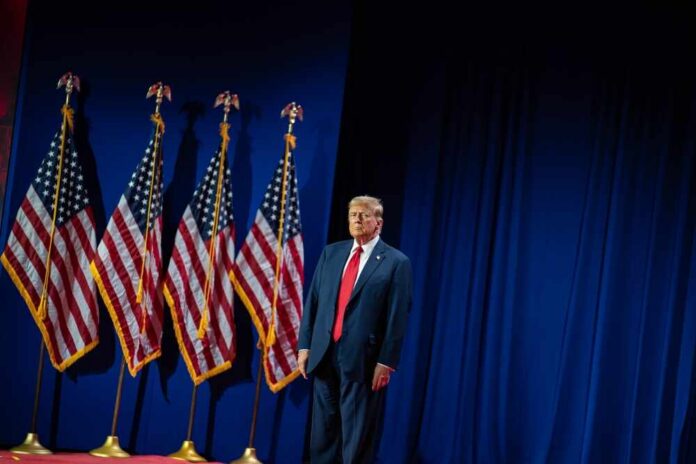
Trump’s “unconditional surrender” demand puts America’s Iran war on a sharper, more explicit track—one that could redefine U.S. objectives from destroying capabilities to reshaping a regime.
Quick Take
- President Trump said the war ends only with Iran’s “UNCONDITIONAL SURRENDER,” rejecting talk of a negotiated off-ramp.
- U.S.-Israel strikes reportedly killed Iran’s Supreme Leader Ayatollah Ali Khamenei, and Iran has answered with missiles and drones that have killed six U.S. service members.
- Trump also discussed rebuilding Iran under a U.S.-acceptable leader, a shift from Defense Department messaging that emphasized limited military aims.
- Regional spillover is intensifying, including threats to Gulf stability, disrupted shipping near the Strait of Hormuz, and heavy air-defense activity by U.S. partners.
Trump’s Demand Signals a Hard End-State
President Donald Trump posted Friday that there will be “No deal except UNCONDITIONAL SURRENDER!” from Iran, framing capitulation as the only condition to end U.S. strikes. Reports also describe Trump pairing that message with a promise of help rebuilding Iran under a “great acceptable leader” acceptable to the United States, punctuated with “Make Iran Great Again (MIGA!).” That combination matters because it defines victory as political submission, not just battlefield effects.
Recent coverage also highlights a tension inside the U.S. message: Defense Secretary Pete Hegseth has described the operation as focused on degrading Iran’s missiles, navy, and nuclear program while denying an “endless war” or regime-change agenda. Trump’s own words, however, lean toward leadership change and U.S. influence over who comes next. For Americans wary of open-ended commitments, that discrepancy is a key detail to watch as the administration clarifies war aims.
How the War Reached This Point in One Week
The conflict escalated rapidly after the U.S. announced “major combat operations” following joint U.S.-Israel strikes that hit Iranian military, government, and nuclear sites. Multiple outlets report that Iran’s Supreme Leader Ayatollah Ali Khamenei was killed in the initial wave, with no successor named publicly. Iran then launched missile and drone retaliation against U.S. bases, Israel, Gulf nations, and oil facilities, and reports say six U.S. service members have been killed.
Iranian leaders have not signaled submission. Iranian President Masoud Pezeshkian has said Iran is committed to peace but will defend sovereignty, while pointing to mediation efforts and placing responsibility on the initiators of the strikes. Foreign Minister Abbas Araghchi publicly defied U.S. pressure and spoke in terms that rejected a ceasefire demand, including statements that Iran is prepared for the arrival of U.S. troops on the ground. Those responses underscore why surrender rhetoric may harden positions rather than end them quickly.
Regional Blowback: Drones, Intercepts, and Energy Risk
By day seven, the war’s regional effects were already severe. Live reporting described Israel expanding strikes into a “new phase,” including attacks in Tehran and Lebanon, while air defenses in Gulf partner states remained active against incoming drones and missiles. Updates also described mass displacement and a worsening security environment across key corridors. The Strait of Hormuz and surrounding Gulf infrastructure remain the strategic pressure point, since shipping disruptions there can quickly ripple into energy prices and broader inflation concerns.
Allies are already spending real resources to blunt the missile-and-drone threat. Reports described the UAE intercepting large numbers of drones and missiles, illustrating how Iran’s retaliation strategy extends beyond Israel to the broader coalition and the regional economy. Other reporting noted unusual international involvement, including Ukrainian drone specialists deployed to help defend U.S. bases in the Middle East. These details show how quickly a “regional” conflict can pull in additional partners and widen operational footprints.
Where the Facts Are Clear—and Where They Aren’t Yet
The strongest, most consistent facts across major outlets are Trump’s direct “unconditional surrender” wording, the timeline of strikes and retaliation, and the reported death of Khamenei during the opening attacks. The unresolved pieces are the ones that will shape risk for American families: the precise U.S. definition of “surrender,” the mechanism for choosing an “acceptable” postwar leader, and whether the administration will pursue a strictly air-and-maritime campaign or accept scenarios that increase ground-war exposure.
🇺🇸 🇮🇷 🇮🇱 US President Donald Trump on Friday demanded Iran's "unconditional surrender" as the only acceptable route to ending hostilities, while promising to help rebuild the country's economy if Tehran complied and installed new leadership ➡️ https://t.co/eDonLM3DR8 pic.twitter.com/L2awIB0nDi
— AFP News Agency (@AFP) March 6, 2026
For a conservative audience that watched the last decade of elite overreach, the central question is whether Washington can stay focused on protecting Americans—troops, allies, and the homeland—without drifting into an undefined nation-building mission. The reporting to date confirms a decisive posture and rapidly evolving battlefield conditions, but it also shows mixed messaging about end goals. Until that gap closes, accountability starts with demanding clarity on objectives, duration, and what “acceptable leadership” means in practice.
Sources:
Trump Demands ‘Unconditional Surrender’ From Iran Amid War
Trump says only ‘unconditional surrender’ of Iran will end war
Iran live updates: IDF targets Iranian internal security
U.S.-Iran war live updates: Israel strikes regime targets
Trump demands unconditional surrender in series of Iran messages