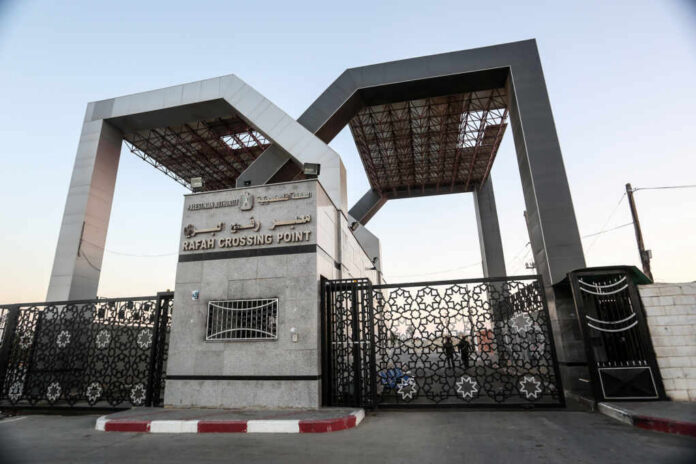
After nearly two years of closure prompted by Hamas smuggling threats, Israel is set to reopen the Rafah crossing with Egypt on February 1, 2026. This reopening is strictly limited to pedestrian traffic and operates under a rigorous security framework designed to prioritize counterterror vetting over open access. The “people only” policy, which bans aid and commercial goods, reflects Israel’s core goal of preventing a return to the pre-war status quo, when Hamas allegedly exploited the crossing for weapons and supplies.
Story Highlights
- Israel plans to reopen Gaza’s Rafah border crossing with Egypt on February 1, 2026, for pedestrian traffic in both directions.
- The reopening is limited to people only; no aid or commercial goods are permitted through Rafah under the current framework.
- Israel will require prior security clearance, using layered checks that include facial recognition and Shin Bet vetting.
- Egypt, the European Union mission, and the Palestinian Authority are set to play defined roles alongside Israeli oversight.
- The move is tied to President Trump’s 20-point regional peace plan and follows the recovery of the last Israeli hostage’s remains.
Rafah Reopens Under a “People Only” Policy, Not a Cargo Lifeline
Israel announced that the Rafah crossing between Gaza and Egypt will reopen on February 1, 2026, allowing pedestrian travel in both directions for the first time since Israeli forces seized the area in May 2024. Israeli officials say the opening is narrow by design: people can pass, but aid and goods cannot. That distinction matters because it limits opportunities for weapons or dual-use items to move through a high-risk corridor.
Israeli forces captured the crossing in 2024 to disrupt Hamas smuggling networks, and Israel’s current posture reflects that history. Before the war, Rafah served as a major outlet for movement between Gaza and Egypt. Israeli officials have argued that, without robust controls, Hamas exploited the crossing and surrounding routes to bring in arms and supplies. The reopening, as described by Israeli authorities, is built to prevent a return to that pre-2024 status quo.
Israel will reopen the Rafah border crossing on Sunday (February 1, 2026) for people to travel between Gaza and Egypt, the Israeli Government agency that coordinates civilian policy in Gaza, the Coordinator of Government Activities in the Territories, said.…
— The Hindu (@the_hindu) January 30, 2026
How the Security Model Works: Vetting, Facial Recognition, and Multiple Checkpoints
Israel’s stated framework centers on individual clearance rather than open-ended passage. According to Israel’s Coordinator for Government Activities in the Territories (COGAT), movement will be coordinated with Egypt after prior Israeli security approval of individuals and under EU supervision. Reporting on the operational concept describes Israeli officers remotely monitoring departures from Gaza using facial-recognition tools to verify approved identities, aiming to stop imposters and flagged suspects.
Israeli screening does not end at the gate. Travelers entering Gaza from Egypt are expected to pass through an IDF checkpoint after crossing, adding another layer designed to catch discrepancies, fraudulent documents, or security risks. The Palestinian Authority is described as having an operational role on the ground, while Israel maintains primary control over the security mechanism and name-clearance decisions. That layered setup signals a core priority: humanitarian movement, but not at the expense of counterterror vetting.
Trump’s Peace Plan Link and the Hostage Condition Driving the Timeline
Israeli officials tied the limited reopening to President Donald Trump’s 20-point peace plan, framing it as a concrete step in implementing ceasefire terms. Reporting also connects the timing to hostage-related conditions, including the recovery of the last Israeli hostage’s remains—Staff Sgt. Ran Gvili—after 842 days in captivity. The sequence matters politically and operationally: Israel is signaling that movement concessions are linked to compliance and tangible outcomes, not vague promises.
That approach is likely to resonate with Americans who watched prior administrations chase “process” over results in the Middle East. The available reporting does not claim the ceasefire is permanent or that underlying disputes are resolved. It does show a leverage-based model: limited openings, verification, and phased steps connected to security benchmarks. Supporters of constitutional, security-first governance tend to recognize this pattern as closer to enforceable policy than to aspirational diplomacy.
Humanitarian Pressure Meets Hard Constraints: Who Benefits and What’s Still Unclear
COGAT data cited in reporting indicates roughly 42,000 Gazans left the Strip during the war, often for medical treatment abroad or because they held dual citizenship. A pedestrian reopening could enable returns and family reunification while also allowing some residents to exit for medical care. The EU’s supervisory role is presented as an accountability mechanism intended to help ensure screening is not arbitrary while still respecting Israel’s demand for security clearance.
Key uncertainties remain because the public details are limited. Reporting notes questions about processing capacity for potentially large numbers of applicants and the practical timeline for security screening at scale. Another unresolved point is how consistently all parties can sustain coordination once daily operations begin. Even so, the structure—people only, no cargo, remote monitoring, layered checkpoints—shows Israel and its partners are attempting to balance humanitarian pressure with the reality that Hamas has exploited border access in the past.
Watch the report: Israel to Reopen Rafah Crossing on Sunday Under Trump’s Gaza Ceasefire Plan | WION News
Sources:
- Israel Set to Reopen Gaza’s Rafah Border Crossing with Egypt for First Time Since May 2024
- Israel confirms Gaza’s Rafah crossing will reopen Sunday in both directions
- Rafah Crossing to Reopen for Pedestrians as Fragile Gaza Ceasefire Moves to Second Phase