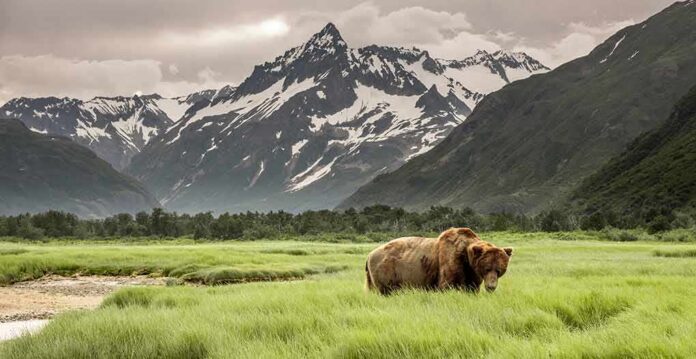
On a narrow Alaskan trail built for “safe” bear viewing, three hikers suddenly learned how fragile that promise can be when a massive grizzly called “Scuba Sue” stepped out of the wild and into their path.
Story Snapshot
- Video shows three hikers freezing on a tight trail as a grizzly known as “Scuba Sue” walks past them at Anan Wildlife Observatory.
- The hikers used standard bear safety steps: stayed calm, spoke to the bear, and did not run.
- Anan Wildlife Observatory is a tightly controlled bear viewing site with daily permit caps and strict access rules meant to protect both bears and people.
- Media pushed a “heart‑stopping” narrative, while official safety guidance says most close bear encounters are not attacks when people act correctly.
A Controlled Wildlife Site Meets a Raw Wild Moment
At Anan Creek in Southeast Alaska, three hikers rounded a bend and found themselves face‑to‑face with a large brown bear nicknamed “Scuba Sue” on a narrow trail. The site is part of the Anan Wildlife Observatory, a remote bear viewing area about 30 miles from Wrangell that visitors reach only by boat or floatplane. The encounter happened during the busy salmon run, when both black and brown bears crowd the creek to feed, and permits tightly limit daily human access.
Video shared by news outlets shows the hikers pressed against the uphill side of the trail while the bear moves slowly past them, focused on salmon rather than the people. ABC World News Tonight highlighted the clip as part of its national broadcast, underscoring how quickly a tourist moment can turn serious when a top predator appears within arm’s reach. The footage ends with no injury and no charge, only a few shaken humans and a bear that goes back to hunting.
How Bear Safety Rules Worked in Real Time
According to the New York Post report, the hikers followed the core rules taught for close bear encounters: they stood still, talked calmly to identify themselves as human, and did not run. Alaska’s Department of Fish and Game tells visitors that in most close encounters “chances are good you are not in danger” if you remain calm and watch what the bear does instead of panicking. Alaska and National Park Service guides stress the same basics: face the bear, group up, speak in a steady voice, and move slowly only if there is space.
Fox News reported that the hikers later recounted how they followed ranger protocols, speaking to the bear as it passed them on the trail. That approach matches written safety frameworks, which warn that screaming or sudden running can startle a bear or trigger a chase response. In this case, “Scuba Sue” reportedly stayed focused on salmon along the creek, using the same human trail as a travel path, which is common at sites where bears and people share narrow corridors near food.
Anan Wildlife Observatory: Managed Wildness and Its Limits
Anan Wildlife Observatory was built to let people watch bears feed while keeping direct contact to a minimum. The site uses a half‑mile boardwalk and viewing platforms above the falls, with a photo blind closer to the action so visitors can see bears catching salmon without standing beside them. The U.S. Forest Service limits most visits to an 8 a.m. to 6 p.m. window from July 5 to August 25, and caps daily permits at about 60 people to avoid pushing bears away or creating dangerous crowding.
Guides and rangers enforce strict rules: no food on the trail, only water; stay with your group; obey directions if a bear appears. Access is allowed only by boat or floatplane, and many visitors must book months ahead because permits sell out early. These tight controls are meant to protect the bear population, keep the public safe, and still give paying visitors an “extraordinary experience” watching a wild hunt from a supposedly secure distance. Yet this trail encounter shows that even well‑managed systems cannot fully tame the wild.
Drama, Reality, and a Shared Unease About Risk
Coverage of the event leaned hard on fear words like “heart‑stopping” and “tense moment,” framing the clip as near disaster rather than successful safety practice. Wildlife guidance tells a more measured story: most bears at sites like Anan are intent on salmon, and when people follow rules, close passes often end uneventfully. That gap between media drama and expert reality feeds a wider distrust many Americans feel when official systems promise safety yet still put ordinary people inches from real danger.
For both right and left, this scene touches a bigger worry: systems run by distant agencies and tour companies make money by selling “managed risk,” but the people on that trail face the consequences if something goes wrong. The observatory rules, permits, and platforms show government can plan; the sudden appearance of Scuba Sue on the walkway shows nature does not always follow the plan. In a time when many feel the “elites” are not the ones at risk, a quiet, rule‑following bear encounter going viral reminds us how thin the line is between control and chaos.
Sources:
redstate.com, nypost.com, kstk.org, recreation.gov, instagram.com, outdoorguide.com, bbc.com, youtube.com, mirror.co.uk, dfw.state.or.us, nps.gov