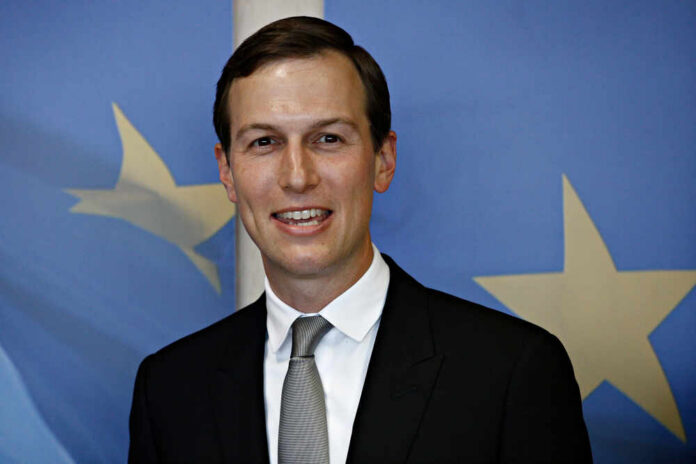
A reported $5 billion foreign fundraising push by Jared Kushner—while he serves as President Trump’s Special Envoy for Peace—is reigniting a familiar Washington question: where does public service end and private profit begin?
Story Snapshot
- Reports say Kushner is seeking at least $5 billion more for his private equity firm, Affinity Partners, from Middle East governments while serving as a U.S. envoy.
- The fundraising effort appears to conflict with Kushner’s statement that his firm had raised enough to avoid raising money during Trump’s term to prevent conflicts.
- The New York Times reporting (as relayed by multiple outlets) describes outreach to Saudi Arabia’s PIF and to investors tied to Qatar and the UAE.
- Critics argue the overlap between diplomacy and fundraising creates a perceived conflict, while key details remain pending a required financial disclosure.
What the reports say Kushner is doing now
Multiple outlets citing New York Times reporting say Jared Kushner, now serving as U.S. Special Envoy for Peace in Trump’s second administration, is seeking “$5 billion or more” from Middle Eastern governments for his private equity firm, Affinity Partners. The described targets include Saudi Arabia’s Public Investment Fund, plus investors connected to Qatar and the UAE. The reporting emphasizes that discussions occurred recently, including meetings with Saudi officials and outreach to additional sovereign-linked investors.
Kushner launched Affinity Partners after leaving the White House, and his firm previously received major backing from Saudi Arabia’s sovereign wealth fund. In early 2026, he also attended the World Economic Forum in Davos as a U.S. delegate, where the reports say fundraising conversations continued. None confirms that any new $5 billion commitment has already closed.
The pledge problem: why December 2024 is central
The controversy turns on a public pledge Kushner made in December 2024, when he said Affinity had raised enough capital “for the next four years,” specifically to avoid fundraising during a Trump term and reduce conflict-of-interest concerns. Reports say that round totaled about $1.5 billion from sources linked to Qatar and the UAE. If he is again soliciting major sovereign investment while holding an active diplomatic portfolio, critics argue the original purpose of that “preemptive” raise has been undercut.
That issue resonates beyond partisan media narratives because the concern is straightforward and constitutional in spirit: Americans expect government power to be used for the national interest, not to create special access or leverage for private gain. This does not establish any illegal act. It does, however, describe an arrangement that can erode public trust—especially when the fundraising sources are foreign governments whose interests can be affected by U.S. diplomacy and security decisions.
Why the envoy role raises the stakes
Kushner’s formal appointment as Special Envoy for Peace on February 19, 2026, matters because it places him inside ongoing U.S. negotiations and sensitive regional disputes. Coverage describes his involvement around Middle East issues, including Iran-related tensions, at a time when Gulf states have strong preferences about U.S. posture. Even if diplomacy is handled properly, the appearance problem intensifies when the same countries that want policy outcomes are also being approached for large investments.
Another practical point raised in oversight. Special envoy roles can trigger financial disclosure requirements, and outside groups have highlighted deadlines for those filings. Until those disclosures are public, key details remain uncertain, including exactly how the fundraising is structured, what firewalls (if any) exist, and whether any steps were taken to separate official discussions from investor outreach.
What’s confirmed, what’s not, and what to watch next
Affinity previously received a major Saudi PIF investment; Kushner publicly framed later fundraising as a way to avoid conflicts during a Trump term; and sources told the New York Times that new outreach is underway aimed at raising at least $5 billion more. The uncertainty is just as important: none of the cited stories confirm the precise amount ultimately sought, the final terms, or whether new commitments have already been made.
For readers who are tired of Washington double standards, the takeaway is less about party labels and more about applying one rule across the board: senior officials and envoys should avoid even the appearance of foreign financial entanglements that could cloud U.S. decision-making. The next real checkpoint will be the required disclosures and any official clarification about what safeguards exist, if any, to keep America’s diplomacy separate from private fundraising.
Jared Kushner reportedly seeks $5B from Middle East governments for his firm while serving as envoy https://t.co/XexwP1fRw8
— Nader Nami (@nami13) March 17, 2026
Until then, the public is left with a familiar modern problem: big money and high office moving in the same orbit, with trust hinging on transparency. If the administration wants to shut down speculation—both from hostile media and from legitimate ethics watchdogs—the cleanest path is full disclosure and clear boundaries. Without that, the story will continue to feed broader concerns about elite access, global money, and whether everyday Americans get the same fairness they’re expected to live by.
Sources:
https://popular.info/p/kushner-breaks-pledge-seeks-5-billion
https://biz.chosun.com/en/en-international/2026/03/15/5EG7C3X5JJAFLDSQUJMWQYUDPM/