While Americans argue over politics at home, a crowded camp in Congo is quietly showing how budget cuts, broken trust, and failing global health systems can turn a local Ebola scare into a warning sign for all of us.
Story Snapshot
- At least 30 people have died in one Congo displacement camp in just weeks, with Ebola-like symptoms and no clear cause.
- Families refused testing for weeks, so officials still cannot say for sure what killed the victims.
- Overcrowding, almost no clean water, and overflowing toilets have turned the camp into a perfect storm for deadly disease.
- United States-backed water and sanitation projects were sharply cut, leaving tens of thousands more exposed to outbreaks.
Unprecedented deaths in a forgotten camp
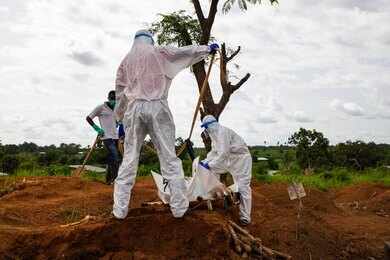
Camp leaders in the Kigonze displacement camp in northeastern Congo say at least 30 people have died since early May, a death toll they call unprecedented for their community.[12] Normally the camp, home to more than 15,000 people who have fled conflict, sees only one to three deaths a month, but one recent week saw 10 burials alone.[12] Many of the dead had headaches, fever, and vomiting, symptoms that match Ebola and other severe infections.[12] Because of this spike, local officials and aid workers fear a serious outbreak may be spreading under the radar among millions of displaced people across eastern Congo.[1]
The camp sits near Bunia, the epicenter of the current Ebola outbreak in Congo, which is driven by the rare Bundibugyo strain that has no approved vaccine.[8] National and international health agencies report hundreds of confirmed Ebola cases and more than 200 deaths across affected provinces, but they do not provide detailed numbers for individual camps like Kigonze.[8] That gap feeds worries that crowded sites housing people who already fled violence are now facing a second threat. It also highlights a pattern seen in past outbreaks, where disease spreads fastest in places that the system barely counts.[15]
Testing delays, distrust, and the fog of epidemic “uncertainty”
Health workers cannot yet say for certain that Ebola caused the Kigonze deaths, because families refused testing of both sick patients and dead bodies until mid-June.[12] Only five samples had been collected when Reuters reported on the situation, and lab results were still pending, which means most cases remain medically unexplained.[12] Doctors point out that the reported symptoms could also come from illnesses such as cholera or malaria, which are common in poor and crowded areas.[3] This kind of uncertainty has marked many past epidemics in displacement settings, where fear of stigma and distrust of authorities often keep people away from clinics.[16]
Residents’ refusal to allow testing did not come from nowhere. Years of conflict, broken promises, and heavy-handed health responses have left many Congolese suspicious of outside teams, especially when they arrive in full protective suits.[17] During earlier Ebola crises, some communities even chased out contact tracers and tried to secretly bury their dead to avoid strict burial rules.[21] When families in Kigonze hold back consent for tests, they may be making a tragic choice between cultural customs, fear of the unknown, and a health system they feel has failed them before. That choice delays answers and helps any disease spread quietly.
Overcrowding, dry taps, and the cost of funding cuts
Conditions inside Kigonze make it almost designed for a deadly outbreak. More than 15,000 people are squeezed into a small space with limited access to clean water, basic hygiene, or medical care.[6] Aid workers describe toilets that fill up quickly, overflow, and sometimes have to be emptied by hand.[1] Many families cannot even afford soap, forcing them to rely on ash to clean their hands.[1] In these conditions, any disease that spreads through bodily fluids, including Ebola, cholera, or other gut infections, can move fast from one person to the next.
The situation has worsened as funding for water, sanitation, and hygiene programs has collapsed. United Nations data show that money for toilets and handwashing stations in Congo was cut by more than half between 2024 and 2025, dropping to about $38 million, while this year’s $80 million appeal is barely one-fifth funded.[1] United States-backed projects that once built dozens of taps and more than 400 public toilets for over 125,000 displaced people have now been scaled back or shut down after cuts under President Donald Trump.[5] One aid group says that, because of these cuts, fewer than 19,000 people now share just six taps and no public toilets.[5]
What this means for Americans tired of failed leadership
For many Americans, this story may feel far away, but it mirrors frustrations on both the right and the left about how leaders handle crises. Conservatives who are skeptical of global spending can still see a problem when money that is spent overseas seems to vanish into bureaucracy while basic safeguards like clean water are left to rot. Liberals who worry about growing inequality see, once again, poor families paying the highest price while well-paid officials in capital cities and global agencies debate labels like “suspected” or “confirmed.”[6]
At least 30 people have died since May in the Kigonze displacement camp in the Democratic Republic of Congo. Their symptoms suggest Ebola is spreading quickly, but tests for the deadly disease have only just been implemented. pic.twitter.com/Z9AYGHqdH7
— Al Jazeera English (@AJEnglish) June 19, 2026
Health experts say the overall risk of this specific Ebola outbreak to people in the United States remains low, but that does not mean Americans can ignore what Kigonze reveals.[8] The camp’s crisis shows how fast a local problem can grow when trust breaks down, basic services fail, and big donors treat sanitation like an optional extra instead of a frontline defense. In a world linked by travel, trade, and migration, weak spots in one country’s health system can become pressure points for everyone else. For readers who feel that unaccountable elites and a bloated bureaucracy keep failing ordinary people, Kigonze is another warning light on the dashboard.
Sources:
[1] YouTube – Congo camp deaths spark fears of undetected Ebola spread
[3] Web – Thirty dead at DRC displacement camp as Ebola threat grows
[5] Web – At least 30 people have died since May in the Kigonze displacement …
[6] Web – At least 30 people have died since May in the Kigonze displacement …
[12] Web – At least 30 deaths at Congo camp show Ebola could be spreading fast
[15] Web – Suspected Ebola victims are moved from a Bunia camp as fears rise …
[16] Web – Ebola outbreak in DR Congo expands into large displacement camp
[17] Web – 5 displacement patterns emerging from the Ebola epidemic – Liberia
[21] Web – Two Ebola-related deaths have been confirmed in a displacement …