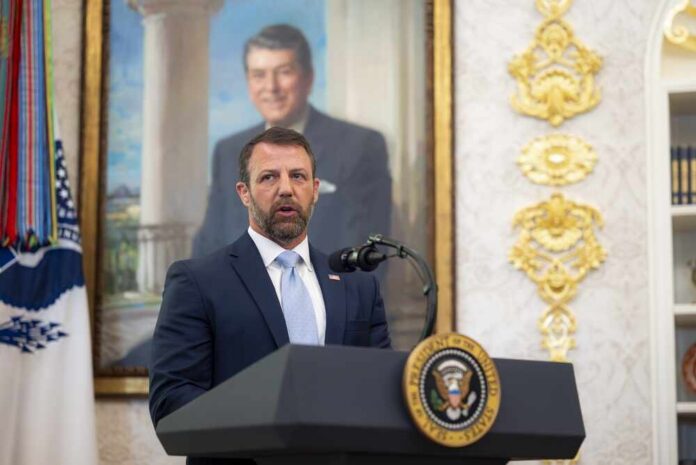
Homeland Security Secretary Markwayne Mullin sat face-to-face with families who lost loved ones to violence linked to illegal immigration — and the raw emotion in that room is now fueling a fierce national debate about who the government is really protecting.
Story Snapshot
- Secretary Mullin met with families of victims killed by illegal immigrants, calling for stronger enforcement against cartels and violent criminal networks.
- Mullin also publicly apologized to families of victims killed in a 2025 shooting at an Immigration and Customs Enforcement facility in Dallas.
- Critics say broad enforcement sweeps have led to wrongful detentions, warrantless home entries, and harm to innocent people — including U.S. citizens.
- Both sides agree the government has failed these families — they just disagree sharply on what the fix looks like.
Mullin Faces Families and Lawmakers
Markwayne Mullin became the ninth Secretary of Homeland Security in 2026. He has quickly become one of the most visible faces of the Trump administration’s immigration crackdown. At a recent House Homeland Security Committee hearing, Mullin defended tough enforcement policies. He said he supports efforts to “identify and dismantle these organizations that are bringing death” — pointing specifically to drug cartels, foreign terrorist groups, and organized crime networks operating across the border. [1]
Mullin also held an emotional meeting with families whose loved ones were murdered by people who entered the country illegally. That meeting put a human face on the immigration debate. For many Americans — especially those who feel the government ignored this problem for years — seeing a cabinet secretary sit with grieving families felt like long-overdue acknowledgment. But critics point out that emotional moments don’t automatically translate into effective policy.
The Dallas ICE Shooting and a Public Apology
Separate from the victim-family meeting, Mullin appeared at a press briefing to apologize to families of people killed in a 2025 shooting at an Immigration and Customs Enforcement (ICE) detention facility in Dallas. The apology was seen by supporters as a sign of accountability. But it also drew sharp criticism. Senator Richard Blumenthal confronted Mullin directly, noting that Mullin had previously said the shooting was “absolutely” justified — a statement Blumenthal called disqualifying. [4][5]
That exchange highlights a real tension at the heart of this debate. Mullin is trying to defend aggressive immigration enforcement while also showing compassion for victims on all sides. Those two goals are not always easy to square. His confirmation hearing transcript shows he also pledged to end warrantless home entries by ICE officers and move away from mass raid operations — a sign that even he sees limits to how far enforcement should go. [6]
Where Critics Push Back
Opponents of the current enforcement approach are not just making political arguments. At a congressional oversight hearing, David Behar of the Cato Institute testified about documented cases of wrongful detention, warrantless home invasions, excessive force, and weak internal oversight inside the Department of Homeland Security (DHS). These are not fringe claims — they come from a hearing record. And they raise serious questions about whether enforcement is hitting the right targets. [1]
Other witnesses at the same hearing argued that broad enforcement policies can harm immigrant communities even when the stated goal is public safety. The core problem is one that frustrates people across the political spectrum: the government keeps making big promises about fixing dangerous problems, but the results are often messy, inconsistent, and sometimes harmful to innocent people. Whether the concern is a grieving American family or a U.S. citizen wrongly swept up in a raid, the common thread is a system that keeps failing the people it’s supposed to serve.
What the Evidence Actually Shows
One thing is clear from the available record: the emotional power of victim-family meetings should not be confused with proof that any specific policy will reduce crime. Mullin’s enforcement focus on cartels and violent criminal networks is a narrower claim than “deporting more people makes communities safer.” Those are different arguments. The research record does not include crime-rate studies, before-and-after data, or controlled comparisons that test whether tougher immigration enforcement actually lowers homicide or assault rates in U.S. cities.
That gap matters. Americans on both sides of this debate deserve more than powerful stories and political theater. They deserve honest data, clear accountability, and a government that can show its work. Right now, the record on all of that remains thin — and that should concern everyone, regardless of where they stand on immigration policy.
Sources:
[1] Web – US Homeland Security boss Markwayne Mullin holds emotional meeting …
[4] Web – Pass Bipartisan MMIW Legislation Before August Recess
[5] YouTube – ‘We’re Sorry’: Mullin Apologizes To Families Of Victims Killed In 2025 …
[6] Web – Sen. Blumenthal confronts Mullin over his comments justifying ICE’s …