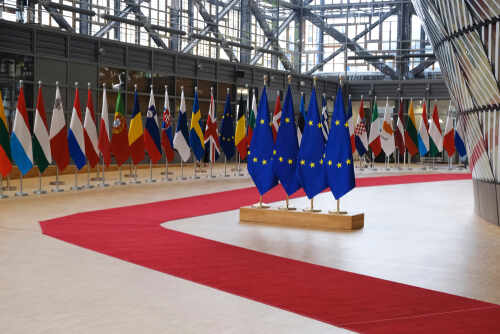
Europe’s leaders arrived in Brussels planning to talk “competitiveness,” but a Ukraine-aid veto and an Iran-war energy shock are now exposing how quickly EU promises can collapse under internal politics.
Story Snapshot
- EU leaders meet March 19, 2026, with the agenda formally centered on competitiveness but dominated by Ukraine funding gridlock and Iran-related energy fears.
- A €90 billion Ukraine loan agreed in late 2025 remains frozen amid veto resistance led by Hungary, with Slovakia.
- Energy prices and supply security have surged up the priority list as fighting tied to Iran raises concerns about key routes like the Strait of Hormuz.
- EU naval deployments to Cyprus followed Iranian drone activity near a UK base, underscoring how fast the crisis moved from distant headline to European security planning.
Summit Agenda Whiplash: Competitiveness Pushed Aside by Crisis
EU heads of government convened in Brussels on March 19 expecting to advance a competitiveness agenda seeded at an informal leaders’ retreat on February 12. That plan is now crowded out by immediate shocks: internal division over support for Ukraine and a rapid energy-price spike linked to the escalating conflict involving Iran. Multiple previews describe the expected summit outcome as uncertain, with officials signaling that conclusions may be vague or limited.
European Council President António Costa framed the meeting around a harsher security environment and the need for defense readiness, while the summit’s guest list signals how wide the discussion has spread. UN Secretary-General António Guterres is slated to join a lunch discussion focused on the Middle East. Separately, economic leaders including ECB President Christine Lagarde and the Eurogroup president are expected to feed into the debate amid renewed inflation anxiety.
Ukraine Aid Stalled: The €90 Billion Loan and the Unanimity Trap
The biggest political snag remains the frozen €90 billion Ukraine loan agreed in December 2025. The package as blocked by veto dynamics that require unanimity, with Hungary’s Viktor Orbán central to the impasse and Slovakia also mentioned as resisting in some accounts. EU officials have publicly emphasized that the issue is not renegotiation but political persuasion, while diplomats discuss workarounds such as more bilateral support.
Energy politics sit directly underneath the Ukraine dispute. EU briefings and pre-summit coverage point to tensions linked to the Druzhba pipeline and broader questions of energy security, a recurring pressure point since the start of the Ukraine war. Ukraine’s side has also warned that the expanding Middle East conflict can divert attention and matériel, raising fears that Russia could exploit the moment with renewed offensives as European unity frays.
Iran War Fallout: Energy Shock, Hormuz Risk, and European Security Moves
The summit is also shaped by events in the Middle East after U.S.-Israeli strikes triggered what multiple outlets describe as a regional war. By March 11, coverage said the conflict had reached day 12, with European leaders voicing frustration and warning of second-order consequences. EU institutions have focused on energy and logistics risks, including how disruption around the Strait of Hormuz could tighten markets and send prices higher.
Security concerns are no longer theoretical. Reports say Iranian drones struck a UK base at Akrotiri on Cyprus, prompting EU naval deployments by multiple member states. That posture signals a desire to protect European interests and stabilize the immediate neighborhood, but officials have also downplayed expectations of sweeping decisions. In pre-summit briefings, Brussels described upcoming discussion on Iran as practical and oriented toward diplomacy and de-escalation, not guaranteed conclusions.
What This Means for Voters Watching From the U.S.
For Americans tracking allied stability under President Trump, the Brussels meeting is a reminder that “global leadership” claims can be undermined by process and politics. The EU’s unanimity rules create openings for single-country vetoes that can stall major security commitments even during wartime. When energy prices spike at the same time, ordinary families feel it first, and governments often respond by talking about subsidies, emergency programs, and spending—policies that can fuel inflation if mismanaged.
What is clear is the convergence of three pressures—Ukraine financing, Iran-linked energy instability, and security readiness—and the EU’s challenge in converting statements into decisive action. The next signals to watch are whether leaders unlock the Ukraine loan, tighten sanctions, or settle for nonbinding language.
LIVE: European Union leaders hold summit for talks on Iran war and Ukraine #AssociatedPress https://t.co/YiQAggRId1
— #TuckFrump (@realTuckFrumper) March 19, 2026
Sources:
Energy, competitiveness, Ukraine and Iran: the EU leaders’ summit is a big question mark
This week: EU summit on Iran war and support for Kyiv, plus Slovenia election and EU-INC top agenda
European Parliament Think Tank briefing (EPRS_BRI(2026)774726)
Orbán’s veto, Iran war and high energy prices set to dominate EU summit (Euronews video)
Iran war enters day 12 as European leaders voice frustration over lack of strategy