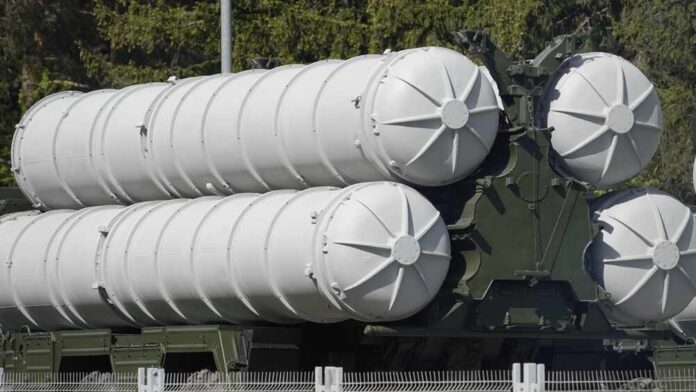
Russia’s new S-500 regiment activation poses a direct challenge to NATO superiority, potentially neutralizing American stealth fighters and satellites in a brewing global standoff.
Story Snapshot
- Russia activated its first S-500 Prometheus regiment on December 18, 2025, capable of striking near-space targets up to 600 km away.
- The system targets fifth-generation aircraft, hypersonic missiles, and low-orbit satellites, escalating tensions with NATO.
- Deployments protect key sites like Moscow, the Urals, Kaliningrad, and the Kerch Bridge amid Ukraine conflict.
- Claims of intercepting Mach 20 hypersonics remain unverified, raising questions on real-world effectiveness against U.S. tech.
S-500 Activation Details
Russian Defense Minister Andrei Belousov announced on December 18, 2025, that the Aerospace Forces formed their first air defense and missile defense division equipped with the S-500 Prometheus system. This regiment entered combat duty, described as a unique capability for striking targets in near space. The system excels against fifth-generation aircraft, low-orbit satellites, ballistic missiles, and hypersonic threats. No specific technical or operational details emerged from the announcement. This move bolsters Russia’s layered defenses amid ongoing Ukraine tensions.
System Capabilities and Superiority
The S-500, or 55R6M Triumfator-M, surpasses the S-400 by targeting exo-atmospheric threats up to 200 km altitude with a 600 km range. It uses 77N6 interceptors for anti-satellite and ballistic roles, while tracking 10 targets simultaneously. Radars like 91N6E(M), 96L6-TsP, 76T6, and 77T6 detect ballistic threats up to 2,000 km. Russian claims include hypersonic interception at 7 km/s, equivalent to Mach 20 speeds. Western analysts note these capabilities challenge NATO air operations, though combat verification lacks.
Development and Deployment History
Almaz-Antey developed the S-500 post-2010 to succeed the S-400, with production delayed from 2014 to first service in 2021 with the 15th Aerospace Army. General Valery Gerasimov stated in January 2025 it neared full readiness. Mid-2025 reports suggested deployments near the Kerch Bridge. By late 2025, limited operational use covered Moscow, Urals, and Kaliningrad regions. The system integrates into Russia’s multi-layered defenses, including S-400 for aircraft and A-235 for Moscow ABM, amid NATO standoffs.
Past precedents include S-400 deployments in Syria drawing NATO sanctions, and sales to India and Turkey. S-500 builds on untested hypersonic intercepts, similar to A-235 satellite demos. Production delays highlight challenges under sanctions, yet Putin-era funding accelerated 2025 rollout.
Russia’s S-500 Air Defense System Claims to Be a Mach 20 Threat to NATOhttps://t.co/4chYErTIAk
— Harry J. Kazianis (@GrecianFormula) March 6, 2026
Strategic Implications for NATO and U.S. Interests
Short-term, the S-500 enhances protection for Crimea and Moscow against Ukrainian and NATO strikes. Long-term, it threatens NATO air superiority, with potential anti-satellite roles escalating space militarization. Deployments near Kaliningrad heighten risks for nearby allies. Under President Trump’s strong defense posture, this Russian advance prompts U.S. countermeasures like F-35 upgrades and hypersonic developments. It strains arms control and accelerates the global ABM race, favoring export to non-NATO states.
Stakeholders like Belousov and Gerasimov drive deterrence narratives, while Almaz-Antey secures contracts. CSIS analyzes radar specs showing 800 km airborne detection. Western skepticism views claims as propaganda, given unproven combat efficacy. With Trump prioritizing American strength, vigilance against such escalations protects U.S. interests and deters aggression.
Sources:
Russia Activates First S-500 Air and Missile Defense Regiment