

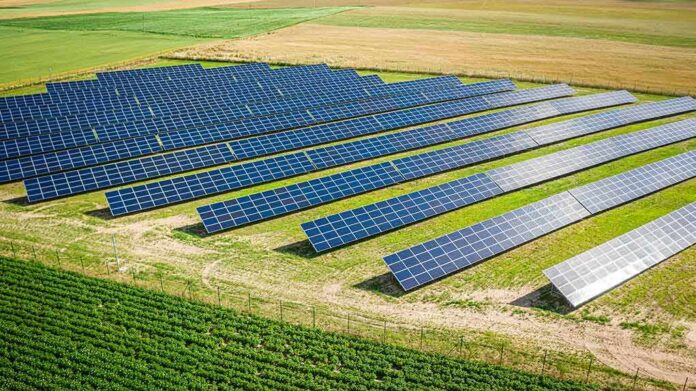
Elon Musk is quietly turning Tesla’s solar business from rooftop panels for families into a giant power engine for artificial intelligence and industrial data centers.
Story Snapshot
- Tesla signed huge long-term deals to buy almost all the output from two utility-scale solar farms in Arizona and Texas to feed growing power-hungry operations.
- Musk is pushing plans for Tesla and SpaceX to manufacture about 100 gigawatts of solar a year, mainly to power AI data centers on Earth and in space.
- Tesla’s shift toward grid-scale solar and storage could reshape who controls energy in America, raising new worries about corporate power over critical infrastructure.
- The strategy may leave everyday homeowners wondering where they fit in Musk’s energy vision, even as AI and big tech soak up more of the nation’s electricity.
Tesla’s New Solar Deals Aim at Industrial Power, Not Homes
Tesla’s latest solar moves are not about putting panels on your roof. They are about locking in massive amounts of electricity for industrial use. Business Insider reports that Tesla agreed to buy nearly all the power from Project Sterling, a large solar and battery storage project in Arizona. The deal covers about 90 percent of the site’s expected output, enough to power around 100,000 homes. Tesla also committed to take the entire output from Zelestra’s Lumen Farm in northeast Texas, a 140 megawatt solar project meant to serve Tesla’s growing energy needs in the state. These long-term contracts make Tesla a major buyer of utility-scale solar power and show that Musk is steering his energy focus toward big loads like factories and data centers rather than just neighborhoods.
For many Americans, this shift taps into a familiar frustration. People on the left and the right already see a federal government that seems unable to keep energy prices low or modernize the grid in a fair way. Now, instead of Washington leading a balanced plan for clean, affordable power, one billionaire is signing deals that can shape how much electricity is left for everyone else. Supporters may cheer any new clean energy. Critics may ask why these choices are driven by corporate AI goals while ordinary families still face high bills and slow rooftop approvals.
Musk’s 100-Gigawatt Solar Goal Tied Directly to AI Growth
Elon Musk has been clear about why he wants so much solar power: artificial intelligence and advanced computing. At the World Economic Forum in Davos, he said Tesla and SpaceX teams are each working to build factories that can produce about 100 gigawatts of solar capacity per year in the United States. He framed this not as a climate project, but as a practical answer to the surge in energy demand from AI and modern infrastructure. Recent reporting describes Tesla hunting for sites in states like Arizona and Idaho to host new solar cell plants, with hiring ramping up to match the plan. In interviews, Musk has argued that solar is “everything” for future energy systems and that other sources are like “a caveman throwing some twigs into the fire,” underscoring just how central solar is to his AI vision. This scale of production would give one private ecosystem enormous influence over both how AI grows and how America powers it.
Many readers will see a deeper pattern here. Both conservatives and liberals complain that powerful interests twist national priorities to serve tech and finance instead of normal citizens. Musk says solar will dominate and help avoid blackouts as AI expands. Yet when a single network of companies controls huge amounts of generation, storage, and computing, it can start to look like a new kind of “deep state” built from corporate boards and engineers rather than elected leaders. People who already worry that elites run the country for their own gain may see these 100 gigawatt plans as one more step toward a system where everyday voters have little say over the energy that keeps their lives running.
From Rooftops to Grid-Scale: What Happens to Homeowners?
Tesla’s current direction is a sharp turn from Musk’s earlier promise of a “solar electric economy” centered on homes. In 2016, Tesla’s bid for SolarCity was sold as a way to build a vertically integrated clean energy company putting panels and batteries on rooftops across America. Over time, however, Tesla Energy has shifted to focus on projects with higher profit margins, such as installations that include its Powerwall and larger grid-facing systems. Analysts now describe Musk’s new solar vision as more tightly linked to storage and utility customers, with solar “joining forces” with battery products to power both consumers and larger energy networks. Tesla is still involved in rooftop solar, but reporting shows the company emphasizing manufacturing scale, big contracts, and utility partnerships over simple household installs. That leaves a real question: in Musk’s world, is your home a priority or just another node feeding power into AI and big industry?
This question matters because people on both sides of politics feel they are being squeezed out of the American Dream. Many conservatives blame past “green” policies for raising energy costs, while many liberals blame corporate profit and weak social protections. Now, Tesla’s pivot risks looking like more of the same: grand plans for AI factories and orbital data centers, but no clear path to cheaper, more reliable power for regular families. When government leaders in both parties seem stuck in gridlock, these choices by the ultra rich can feel like the real energy policy—made without local input or public debate.
Space Solar, AI Data Centers, and Who Controls the Future Grid
Musk’s ambitions extend beyond Earth’s surface. He has talked openly about building solar-powered AI satellites and space-based data centers that avoid land limits and grid bottlenecks. Reports describe filings to launch up to a million satellites that would capture solar power and run advanced computing in orbit, with constant sunlight and no need for large cooling systems. Musk has argued that “space-based AI is clearly the sole method to scale,” suggesting he sees space as the answer to the energy crunch caused by AI on Earth. A project tying SpaceX rockets, Tesla solar manufacturing, and xAI’s computing together would create an integrated machine stretching from American factories to orbital platforms. For citizens already uneasy about how much control Big Tech has over speech, finance, and jobs, the idea of tech-led control over power itself—both on the ground and in space—deepens fears that the future grid will answer more to shareholders than to voters.
At the same time, Musk insists that large-scale solar can bring “abundance,” not scarcity, if fully built out. His supporters say a bold private push can succeed where the federal government has stalled. Skeptics counter that when energy, AI, and even space infrastructure are packed into the hands of a few companies, the risk of abuse grows, especially in a system many already see as captured by elites. Whether you lean right or left, Tesla’s turn from powering homes to powering AI forces a hard question: will this solar revolution serve the people, or mainly the machines and the men who own them?
Sources:
businessinsider.com, cnbc.com, eu.36kr.com, utilitydive.com, bloomberg.com, carboncredits.com, electrek.co, youtube.com, pv-tech.org, latitudemedia.com