A man who reportedly believed he was Jesus Christ was shot and killed by the United States Secret Service after opening fire near a White House security checkpoint — and the full picture of what happened that night is still coming into focus.
Story Snapshot
- The United States Secret Service confirmed a shooting near White House security checkpoint; protectees were safe.
- Early accounts describe multiple weapons and an evacuation of top officials, but some facts remain fluid [2].
- Shot counts, motive, and responsibility for a bystander’s wound are still disputed in contemporaneous reporting [3].
What Officials Confirmed Within Hours
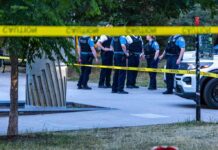
Officials say a shooting erupted near a White House security checkpoint on a Saturday evening, when twenty-one-year-old Maryland resident Nasire Best allegedly pulled a firearm from a bag and opened fire toward officers guarding the area.[3] The exchange took place close to 17th Street and Pennsylvania Avenue Northwest, just outside the main White House grounds. Secret Service officers returned fire, critically wounding Best, who was transported to a hospital and later pronounced dead. A nearby bystander was also injured during the gunfire.
Conflicting Reports And Unresolved Facts
Live coverage and early summaries diverged on crucial specifics, including the number of shots fired and which firearm was used, with some accounts estimating “20 to 30” gunshots while others referenced only a few suspect rounds [3][4][5]. Reporting also noted a bystander was shot, but contemporaneous coverage could not confirm whether the wound came from the suspect or from return fire by the United States Secret Service [3]. These discrepancies remain common in fast-moving security incidents where audio, angles, and stress distort early assessments [3].
Sources identified the suspect as heavily armed and suggested an intent to target multiple Trump administration officials, but the material provided does not include a primary-source affidavit, charging document, or forensic report substantiating motive or target selection. Assertions about intent therefore rest on secondary summaries rather than direct documentary evidence. Without a sworn complaint, surveillance timeline, or ballistic reconstruction, the exact sequence—who fired first, how many shots were discharged, and what the immediate target was—cannot be verified from the current record.
Security Response And The Lockdown’s Broader Meaning
Reports state the United States Secret Service evacuated President Donald Trump, First Lady Melania Trump, Vice President JD Vance, and Cabinet members, while agents ordered those on site to shelter and moved personnel into secure spaces during an observed lockdown posture [3][4][5]. Evacuations at such venues signal the protection detail’s judgment that the risk profile has shifted from routine screening to imminent threat. Given the venue’s density, that decision aligns with established protective protocols designed to favor caution over convenience.
White House Shooting
A gunman opened fire near the White House checkpoint today. The Secret Service quickly neutralized the suspect, who was killed on the spot. One bystander was injured.
The attacker had a history of mental health issues and prior encounters with authorities.… pic.twitter.com/NpevdXZVux
— Adv. Divya Jakhar (@DivyaJakha91339) May 24, 2026
For Americans across the political spectrum, this episode highlights a recurring pattern: initial, fragmentary reports solidify into a narrative before the forensic record is public. Conservatives worry that institutional opacity conceals failures and feeds media sensationalism; liberals worry that threat framing can expand state power without accountability. Both concerns fit here. The remedy is transparency: release the incident timeline, body-camera inventories, ballistic analyses, and the criminal complaint to replace conjecture with verifiable facts [2][3].
Sources:
[2] Web – White House Correspondents’ Association dinner shooting – WHYY
[4] YouTube – White House placed in lockdown after reported gunfire near complex
[5] YouTube – Gunshots heard near White House | 9 News Australia