Lightning does not negotiate distance — a bolt that strikes a neighbor’s yard rather than the person standing in it is not a near-miss in the casual sense; it is a survival event separated from catastrophe by a matter of feet and milliseconds.
At a Glance
- On June 27, Ring doorbell footage captured Florida resident Jessika Gonzalez unloading her car as a lightning bolt struck a tree in her neighbor’s front yard just behind her.
- The strike instantly ignited a fire in the neighbor’s yard; Gonzalez was not injured.
- The footage is consistent with documented patterns of authentic residential lightning captures — and illustrates precisely the kind of outdoor exposure the CDC identifies as high-risk.
- Viral lightning videos occupy a contested space online, where authentic footage is routinely scrutinized alongside a genuine history of misdated and digitally altered clips — though nothing in the available reporting challenges the authenticity of this one.
- The event is a practical case study in why lightning safety protocols emphasize seeking shelter at the first sound of thunder, not the first visible bolt.
What the Footage Shows
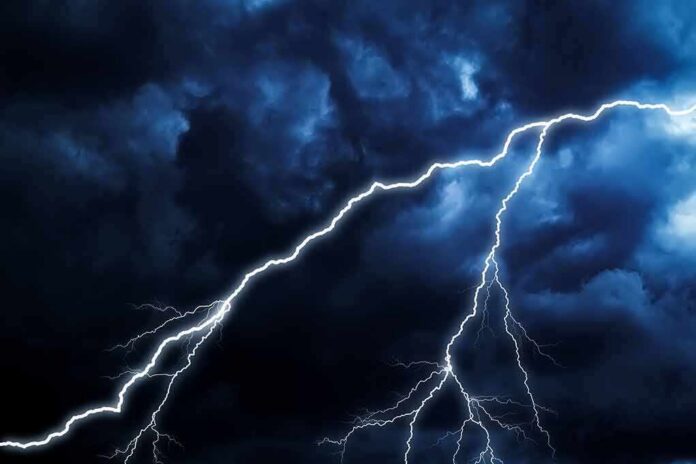
The Ring doorbell camera recorded the sequence with the dispassionate clarity that makes home surveillance footage so useful as evidence. Jessika Gonzalez is visible unloading her car when a series of bright flashes punctuates the sky — the stepped-leader phase of a cloud-to-ground discharge, in which the ionized channel probes downward before the main return stroke blazes upward at roughly one-third the speed of light. Then the bolt connects, striking a tree in the neighbor’s front yard directly behind her. She slams the car door and runs for cover. The fire ignites immediately.
The Independent and the New York Post both reported on the footage, with the Independent specifying that the bolt hit a tree in the neighbor’s front yard. That detail matters: trees are among the most dangerous places to shelter near during a storm precisely because they attract strikes and then conduct energy outward through the root system — ground current that can incapacitate or kill a person standing yards away. Gonzalez’s instinct to run toward an enclosed structure rather than crouch near the car was, by the physics of the situation, the correct one.
Florida’s Lightning Geography: Why This Keeps Happening
Florida is not incidentally prone to lightning; it is the most lightning-struck state in the continental United States, a distinction earned by the collision of Gulf and Atlantic moisture streams over a flat peninsula that heats rapidly each afternoon. The convective storms that result are among the most electrically active on the planet, and they develop with a speed that routinely catches people mid-task — mid-commute, mid-unloading, mid-yard work — before they can seek shelter. Gonzalez’s situation on June 27 was not unusual in Florida terms; it was representative.
The CDC’s lightning safety guidelines are unambiguous on the core principle: if you can hear thunder, you are already within striking range. The guideline’s logic rests on the fact that a cloud-to-ground bolt can travel horizontally several miles from the parent storm cell before connecting with the ground — what meteorologists call a “bolt from the blue,” though the phenomenon is not actually anomalous. Waiting for rain to start, or for the sky to darken overhead, is waiting too long. The standard recommendation is to seek a substantial enclosed structure or a hard-topped vehicle — not a carport, not a tree line — and remain there for at least thirty minutes after the last audible thunder.
The Authenticity Question and Why It Matters
Any viral weather video now enters a verification ecosystem shaped by a genuine history of manipulation. AFP Fact Check documented a widely shared lightning video that had been recirculated with a false date, claiming to show a May 2020 strike in Guangzhou when the footage was actually from months earlier. AccuWeather’s meteorologists have publicly corrected videos that appeared to show direct strikes but actually captured nearby ground current or transformer explosions. The History Channel’s own fact-checking segments have caught CGI-enhanced lightning clips that fooled large audiences before analysis revealed the artifacts.
Against that backdrop, the Gonzalez footage is notably unremarkable in the best sense. It shows a residential doorbell camera angle, the characteristic branched morphology of a real return stroke, an immediate secondary event — the fire — consistent with a tree strike, and a human response that matches the stimulus precisely. Nothing in the available reporting raises an authenticity challenge, and the footage’s behavior aligns with what experts describe as the markers of genuine lightning capture: the bead-out phase of the channel’s decay, the absence of the too-perfect symmetry that CGI tends to produce, and a reaction from the subject that is timed to the actual event rather than to an edited one. The verification gap that does exist — no National Weather Service strike log has been cited, no fire department incident report published — is a gap in documentation, not a gap in credibility. Ring cameras do not manufacture lightning.
Florida Mom Jessika Gonzalez in Kissimmee narrowly avoided injury when a massive lightning bolt struck the neighbor's yard, instantly igniting the grass. Caught on her Ring camera on June 27th, the terrifying footage shows her running inside her garage as sparks fly and her… pic.twitter.com/Ppvv2jWQ0J
— Denn Dunham (@DennD68) July 17, 2026
What a Near-Strike Actually Does to the Human Body
The medical literature on lightning injuries describes a spectrum of injury mechanisms that most people, focused on the dramatic direct-strike scenario, overlook entirely. A direct strike — current traveling through the body from point of contact to ground — is actually the least common mechanism. Far more frequent are side flash (current jumping from a struck object to a nearby person), ground current (energy radiating outward from the strike point through the soil), and contact injury (touching an object that is being struck). At the distances visible in the Gonzalez footage, ground current was the primary threat: the return stroke’s energy disperses radially from the strike point, and a person standing within several meters can receive a potentially lethal dose through their feet even without any direct contact with the bolt channel.
That Gonzalez was not injured is a function of distance, ground composition, footwear, and chance — in roughly that order of influence. The medical consequences of a near-miss at that range can include cardiac arrhythmia from the electromagnetic pulse, temporary paralysis of the limbs (keraunoparalysis, which typically resolves within hours), and blast-related injuries from the explosive expansion of superheated air. The absence of injury here is genuinely fortunate, not merely dramatic.
The Broader Lesson in a Single Frame
What makes footage like this valuable beyond its immediate shock is the concrete illustration it provides of an abstract hazard. Lightning safety messaging has always struggled with the same problem: the threat is statistically real but experientially rare for any individual, which breeds the kind of casual outdoor behavior — finishing the grocery run, completing one more lap of the park — that puts people in exactly Gonzalez’s position. A Ring camera recording a bolt hitting a tree fifteen feet behind someone unpacking her car collapses that abstraction entirely. The gap between routine and catastrophe is visible, measurable, and disturbingly small. That is the image that safety campaigns cannot manufacture and that no amount of statistics can replicate — and it is, in the end, the reason this footage travels.
Sources:
thegatewaypundit.com, newsbreak.com, ftc.gov, cincinnati.com, accuweather.com, youtube.com