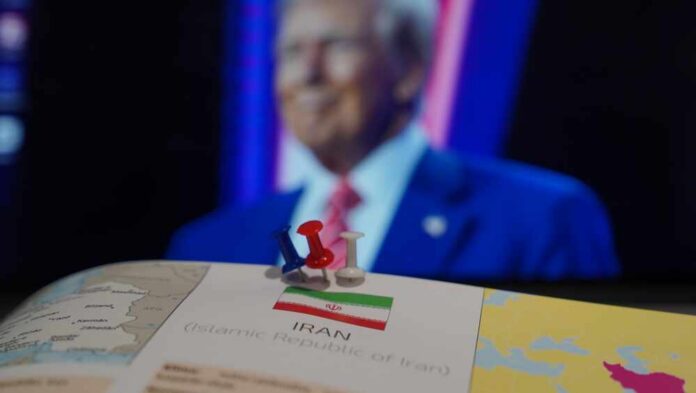
When a president claims Iran “HAS REQUESTED A MEETING” while Tehran swears no talks exist, it confirms what many Americans already fear: powerful people are playing information games while real lives and dollars are on the line.
Story Snapshot
- Trump says Iran requested a meeting and wants a ceasefire, but Iranian leaders flatly deny it.
- Conflicting claims come as a fragile ceasefire and costly war deepen public distrust of Washington and Tehran.
- Fact‑checkers say Trump has a long record of hyping “deals” that never materialize, while Iran calls his claims “fake news” meant to move oil markets.
- The clash shows how both governments control the narrative while ordinary Americans and Iranians pay the price.
Trump’s New Claim: Iran Wants a Meeting and a Deal
On Monday morning, President Donald Trump posted on Truth Social that “IRAN HAS REQUESTED A MEETING” and said it would happen in Doha the next day, tying it to efforts to shore up a shaky ceasefire in the war.[4] Earlier this year, he wrote that the United States and Iran had “very good and productive conversations” about a “complete and total resolution” of hostilities and bragged about postponing new strikes based on those talks.[5][9] Trump has also claimed Iran’s leadership asked for a ceasefire if the United States forces reopen the Strait of Hormuz to global oil trade.[6]
Trump has repeated versions of this story for months. He has said negotiations are underway, that Iran wants “to make a deal,” and that his envoys Jared Kushner and Steve Witkoff have been in direct contact with Iranian figures, working through detailed terms.[6][1] He has talked about a 15‑point framework, pledged that Iran will never have a nuclear weapon under the deal, and insisted documents are in “pretty final shape.”[8] Cable news analysis counted at least 38 times since early April that Trump has said an Iran deal is close, with no public proof that the situation on the ground has changed.[9]
Tehran’s Response: “No Talks, No Ceasefire Request”
Iran’s leadership tells a very different story. The Iranian Foreign Ministry and senior officials have repeatedly said they have not requested talks or a ceasefire and that no direct or indirect negotiations with Washington are taking place.[6][11][14] A ministry spokesperson said “from our side, no request for a meeting has been made,” directly rejecting Trump’s suggestion that Tehran is eager to sit down.[2] Iran’s Parliament Speaker Mohammad Bagher Ghalibaf went further, calling Trump’s negotiation claims “fake news” designed to sway financial and oil markets and insisting “no negotiations have been held.”[7][9]
Iranian state and semi‑official media back up those denials. Reports quote senior security officials saying there are no talks with the United States, even though Iran has received messages through mediators since the war began.[7][9] Tehran has instead pushed its own public counter‑proposal, with strict conditions for any end to the war, including recognition of Iranian control over the Strait of Hormuz and reparations for damage.[13] Iranian leaders also reject Trump’s claim that they accepted broad nuclear inspections or agreed to give up highly enriched uranium on terms he described.[5][4]
Who Is Telling the Truth – and Why It Is So Hard to Know
Independent reporting paints a murkier picture that will feel familiar to many readers who are tired of government spin. Journalists say there have been indirect contacts through countries like Pakistan, Turkey, Egypt, and others, but no confirmed direct meeting between United States and Iranian officials so far.[3] Some of these back‑channel talks focused on short pauses in fighting, not a full peace or formal ceasefire. In other words, there is some movement in the shadows, yet not the direct “productive conversations” Trump loudly described.[3]
Iran just denied they are having any talks with the US and Trump immediately jumps on the internet to claim a meeting is taking place tomorrow. https://t.co/cgnkUkHXL8
— Carolina Lion (@CarolinaLion2) June 29, 2026
At the same time, Trump has a long record of exaggerating progress toward big foreign deals. Fact‑checks on his Iran war comments describe repeated false or misleading claims about Iranian military losses, nuclear progress, and the status of talks.[1][21] Analysts have tracked a broad pattern going back years: Trump often announces that major deals with rivals like Iran or North Korea are almost done, but those agreements either collapse, stall, or look very different from his early promises.[8][9] That history does not prove he is lying this time, but it gives many Americans reason to doubt both his timeline and his certainty.
Market Moves, War Fatigue, and Deep State Suspicions
For many on both the right and the left, this is not just about Iran; it is about trust. Media and market analysts have noted suspicious patterns of large oil trades or short positions that show up right before optimistic White House statements about ceasefires or talks.[3] Iranian officials claim Trump’s comments are timed to calm markets and cover up policy failures.[7][9] At the same time, some American commentators point to these swings as more proof that insiders and global financial players profit from war news long before regular citizens know what is truly happening.[3]
Meanwhile, the war with Iran has cost billions of dollars and American lives, with little to show beyond a fragile ceasefire and rising regional tension.[21] Many conservatives see another expensive foreign entanglement that clashes with “America First” promises. Many liberals see more proof that Washington can always find money for bombing campaigns but not for crumbling schools and health care. Both sides look at this information fog — a president claiming secret progress, an enemy government shouting “fake news,” and media chasing clicks — and feel the same thing: the people at the top are not leveling with them.[20][26]
Why This Fight Over Facts Matters for Ordinary Americans
When two governments offer opposite stories about something as basic as “are we talking or not,” it becomes almost impossible for citizens to judge real risk. Are we closer to peace, or one misstep away from a wider war that sends gas prices soaring and more troops into danger? The answer should not depend on which leader you like more, or which channel you watch. It should come from verifiable actions: signed documents, confirmed meetings, and independent inspections, not just Truth Social posts and angry denials.[4][5][11]
Many Americans, especially those who have lost trust in both parties, see this as one more sign that the system serves itself. Elites hold private talks through back channels while telling different stories in public. Markets jump before the rest of us can react. Fact‑checkers scramble to keep up but cannot see classified cables or secret calls. Until leaders on all sides open the books — on negotiations, on war goals, on who profits from each “breaking news” alert — the gap between official stories and public belief will only grow.
Sources:
[1] Web – Trump Claims Iran ‘HAS REQUESTED A MEETING’ Amid Shaky Ceasefire
[2] Web – Fact-checking statements made by Trump to justify U.S. strikes on Iran
[3] Web – Fact-checking Trump’s interview with NBC News’ ‘Meet the Press’
[4] Web – Trump leaves Situation Room meeting with no update on an Iran deal
[5] Web – US, Iran issue conflicting reports on deal as Trump says no sanction …
[6] YouTube – Iran rejects Trump’s claim it agreed to nuclear inspections
[7] Web – WATCH: Trump claims U.S. and Iran are holding talks, Iran wants ‘to …
[8] Web – Trump says ‘good’ talks ongoing with Iran but offers few details – BBC
[9] YouTube – Trump Claims Iran Secret Deal Exposed In Shocking New Statement
[11] YouTube – Iran Denies Talks with US as Trump Claims Progress
[13] Web – Iran ‘will not negotiate with US’: Top Iranian official – Anadolu …
[14] YouTube – Iran rejects U.S. peace talks proposal, sends counteroffer
[20] YouTube – Iran’s Ghalibaf Says Trump Made Seven False Claims in Nuclear Talks
[21] Web – Trump Is Hiding the Truth About the War in Iran – The New York Times