

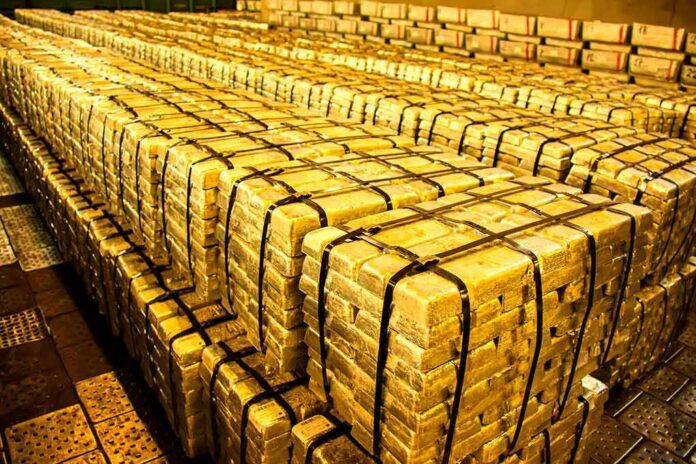
Central banks bought massive amounts of gold even as prices fell, signaling a split between official demand and market mood that could reshape how money and power work worldwide.
Story Highlights
- Global gold demand hit a record in 2025, led by investment and central-bank buying.
- Central banks kept buying at near-record levels into 2026 as prices slipped.
- Banks and the World Bank say pricing moves reflect position unwinds, a strong dollar, and rate fears—not a crisis.
- Evidence of broader financial contagion is limited; key proof points remain unverified.
What the Data Show: Record Demand, Shifting Buyers
The World Gold Council reported that total gold demand reached 5,002 tonnes in 2025, the highest on record. Investment demand jumped 84% to 2,175 tonnes, while central banks added 863 tonnes for the year. Jewelry demand fell, especially in China, which hit its lowest level since 2009, marking a shift from adornment to balance-sheet and portfolio demand. These figures show a clear change in who is buying and why. They do not, by themselves, prove market failure.
World Gold Council updates into 2026 show central-bank demand staying strong. First, net purchases in early 2025 ran above the five-year quarterly pace. Then, 2025 ended with historically high official buying. Reporting in mid-2026 cited second-quarter net purchases near 289 tonnes, far above the prior quarter. This pattern suggests steady diversification by reserve managers. It does not tell us whether those buyers cut dollar assets at the same time.
Why Prices Fell While Buying Stayed Strong
Deutsche Bank Research said price drops reflected margin hikes and the forced unwind of crowded trades. The bank described silver as more fragile, with stretched positioning, and noted tighter physical liquidity as a metal-specific factor—not a system-wide break. The World Bank tied gold’s second-quarter 2026 decline to stronger expectations for interest-rate hikes and a stronger dollar, and framed the year’s moves as a price cycle, not a collapse. Those explanations are testable with trading and macro data.
Another part of the puzzle is how different venues price metal. London’s over-the-counter market deals in physical and unallocated gold, while New York’s exchange trades standardized futures. Spreads can widen when moving metal is hard, costly, or slow. That can create short-term price gaps without implying a market breakdown. Such frictions are common in stress windows. They invite caution before calling a deeper failure.
What This Means for Savers, Workers, and the Dollar System
Persistent central-bank buying tells us large institutions value gold as a hedge and as political risk insurance. That aligns with surveys and academic work that frame gold as a diversifier rather than a magic shield. International Monetary Fund research warns that gold is volatile and offers only conditional safe-haven benefits. Federal Reserve research has also found that many countries diversify reserves without fully abandoning the dollar. These points matter for retirees and taxpayers who hear “crisis” and must separate signal from noise.
Americans across the spectrum worry that the system serves insiders first. Precious-metals swings can feed that fear. When prices fall while officials buy, people suspect hidden games. The hard truth is more mixed. Strong demand can coexist with selloffs when traders unwind bets or when rate paths shift. That is not comforting. But it is a normal feature of markets that move fast and use leverage. It is not proof of a monetary reset.
What Evidence Would Prove a Deeper Breakdown
Claims of a looming reckoning need exchange-level proof. That includes wider bid-ask spreads, failed settlements, delivery defaults, empty inventories, and margin stress at clearing firms. It also includes clear links from gold to bank losses or sovereign stress. The public data so far confirm record demand and strong official buying, plus a mid-2026 price drop. They do not show large-scale contagion into the banking system. The case remains open but unproven.
The Precious Metals Crisis That Could Trigger A Global Financial Reckoning https://t.co/vytr6XCTf2 #Money #Finance #Economics #Market
— Alen Karabegovic (@AlenKarabegovic) October 17, 2026
Here is a fair test for the months ahead. First, verify second-quarter 2026 official purchases directly against the World Gold Council dataset and International Monetary Fund reserve reports. Second, compare reserve data to Treasury holdings to see if gold gains matched dollar cuts. Third, track venue spreads and delivery notices to see if frictions persist. These steps would reveal whether we face normal churn or a deeper shift in the rules of money.
Sources:
china.gold.org, gold.org, reuters.com, zerohedge.com, bfsi.economictimes.indiatimes.com, wealth.db.com, tradingkey.com, metalcharts.org, nextmsc.com