
President Trump marked the public reopening of the Lincoln Memorial Reflecting Pool after months of repairs, capping a project that changed the pool’s look and addressed long-running leaks and algae.
Story Snapshot
- National Park Service repairs led to the pool’s refilling and public access resuming after closures.
- The pool now shows a blue surface and restored reflections of nearby monuments.
- Trump highlighted new pipes, joint fixes, and algae control steps in his remarks.
- Earlier delays, algae blooms, and peeling liner forced extra work and added costs.
What Happened at the Reflecting Pool
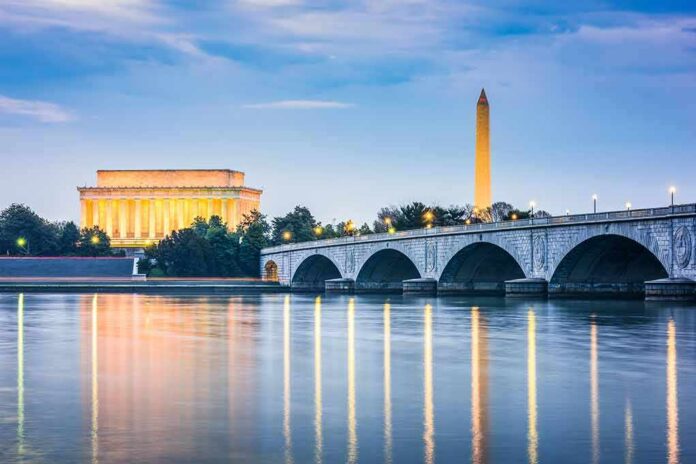
President Trump delivered remarks at the Lincoln Memorial Reflecting Pool as the site reopened to visitors following repair work and refilling. The National Park Service had closed access in April to clean the basin, repair joints, and install lining material. Fencing later came down, and the public could again walk along the water’s edge. The reopening offered a clear view of the pool’s surface and its signature reflection of the Washington Monument after months of disruption.
Trump used his speech to detail the work, describing refurbished pipes, fixes to old joints, and steps aimed at curbing algae growth. Coverage of his remarks noted references to rusty pipes and other aging components. He framed the project as a practical fix to restore both function and appearance. Reporters on site described the pool’s renewed reflective quality after refilling, with visible differences that drew crowds back to the National Mall setting.
What Changed and Why It Matters
Visitors encountered a blue-toned pool surface and a clear mirror effect, which are central to the landmark’s appeal. The visual update followed a National Park Service program that focused on cleaning, lining, and joint repair to reduce leaks and improve water performance. The changes aimed to address problems that had built up over time, including water loss and recurring algae. The restored reflections signaled a return of the pool’s role as a national backdrop for civic life and tourism.
The work fits a familiar pattern: leaders emphasize what people can see on opening day, while engineers track how long systems hold up. The Reflecting Pool has a history of early wins followed by fresh headaches. After past reconstructions, algae and leaks returned soon after reopening. The 2026 push produced a visible reset, but reporting also documented an initial liner failure and algae bloom that required draining and repairs before this public return to form.
Delays, Costs, and a Tight Timeline
Reporting around the event highlighted rough spots that complicated the project’s rollout. Journalists noted schedule slips, extra repair cycles, and costs above early figures, as crews battled algae and peeling sections of the new coating. Those setbacks forced repeat work and another refill of the pool ahead of the public reopening. The scene on the Mall now shows a functioning landmark again, but the earlier disruptions shaped how many observers viewed the final result.
The timing also carried political weight. News outlets framed the remarks as part of Trump’s closing message before the midterm elections, with the Reflecting Pool serving as a symbolic stage. Even so, the core developments remain straightforward: the National Park Service managed a closure, contractors performed repairs, and the pool reopened with a fresh look and restored reflections. Long-term performance, as always with public works, will depend on maintenance and season-to-season operation.
Sources:
youtube.com, transcripts.cnn.com, home.nps.gov, pbs.org, nytimes.com, theolympian.com, cnn.com, sandiegouniontribune.com, inquirer.com