

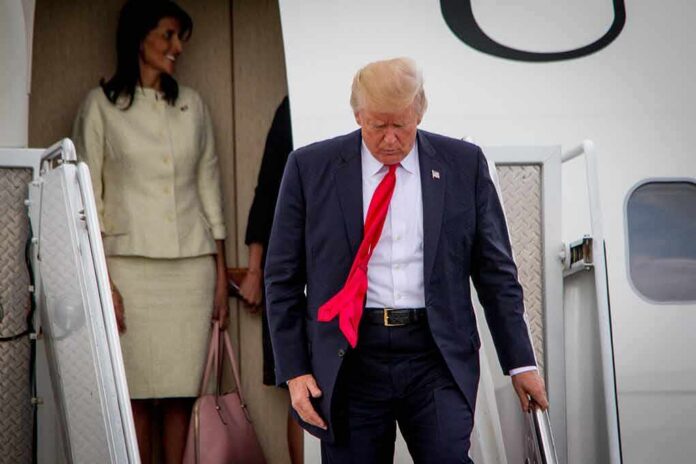
President Trump landed in Manila to launch a rare push for nuclear risk talks that will bring him together with China’s Xi Jinping and Russia’s Vladimir Putin later this week.
Story Snapshot
- Trump began his Asia trip in the Philippines before a first-ever three-leader nuclear discussion in China.
- The White House says Trump will press for reducing nuclear arsenals at the trilateral meeting.
- A senior official cast the summit as an entry point, not a deal-signing session.
- Trump also left open a possible meeting with North Korea’s Kim Jong Un while in China.
Manila Stop Sets Stage for Nuclear-Focused Week
President Trump arrived in the Philippines to attend regional meetings and prepare for a high-stakes visit to China. The administration framed the trip around security and economic talks, with a central goal of opening nuclear risk discussions with Beijing and Moscow later in the week. Officials said Trump would use Manila to consult allies before heading to China’s Asia-Pacific summit, where the three leaders plan their first joint session focused on nuclear issues.
White House aides said Trump aims to lower nuclear dangers and push conversations on limiting arsenals. They described the upcoming session with Xi Jinping and Vladimir Putin as the first such gathering among the three leaders. They also said the meeting is meant to start a process, not finalize a treaty, with risk reduction and future steps on the table. The scheduling places the summit on the sidelines of this week’s events in China.
What the Trilateral Summit Will and Will Not Do
Officials and reports described the meeting as historic, but expectations remain guarded. A senior United States official called it an entry point and warned against expecting an immediate agreement. The three leaders are set to discuss reducing nuclear weapons and other global security threats. Trump’s team linked the talks to broader flashpoints, including the wars in Ukraine and tensions with Iran, which shape nuclear risks even if they are not the core of any first-step plan.
Any path to a formal three-way deal faces a basic gap in arsenals. Analysts estimate the United States and Russia each hold more than 5,000 nuclear warheads, while China holds about 620, and Beijing has long argued that Washington and Moscow should cut further before China accepts limits. That stance makes an early, binding cap unlikely, but it still leaves room for steps like crisis hotlines, test notifications, or norms that slow arms racing, which experts say can start at the leader level.
Possible North Korea Contact and Wider Security Agenda
Trump said he might meet North Korea’s Kim Jong Un while in China, adding that the decision would rest with Xi Jinping. Such a contact, if it happens, would tie Northeast Asia security to the broader nuclear agenda. United States officials also signaled discussions about Iran and the war in Ukraine during the trip, reflecting how regional wars and missile programs raise the chance of miscalculation. Those threads give the summit urgency, even if the first session ends without a written accord.
For Americans worried about rising global risk and distracted leaders, this week offers a test. A face-to-face among the three largest nuclear powers is rare. It can show whether top officials will put safety before politics and business as usual. Many on the right and left doubt Washington’s focus and fear elite drift. Concrete steps to cut danger, even small ones, would mark a win for public safety and a nod to basic responsibility in government.
A historic first trilateral summit between US President Trump, Chinese President Xi, and Russian President Putin at APEC in Shenzhen is overshadowing the Anthropic IPO.#Forex #Trading #Geopolitics #APEC https://t.co/KU3nJRZiS4
— RADEX MARKETS (@RadexMarkets) November 17, 2026
Sources:
redstate.com, afp.com, apnews.com, cnn.com, nbcnews.com, 2news.com, koreaherald.com, aljazeera.com, rocketnews.com