
President Trump told the Attorney General directly, in front of cameras, to seek the death penalty for anyone who murders a firefighter.
Quick Take
- Trump made the demand at a White House Rose Garden lunch on October 15, 2026, naming Attorney General Todd Blanche.
- He said the punishment should apply to anyone who shoots a firefighter “going up a ladder.”
- No written Department of Justice directive, memo, or executive order has surfaced yet to spell out how the policy would work.
- Federal law already limits which murders can even qualify for a death sentence, so the idea faces real legal limits.
- The announcement follows a bipartisan law Trump signed in December expanding benefits for firefighters.
Trump Calls Out His Attorney General By Name
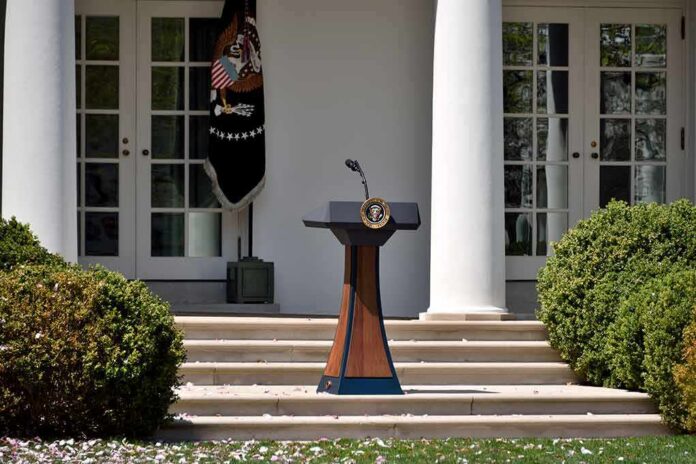
At a Rose Garden luncheon, Trump turned to Attorney General Todd Blanche and said firefighters are too often targeted while doing their jobs. “Anybody that murders a firefighter, going up a ladder, and they shoot him… Death penalty, Todd,” he said, according to a transcript of the event. The comment was public, direct, and aimed at the nation’s top law enforcement official.
Reporters at the event described the remarks as more than a passing comment. Multiple outlets said Trump told the crowd he had already directed the Department of Justice to pursue capital punishment in cases where someone kills a firefighter. He argued the threat of execution would make these shootings stop almost overnight, calling the kind of attack he described an “ancient crime” once the penalty took hold.
What’s Missing From the Record So Far
No signed executive order, Justice Department memo, or Federal Register notice has been found confirming a binding directive. What exists is Trump’s spoken statement and news coverage of it. That does not mean the policy isn’t real. It means the public has only the president’s own words so far, not a formal document laying out how prosecutors should carry it out.
Trump did not say whether the policy would cover every firefighter killing, only killings connected to the job, or attempted murders too. The reporting on his remarks does not clear up that gap. That kind of vagueness matters, because it leaves prosecutors and the public guessing at the actual rules until more guidance appears.
Why Federal Law Limits How Far This Can Go
A president cannot simply order the death penalty into existence for a category of crime. Federal capital punishment requires a specific federal offense, proof the defendant caused the death, and legally defined aggravating factors under the Federal Death Penalty Act. Most firefighter killings happen under state, not federal, jurisdiction, and several states don’t allow the death penalty at all. That means Trump’s directive, even if formalized, could only reach a slice of these cases.
The Justice Department’s own internal rules require federal prosecutors to send death-eligible cases through a centralized review process before deciding whether to seek execution. That system existed long before this announcement and would still apply. A presidential statement does not override it, even when the president names his Attorney General on the spot.
The Deterrence Claim Has No Backing Yet
Trump said the death penalty would make these shootings nearly disappear, but he offered no study, statistic, or data to support that claim. Research from the National Research Council, a panel under the National Academies of Sciences, concluded in 2012 that decades of studies on the death penalty’s deterrent effect were not reliable enough to guide policy. That finding doesn’t prove Trump wrong, but it shows the deterrence argument remains unsettled among researchers who have studied it for years.
🚨 BREAKING NEWS | U.S.
Trump said Thursday he wants the death penalty for anyone who kills a firefighter, directing AG Todd Blanche to have DOJ pursue it. The push extends his call for executing cop killers.
📍 Washington, D.C. | October 2026#USANewsNow #Trump #DeathPenalty pic.twitter.com/W5PPjoAizU— USA News Now (@USANewsNowHQ) October 16, 2026
The announcement also arrives alongside a real, already-signed law helping firefighters. In December 2025, Trump signed the Honoring Our Fallen Heroes Act, which expanded survivor benefits for firefighters who die from job-related cancers. Firefighter groups praised that bipartisan law at the time. The death-penalty proposal adds a harder-edged, more combative tone to what has otherwise been a steady push to support first responders through concrete legislation.
What Happens Next
For now, the proposal sits as a public demand from the president to his Attorney General, not a finished policy. Whether it becomes one depends on steps that haven’t happened yet: a written directive, a mapped-out legal strategy, and actual prosecutors applying it to a real case. Until that paperwork appears, the gap between what Trump said and what the law currently allows remains the central fact of this story.
Sources:
youtube.com, ap7am.com, tommyxtopher.substack.com, iaff.org, usatoday.com, cmsapi.theepochtimes.com, yournews.com, nij.ojp.gov, nap.nationalacademies.org, justice.gov