Washington’s latest move in the Persian Gulf aims to choke off Iran’s economy without choking off the world’s oil.
Quick Take
- The U.S. Navy is enforcing a targeted blockade focused on Iranian ports and coastal waters, not a blanket shutdown of the Strait of Hormuz.
- The distinction matters because the strait carries roughly 20% of global oil, and a full closure could spike prices and destabilize markets.
- President Trump paired the blockade with a short ultimatum and publicly warned of strikes on Iranian infrastructure if the strait is not reopened.
- Iran’s likely pressure point may be asymmetric retaliation, including proxy actions near other chokepoints such as Bab al-Mandeb.
A “blockade of Iran,” not a blockade of the world’s shipping lane
U.S. Central Command has described the operation as a blockade aimed at Iranian ports and traffic tied to Iranian waters, a narrower approach than sealing the Strait of Hormuz itself. That framing is not a semantic game; it is a strategic attempt to isolate Tehran economically while keeping non-Iranian commercial shipping moving. The practical goal is to restrict Iran’s ability to export oil and project leverage without detonating global energy supply chains.
President Donald Trump has publicly tied the operation to a pressure campaign designed to force Iran to back off its control posture in the strait. His warnings have included the possibility of wider maritime interdiction if needed, alongside threats to escalate against Iranian infrastructure if Tehran does not comply. The administration’s bet appears to be that a targeted squeeze can be sustained politically at home while limiting collateral damage that would hit American consumers through higher gasoline and transport costs.
Why the Strait of Hormuz remains the red line for markets
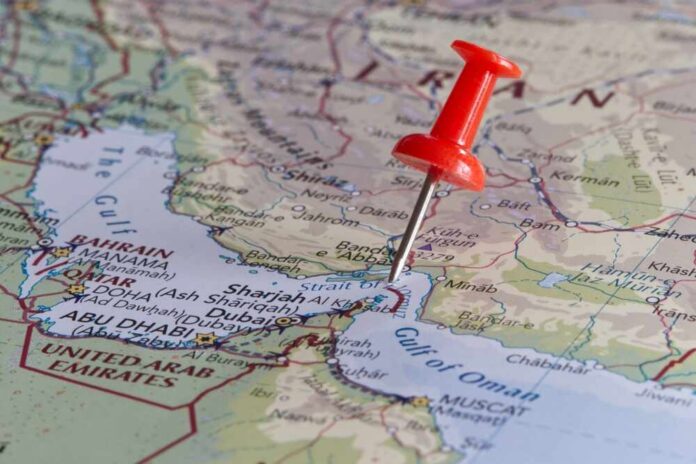
The Strait of Hormuz sits between Iran and Oman and functions as the main maritime gateway from the Persian Gulf to the Gulf of Oman and the Arabian Sea. Estimates cited in the background research place about one-fifth of global oil flows through this corridor, which is exactly why “closing the strait” has long been treated as the nightmare scenario. Even short disruptions can trigger outsized price spikes because traders price risk instantly, not gradually.
The geography also favors disruption tactics that do not require a formal closure. Narrow shipping lanes and the feasibility of rapid mine-laying mean a conflict can cause insurers to raise rates, shippers to hesitate, and navies to shift assets—effects that ripple into prices long before any official blockade is declared. For U.S. planners, that reality explains the emphasis on keeping transit open for non-Iranian traffic while applying concentrated pressure on Iranian routes and facilities connected to Iranian ports.
Legal and strategic fault lines: transit passage versus wartime interdiction
International law debates hover over every move in the strait because the world’s major economies depend on predictable passage. Legal analysis referenced in the research stresses that transit passage through straits used for international navigation is not supposed to be “suspended,” and it argues that Iran has historically lacked legal justification for blocking passage in response to sanctions. At the same time, competing arguments that defensive measures and proportional responses can be framed differently during active hostilities.
For American voters already distrustful of distant conflicts and Washington bureaucracy, the legal fight matters because it shapes whether allies cooperate, whether neutral shippers comply, and whether enforcement escalates into broader war. A targeted blockade focused on Iranian ports rather than shutting the entire strait is more consistent with preserving transit passage for third parties. It also limits the political blowback that would follow if Washington were seen as triggering an energy shock through overreach.
Iran’s likely response: proxies and alternative chokepoints
The concerns that Tehran may look beyond Hormuz for leverage, especially through partners and proxy forces. One focal point is Bab al-Mandeb, a chokepoint at the southern end of the Red Sea that connects toward the Suez route and carries significant energy and trade flows. Analysts cited in the research warn that Iran could encourage proxy actions there or elsewhere in the Gulf region, seeking to raise costs for the U.S. and its partners without meeting U.S. naval power head-on.
The Blockade Isn’t Closing the Strait of Hormuz. It’s Closing Iran. There’s a Difference.https://t.co/PMvV8T19tD
— Harry J. Kazianis (@GrecianFormula) April 14, 2026
That risk puts a premium on clarity and restraint: investors, shippers, and families paying for energy need to know whether Washington’s aim is controlled economic pressure or open-ended escalation. The targeted-blockade concept is designed to keep the global commons functioning while depriving Iran of revenue and bargaining power. How long it can succeed depends on enforcement results, Iran’s willingness to test the perimeter, and whether proxy escalation forces the U.S. into a broader regional containment posture.
Sources:
Transit Passage Rights in the Strait of Hormuz and Iran’s Threats to Block Passage
Gate of Tears risk: Iran threatens major new global chokepoint as US moves in Hormuz