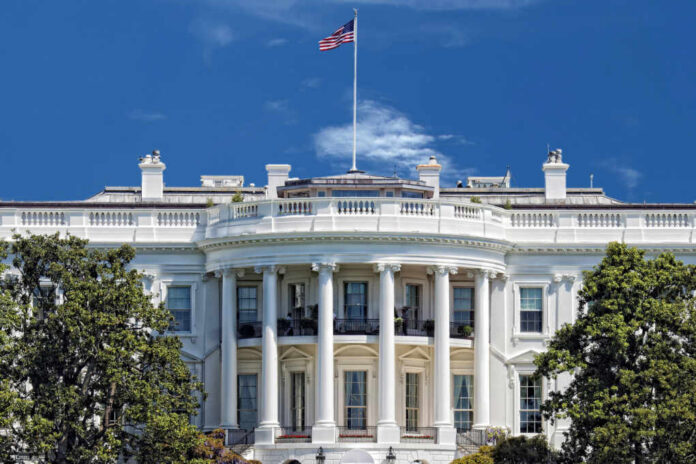
A $400 million “privately funded” White House ballroom is moving forward even as most public comments opposed it—raising hard questions about priorities, transparency, and executive power in a time of war and economic strain.
Quick Take
- The Commission of Fine Arts unanimously approved the White House State Ballroom on Feb. 19, 2026, despite reports that 99% of roughly 2,000 public comments opposed the plan.
- A federal judge rejected a preservation group’s attempt to block construction, limiting legal avenues to slow the project.
- The project cost rose from an early estimate of about $200 million to $400 million, alongside major design and capacity changes.
- The East Wing is being demolished to make way for a large new event space as construction continues into 2028.
Approval Moves Fast as Public Pushback Falls Flat
The Commission of Fine Arts approved the State Ballroom project in February 2026, a milestone that effectively green-lights the design side of a major White House alteration. The commission voted unanimously even though the public feedback it received ran overwhelmingly against the plan. That contrast—formal approval versus public rejection—has fueled criticism from Americans who already feel Washington institutions ignore ordinary voters, especially during a costly overseas conflict.
President Trump’s supporters are not monolithic on this. Some see a larger venue as a practical fix for the tenting and logistical workarounds used for large state events. Others look at the timing—America at war with Iran, voters angry about inflation-era belt-tightening, and energy costs still biting—and ask why the administration is spending political capital on a legacy construction project at all.
What’s Being Built, What’s Being Torn Down, and Why It Matters
The plan replaces the East Wing with a new ballroom structure described in multiple reports as about 22,000 square feet, while other accounts cite a larger overall project footprint—an ambiguity that has added to public skepticism. Capacity projections also changed over time, expanding well beyond today’s constraints, where the East Room’s seated dinners are far smaller. The project has been pitched as modernizing state-function capabilities that have been limited for decades.
Design coverage describes a neoclassical exterior intended to match the White House, while the interior is set to echo features associated with Trump’s Mar-a-Lago style, including coffered ceilings, chandeliers, and patterned flooring. For constitutional-minded conservatives, the aesthetics are secondary to process: opponents argue that even “private” projects at the seat of executive power deserve maximum transparency, because the White House is not a private club—it’s a national symbol.
Cost Escalation, Private Funding, and the Transparency Problem
The budget estimate climbed from roughly $200 million to $300 million and then $400 million as the concept expanded. The administration has said the project is privately funded, which can reduce direct taxpayer exposure. But “privately funded” is not the same thing as “publicly accountable.” Donor identities and the structure of contributions have been only partially disclosed in reporting, leaving citizens to wonder who gains access, influence, or prestige from financing a marquee White House upgrade.
That question lands differently in 2026 than it might have in a calmer era. Many MAGA-aligned voters are now openly suspicious of permanent-war logic and elite dealmaking, especially as the Iran conflict deepens and the grassroots debates how far U.S. commitments should extend—and how closely America’s strategy should be tied to Israel’s regional security concerns. In that climate, any perception of “insider funding” at the White House feeds broader distrust.
The Court Fight Shows How Limited the Checks Can Be
The National Trust for Historic Preservation tried to stop the project in federal court, arguing the process violated federal law and stepped into Congress’s lane. U.S. District Judge Richard Leon rejected the request, finding the challengers were unlikely to win and concluding the White House office involved was not the kind of “agency” covered under the Administrative Procedure Act. The ruling leaves opponents with fewer tools to delay construction through litigation.
The practical consequence is a familiar Washington dynamic: once approvals align and courts decline to intervene, the machinery keeps moving—even when public sentiment is lopsided. Critics say that pattern is exactly what Americans resent after decades of top-down decisions, from globalist trade-offs to open-border policies to interventionist foreign adventures. Supporters counter that presidential facilities must evolve, and that history shows expansions were often unpopular at first.
What Conservatives Should Watch Next
The National Capital Planning Commission was scheduled to discuss the project in early March 2026, and construction is expected to run into summer 2028. The key conservative concern is not whether a ballroom is tasteful, but whether precedent is being set for major executive-branch projects to advance with minimal public leverage—especially when funded by wealthy private interests. In a war footing, voters will also watch whether attention shifts from core priorities: security, energy affordability, and constitutional limits.
Sources:
The White House Announces White House Ballroom Construction to Begin
Judge rejects request to block Trump White House from building its $400 million ballroom project
$400M White House ballroom plan faces public review
Inside President Donald Trump’s White House Ballroom Plans
White House judge rejects attempt to block Trump’s $400m ballroom plans