

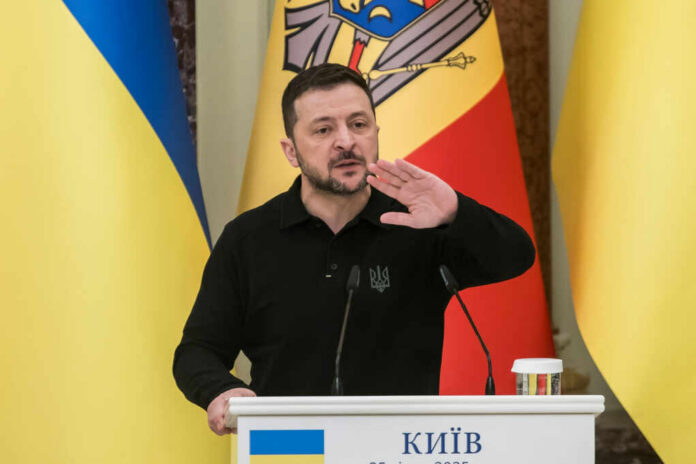
After years of Washington pledges and European “summits,” Ukraine is now racing to field a new anti-missile shield within a year as Russian aerial strikes grind on.
Quick Take
- President Volodymyr Zelensky says Ukraine plans to acquire and deploy an anti-missile system “within a year,” aiming to blunt continued Kremlin air attacks.
- Ukraine is pairing air-defense upgrades with a broader modernization push, including procurement of 25,000 ground robotic systems for frontline use in early 2026.
- Independent conflict analysts describe Ukraine’s battlefield position as “difficult but not critical,” with Russia’s territorial gains reportedly slowing compared with the prior year.
- The plan’s biggest unanswered question remains which specific anti-missile system Ukraine will receive and how quickly partners can deliver it at scale.
Zelensky’s one-year clock on anti-missile defenses
President Volodymyr Zelensky has announced a plan to bolster Ukraine’s air defenses by acquiring and deploying an anti-missile system within a one-year timeline. The announcement lands amid sustained Russian aerial bombardment that has targeted Ukrainian infrastructure throughout the war. The promise is strategically simple: reduce the damage from missiles and drones, protect civilians, and keep industry and logistics functioning under pressure while the broader ground war continues.
The public commitment to a timeline matters because air defense is one of the most resource-intensive forms of modern warfare: interceptors are expensive, radar and command systems are complex, and training plus integration take time. It wasn’t specified which anti-missile system is planned, its technical parameters, or a firm delivery schedule from international partners. That lack of detail is not unusual during wartime, but it limits outside ability to judge feasibility.
Robots, drones, and the shift toward preserving manpower
Ukraine’s air-defense push is not happening in isolation. The defense ministry is also procuring 25,000 ground robotic systems for frontline deployment in the first half of 2026, part of a wider effort to move dangerous tasks away from human soldiers. Defense Minister Mykhailo Fedorov has framed the objective bluntly: make frontline logistics fully robotic. If implemented, that would represent a major doctrinal shift in how Ukraine moves supplies under fire.
Ukraine has also continued to lean on drones for operational reach. Ukrainian drone forces striking Russia’s Black Sea port of Tuapse, hitting an oil refinery and triggering fires. Kyiv has also highlighted battlefield use of robotic systems in a recapture operation involving surrendering Russian troops, described as a first. These underscore a reality that many Americans recognize from other conflicts: technology can offset disadvantages, but it cannot eliminate the need for sustained production and supply.
What the war’s “attrition” phase means for policy—and for taxpayers
Independent assessments characterize the conflict as a prolonged war of attrition, where economics and replacement rates matter as much as headlines. Analysts at the Institute for the Study of War have described Ukraine’s position as “difficult but not critical,” while noting indicators that Russia’s daily territorial gains have declined compared to the prior year. The same analysis points to Russia’s economic strain and personnel losses as constraints that may increasingly shape the trajectory of the war.
For American readers—especially those skeptical of endless overseas commitments—the key question is not whether air defense is useful, but whether strategy and accountability match the scale of spending. Conservatives who watched “nation-building” drift for decades tend to demand clear objectives, measurable results, and oversight. Many liberals who distrust militarized policy still worry about humanitarian impacts. The one area where voters increasingly converge is frustration with government institutions that fund big commitments without transparent metrics.
The unanswered question: which system, whose inventory, and how fast?
Zelensky’s “within a year” pledge places pressure on international partners, because anti-missile systems and interceptors draw from finite inventories. This does not identify the specific system Ukraine expects to field, which partner nation will supply it, or what the sustainment pipeline will look like once missiles start flying. Those details will determine whether the plan becomes a durable shield or a symbolic announcement constrained by production capacity and politics.
In practical terms, air defense modernization also raises familiar governance questions: who controls escalation risks, how rules of engagement are set, and how to ensure procurement is not captured by well-connected contractors. With Republicans controlling Washington in 2026 and Democrats attempting to obstruct Trump’s agenda, Ukraine funding debates are likely to remain politically charged. The most constructive standard—regardless of party—will be insisting on transparency, performance benchmarks, and a defined end-state.