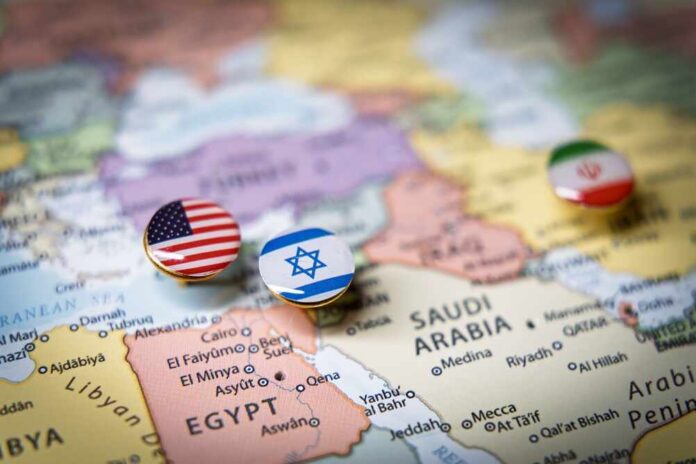
Trump’s own strike video is reigniting a hard question for America First voters: how did “no new wars” turn into another Middle East escalation with a $200 billion price tag?
Quick Take
- President Trump shared video showing major U.S. strikes on Iranian sites, with reporting pointing to attacks in and around Isfahan and other locations.
- Iran’s interim leadership issued an apology to regional neighbors and signaled a halt to further strikes on them unless provoked.
- U.S. actions are happening alongside Israeli operations, with both sides claiming Iran’s missile and drone capacity has been degraded.
- The administration’s mixed messaging—talk of “winding down” paired with reinforcements—has deepened division inside the MAGA coalition.
What Trump Posted—and What the Video Does and Doesn’t Prove
President Donald Trump posted or shared footage on Truth Social depicting large explosions and what supporters describe as U.S. airstrikes against Iranian military sites. The online framing has included claims of an Iranian “ICBM base” in Isfahan, while other coverage highlights strikes across multiple areas in and around Isfahan, plus additional hits in Yazd and on a radar site on Kish Island. The visuals show destruction, but the specific target types are not independently established by the clip alone.
Iranian outlets said the attacks occurred on a Saturday in late March 2026, with video reportedly filmed from inside Isfahan the same day. It places the strike video inside a wider campaign that has been unfolding for weeks, not as a one-off response. What is unclear is a verified battle damage assessment, casualty figures, or confirmation that an “ICBM base” was the primary target rather than conventional missile, air defense, or command facilities.
How the Iran Campaign Escalated Into a Regional Fight
The latest wave of strikes fits into a broader U.S.-Israel air campaign that reportedly began around March 1, 2026, with claims of roughly 2,000 ballistic missile and drone-related aimpoints hit in the early phase. It also states Supreme Leader Ali Khamenei was killed in initial strikes, an event that would represent a dramatic escalation and a likely driver of Tehran’s retaliatory posture. Iran responded with missile attacks reaching beyond Israel to multiple Gulf neighbors, expanding the risk of a wider regional war.
Follow-on operations included a strike on Iran’s Natanz nuclear facility on March 21, saying no radiation leak was detected. At the same time, some described extensive Iranian naval losses, including claims that all 32 ships were sunk. Those kinds of battlefield claims often require later verification, but the combined picture is consistent on one point: Washington and Jerusalem are attempting to degrade Iran’s ability to launch missiles and drones while pressuring Tehran’s leadership structure during a succession crisis.
Iran’s Apology, Leadership Vacuum, and the Danger of Miscalculation
Iranian President Masoud Pezeshkian publicly apologized to neighboring states after Iranian missiles struck across the Gulf. Reports also say a temporary leadership council instructed Iran’s armed forces to halt further strikes on neighbors unless provoked. That apology suggests Iran is trying to contain blowback and prevent a unified regional front. At the same time, the leadership vacuum and internal pressure to choose a new supreme leader raise the odds of miscalculation.
Trump’s public messaging has leaned heavily on victory language, including statements implying Iran has “surrendered” and warnings of new targets for “bad behavior.” Those cross-currents matter for deterrence, because adversaries and allies both watch whether U.S. commitments are limited, open-ended, or subject to rapid change.
MAGA’s Split: Supporting Strength Without Signing Up for Another Forever War
The internal divide among Trump-supporting voters is driven less by sympathy for Tehran and more by fatigue with open-ended interventions and domestic costs. U.S. sent 2,500 Marines and three warships, while Trump asked Congress for $200 billion tied to the conflict. For conservatives already angry about inflation, high energy prices, and years of Washington overspending, that number lands like a warning sign. Many voters want America to project strength, but not to absorb another decade of chaos.
Sources:
https://www.iranintl.com/en/202603075387
https://www.foxnews.com/live-news/us-iran-israel-war-latest-march-6