
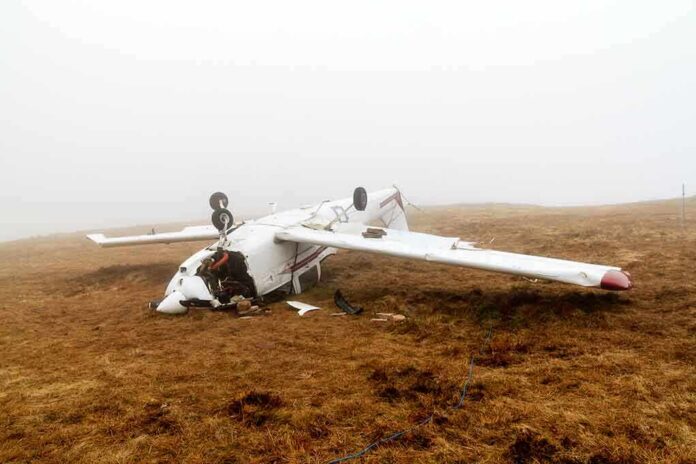
A Cessna 210 crashed one minute after takeoff in central Mexico, killing both people on board, according to aviation officials.
Story Snapshot
- Mexico’s aviation authority reported two deaths after a Cessna 210 crashed near Pachuca.
- The plane went down roughly 500 meters from the runway during initial climb, then burned.
- Multiple outlets named the pilot and co-pilot; some early reports called the IDs preliminary.
- Investigators opened a probe; the cause of the crash has not yet been determined.
What Authorities Confirmed About the Crash
Mexico’s civil aviation authority said a Cessna 210 with registration XB-AZG crashed shortly after departing Juan Guillermo Villasana Airport in Pachuca on November 2, 2026. Officials said the aircraft lifted off at 9:30 a.m. local time bound for Cuernavaca and went down at about 9:31 a.m., roughly 500 meters from Runway 21, during initial climb. The agency reported that both people aboard died in the crash, and it opened a formal investigation into the accident’s cause.
Local and national outlets reported that state authorities identified the dead as pilot Moisés González Meléndez and co-pilot José Jaime Jarquín Ramos. Reporters described fire crews putting out flames and finding two deceased crew members inside the wreckage. These accounts aligned on the aircraft type, the quick timeline after takeoff, and the toll of two fatalities with no additional occupants reported at the scene.
Identities Reported and How Confident They Are
Several independent reports matched on the same names and roles for the two victims, citing government sources in Hidalgo and other officials. These outlets described González Meléndez as the pilot and Jarquín Ramos as the co-pilot, and they stated that both were the only occupants. Some early coverage said the identifications were preliminary or not yet officially confirmed, signaling a normal step before forensic confirmation. Later coverage still pointed to authorities as the source of the names.
That pattern reflects how victim identification often works after aviation crashes. Local authorities may release names based on documents or on-scene information, while medical examiners or coroners later confirm identities through forensic methods. In the United States, the National Transportation Safety Board explains that coroners handle identification and death certification, and a preliminary report with early facts usually arrives within weeks. The same basic sequence is common in other countries’ investigations.
What We Know About the Flight Path and Conditions
Reports place the crash near the Venta Prieta area of Pachuca, close to commercial stores and a major road, after a very brief climb-out. The aircraft’s departure for Cuernavaca suggests a relatively short cross-country route within central Mexico. The airframe, a Cessna 210, is a single-engine, high-performance aircraft known for speed and range in general aviation. The quick loss after liftoff points investigators toward takeoff performance, engine power, weight and balance, or control issues, but officials have not cited a cause.
Small Plane Crashes and Bursts into Flames Near Sam’s Club in Mexico
A small Cessna aircraft went down on a major road in the El Tezontle neighborhood of Pachuca, Mexico, close to a Sam’s Club and just meters from a military zone.
The plane crashed and caught fire. Preliminary… pic.twitter.com/lGW8mPW3Ey
— mahmoud khalil (@sahel2212) November 3, 2026
Officials have not released cockpit records, maintenance logs, or air traffic control audio tied to the event. Without those materials, investigators typically gather witness accounts, inspect the engine and flight controls, and review pilot qualifications and recent flying. That process helps separate three key questions: who was aboard, who was flying, and what mechanical or human factors led to the crash. Authorities said the probe is underway, and they will issue findings when ready.
Why This Matters Beyond One Crash
Early clarity on facts builds trust when videos of graphic crashes spread fast online. When authorities share concrete details quickly—time of departure, distance from the runway, aircraft identity, and the number of victims—it counters rumor and helps families and the public. Aviation agencies often balance speed with accuracy, which is why some names appear first as preliminary and later as confirmed after forensic checks. That careful pace protects both truth and dignity.
What to Watch Next
Watch for authorities to release a preliminary accident summary with basic facts drawn from the scene. Look for official confirmation of the victims’ identities from the responsible medical authority. Expect updates on engine teardown results, control continuity checks, and any alerts about maintenance or pilot factors. Until then, the most reliable information remains the official notice reporting the two deaths, the aircraft registration, the short timeline, and the start of a full investigation.
Sources:
youtube.com, periodicocorreo.com.mx, riodoce.mx, nortedigital.mx