When Guatemala’s “Volcano of Fire” roars to life, it is a harsh reminder of how quickly nature can threaten ordinary people while governments everywhere struggle to keep citizens safe.
Story Snapshot
- Guatemala declared a national “danger” (orange) alert after a strong eruption at the Fuego volcano.
- Authorities began evacuating nearby hamlets, closed roads, and suspended classes to protect families.
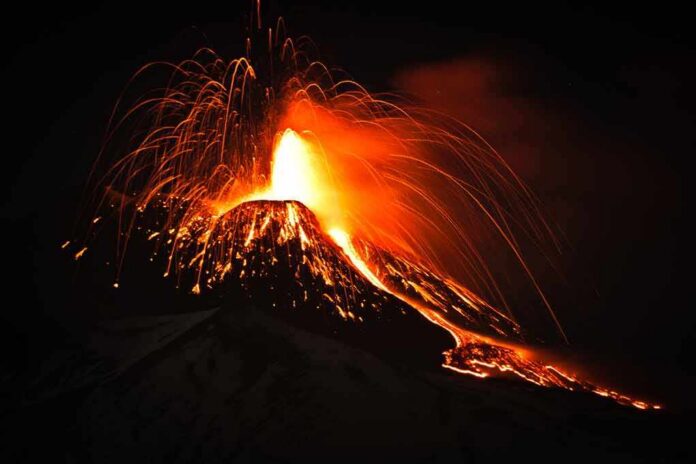
- The eruption sent lava, hot gases, and ash plumes high into the sky near the capital city.
- Past deadly eruptions at Fuego show why officials act fast, even as trust in government is weak worldwide.
What Guatemalan officials say is happening at Fuego
Guatemala’s disaster agency, the National Coordinator for Disaster Reduction, announced a national “danger” alert after the Fuego volcano entered a powerful eruptive phase about 35 kilometers from Guatemala City. Officials reported that the volcano was throwing out lava, huge columns of gas, and thick ash plumes, creating real risk for nearby communities and travelers. Early Monday night, authorities began evacuating at least two neighboring hamlets and warned more residents to be ready to move if the eruption worsened.
Local reports describe a mix of hot gases, ash, and volcanic debris moving away from the crater, the kind of activity that can turn deadly if flows reach villages on the volcano’s slopes. Guatemala uses a four-color alert scale; orange means a stronger eruption appears likely and an “active danger zone” has been defined. At this level, tour operations pause, emergency protocols kick in, and officials may order precautionary evacuations on the south and southeast flanks where the risk is highest.
What the ‘danger’ alert and evacuations really mean
In Guatemala’s alert system, green is normal, yellow is elevated unrest, orange is active danger, and red is full emergency with a major eruption underway. The current “danger” or orange alert sits just one step below red, which would trigger mandatory evacuations in all designated zones and complete closure of access to the volcano area. Under orange, the disaster agency can close roads, limit access to other nearby volcanoes, and suspend classes in towns that may be hit by ash or falling rocks.
Officials have already closed at least one key road that links southern Guatemala to the historic city of Antigua, a major tourist site, and suspended classes in local schools. During earlier recent eruptions, the government evacuated more than 500 people and directed them to four shelters, after lava and pyroclastic flows—fast-moving clouds of hot gas and rock—reached up to seven kilometers from the summit. That same pattern is now repeating: orange alerts, road closures, and preventive evacuations aimed at getting families out before flows reach their homes.
Why this volcano worries experts — and why trust is hard
The Fuego volcano is one of the most active in Central America and has a deadly history. In 2018, its most violent eruption in a century killed at least 62 people, with many more missing and thousands evacuated, after sudden pyroclastic flows swept through nearby communities. That disaster still shapes how Guatemalan agencies respond today: when they see stronger eruptions and ash plumes, they move fast, because waiting for perfect data can cost lives.
Experts say most danger lies on the south and southeast flanks of Fuego below about 2,500 meters, where villages sit along ravines that channel lava and hot flows. Orange-level activity is uncommon and usually lasts only a few days, but during those days risk is real for people who live or work close to the mountain. Ash plumes can also harm farmers’ crops, contaminate water, and disrupt air travel, which is why the United States Embassy has warned travelers to expect delays and monitor local alerts during recent eruptions.
Lessons for a world losing patience with its leaders
Many Americans watching this story see a familiar pattern: ordinary people face danger while they hope their leaders are competent, honest, and focused on safety rather than politics or profit. In Guatemala, the same distrust exists, yet when a volcano erupts, citizens must still rely on national agencies to sound the alarm, close roads, and organize shelters. No private group can map ash plumes or track lava flows on its own; that needs real equipment and clear public warnings.
🇬🇹🌋 Guatemala's Fuego volcano has entered an intense eruptive phase, and authorities (CONRED) declared a national "orange alert" — a "danger" level, the second-highest — with preventive evacuations underway. Residents of two villages (El Porvenir and Las Lajitas) are being moved… pic.twitter.com/t6XsafAYyk
— 🔥🗞The Informant (@theinformant_x) August 4, 2026
For conservatives and liberals in the United States who agree the federal government is often slow, wasteful, or captured by elites, Fuego’s eruption is a reminder of something else: some threats are bigger than party fights. When nature moves, you need systems that work, not slogans. Guatemala’s rapid “danger” alert, evacuations, and school closures show how a government can act decisively when lives are on the line. The challenge—in Guatemala and here at home—is making sure that same urgency exists for the everyday crises that keep people from reaching the American Dream.
Sources:
insiderpaper.com, aljazeera.com, gt.usembassy.gov, volcano.si.edu, reliefweb.int, youtube.com, ktla.com, euronews.com