
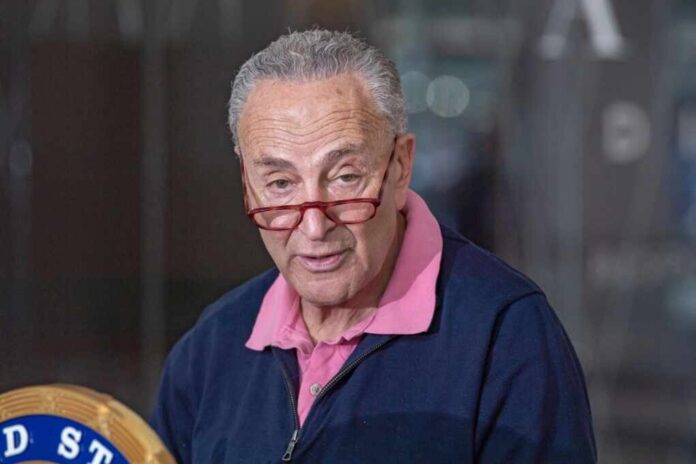
Thirteen consecutive Democrat blockades threaten to grind the federal government to a halt, exposing the cost of gridlock and the consequences of refusing to secure the border or rein in reckless spending.
Story Snapshot
- Democrats in the Senate have blocked government funding bills 13 times in 2025, risking a full government shutdown.
- The standoff centers on conservative policy riders for border security, abortion restrictions, and climate funding cuts—priorities House Republicans say Americans voted for.
- Repeated blockades have triggered economic uncertainty, threatened vital services, and fueled public frustration with Washington dysfunction.
Democrats’ Blockade Pushes Government Toward Shutdown
Senate Democrats, led by Chuck Schumer, have blocked a government funding bill for the thirteenth time in 2025, prompting urgent warnings from federal agencies and watchdogs as a shutdown looms. House Republicans passed a funding package including policy riders on border security, abortion, and climate funding, which Democrats refuse to consider. This unprecedented frequency of blockages—thirteen in a single fiscal year—underscores deep partisan divisions and the Senate’s power to stall bills through filibuster and procedural votes. The result is a government on the brink, with negotiations stalled and both parties blaming each other for the impasse.
Republican leaders have argued that their riders—like tighter border controls and fiscal restraints—are not only campaign promises but necessary to restore order after years of open borders, overspending, and progressive social engineering. Democrats, meanwhile, insist on “clean” funding bills with no conservative amendments, even as public opinion polls show Americans are increasingly frustrated by congressional gridlock and worried about the tangible impacts of a shutdown. With federal agencies preparing contingency plans, the threat to national services grows more severe by the day.
Nearly every Democrat voted for Continuing Resolutions *13 TIMES* under Biden — typically routine, bipartisan mechanisms to keep government open as Congress works on final budgets.
Except this time. Radical Left Democrats shut it all down over free health care for illegals. pic.twitter.com/omu5r0R0ao
— Rapid Response 47 (@RapidResponse47) October 2, 2025
Policy Riders Reflect Core Conservative Priorities
The current standoff is rooted in House Republican demands to attach policy riders to the funding bill that reflect longstanding conservative priorities. Chief among them are stronger border security provisions to address illegal immigration, abortion restrictions to protect the unborn, and cuts to climate change funding that many see as wasteful government overreach. These riders are viewed by Republican lawmakers as a direct response to the left’s previous “woke” and globalist policies, which contributed to fiscal mismanagement and undermined family values during the Biden years. Democrats’ blanket refusal to negotiate on these issues highlights a growing rift over what constitutes responsible governance.
Democrats’ opposition is driven by progressive advocacy groups and a determination to block any rollback of left-leaning gains made in recent years. Their insistence on clean bills, even in the face of repeated public dissatisfaction and economic risk, has become a lightning rod for conservative criticism. The result is a legislative stalemate, with the filibuster rules giving the Senate minority power to obstruct even widely supported reforms, and the House majority unable to advance its agenda without compromise.
Economic and Social Fallout Mounts as Shutdown Nears
Beyond the political theatrics, the real-world impacts of these repeated blockades are severe. Federal employees face imminent furloughs, while public services like national parks, passport processing, and social safety net programs stand to be disrupted. The Congressional Budget Office estimates the economic cost of a shutdown at $1.5 billion per week, not counting the indirect damage to business confidence and contractor operations. For ordinary Americans, the consequences include delayed paychecks, suspended benefits, and a sense that Washington is failing its most basic responsibilities.
As election-year pressures intensify, both parties are positioning for the 2026 midterms. Democrats accuse Republicans of “hostage-taking” over policy riders, while Republicans highlight Democratic obstructionism as a threat to constitutional order, border security, and fiscal discipline. Political scientists note that thirteen consecutive funding blockages are historically rare, and that repeated shutdown threats erode both public trust and America’s global reputation. The standoff has become a referendum on government accountability and the direction of national priorities.
Industry analysts from respected institutions such as Brookings and Heritage agree that this gridlock reflects deeper institutional dysfunction. While progressive groups blame Republicans, conservative organizations argue that policy riders are essential for restoring fiscal discipline and protecting American values. The economic toll, rising public frustration, and risk to national stability are all direct consequences of a political class more interested in scoring points than serving the people. If this standoff continues, millions of families and businesses will pay the price for Washington’s failure to act.
Sources:
President Trump Marks Six Months in Office with Historic Successes
Trump Administration Accomplishments – McLean County Republicans
Celebrating Big Wins of the Trump Administration – HHS.gov
Trump’s 2025 Executive Orders – Holland & Knight
First 100 days of the second Trump presidency – Wikipedia
Presidential Actions – The White House
Project 2025 Executive Action Tracker – Center for Progressive Reform