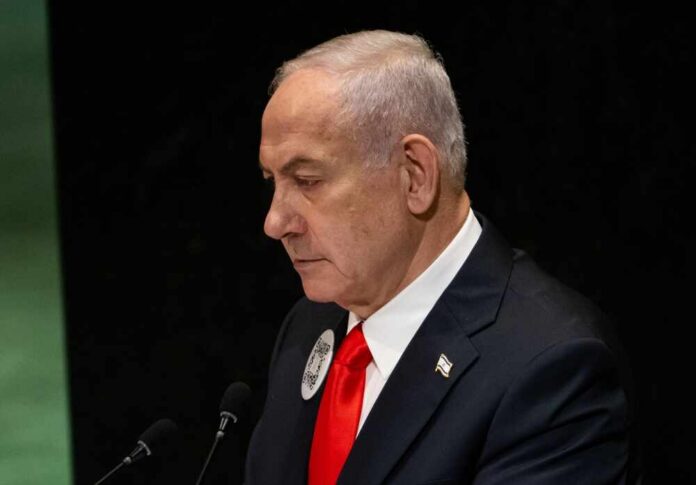
Even a wartime health update can become a weapon—so Israel’s prime minister says he waited to reveal a cancer diagnosis until it couldn’t be spun by Tehran.
Quick Take
- Israel’s Prime Minister Benjamin Netanyahu disclosed he was diagnosed with early-stage prostate cancer and has been declared cancer-free.
- The cancer was found after follow-up imaging tied to a December 2024 procedure for an enlarged prostate at Hadassah Medical Center in Jerusalem.
- His office’s annual health report said the malignancy was small, localized, and fully eradicated after targeted radiation treatment.
- Netanyahu said he delayed disclosure for roughly two months to avoid Iran using it for propaganda during an ongoing war.
What Netanyahu Disclosed—and Why the Timing Matters
Israeli Prime Minister Benjamin Netanyahu, 76, announced on April 24, 2026, that he had been diagnosed with early-stage prostate cancer and has since been declared cancer-free. The disclosure came through the prime minister’s annual health report and a public statement in which Netanyahu said he is “healthy” and in “excellent physical condition.” Netanyahu said he held back the information for about two months, arguing that releasing it during the peak of fighting would invite exploitation by Iran.
In most democracies, voters expect transparency about a leader’s health, especially in wartime. Netanyahu’s explanation frames the disclosure as a national-security judgment: limit information that an adversary could twist to undermine morale, sow doubt about continuity of government, or fuel disinformation. It does not indicate any operational gap in leadership connected to the condition, because the diagnosis and treatment occurred well before the public announcement and the follow-up tests reportedly showed no remaining disease.
How a Routine Procedure Led to an Early Cancer Find
Netanyahu’s office said the sequence began with surgery on December 29, 2024, to treat benign prostatic hyperplasia—an enlarged prostate—at Hadassah Medical Center in Jerusalem. The procedure was reported as successful and without complications. During routine follow-up afterward, an MRI detected a suspicious lesion described in reports as very small, and subsequent testing identified it as early-stage prostate cancer. The health report said there was no evidence the cancer had spread.
The medical details are unusually specific for a head of government, naming clinicians involved in treatment and describing post-treatment results. The reported lesion size varies slightly across outlets—described as less than one centimeter in some accounts and less than one millimeter in another—yet the accounts align on the key point: the malignancy was localized and caught early during monitoring. With early detection, the immediate policy concern becomes less about incapacity and more about how, when, and why the government communicates medical information to the public.
Treatment and the “Cancer-Free” Determination
According to the Israeli reporting on the annual health report, Netanyahu received radiation therapy at Hadassah’s Sharret Institute and the treatment was described as fully successful. His medical team reportedly included Prof. Aharon Popovzer, Dr. Mark Wigoda, and Dr. Shraga Gors. Follow-up imaging and tests were said to show the lesion had completely disappeared, leading the report to describe him as having a clean bill of health and no trace of the cancer remaining.
Because the available sources do not provide a precise date for the radiation therapy, the public timeline is incomplete on that point. What is clear is that the office report was dated April 20, 2026, and released publicly on April 24. By the time of release, the treatment was already in the rearview mirror, and Netanyahu’s public message emphasized fitness for duty. For allies and adversaries alike, the most consequential fact is that Israel signaled continuity: the prime minister remains active, and the government says his condition is resolved.
Transparency vs. Security in a Disinformation Era
Netanyahu’s decision to delay disclosure highlights a broader challenge facing Western governments: open societies must balance voters’ legitimate demand for transparency with the reality that hostile regimes and online networks rapidly weaponize personal information. Netanyahu argued that the “Iranian terror regime” would use the news for “false propaganda.” The reporting provided does not independently verify specific Iranian propaganda plans, but it does document Netanyahu’s stated rationale for withholding the information during wartime.
For Americans watching from afar—especially those already skeptical of “narrative management” by political elites—the episode lands in familiar territory. Leaders routinely ask citizens to trust that withheld information is for the public good. That trust is earned by consistency, clear standards, and verifiable updates. In this case, the record shows Israel eventually released an official health report with concrete medical claims and an unambiguous conclusion: the cancer was found early, treated, and eradicated, and Netanyahu says he is in excellent condition.
The political takeaway is less about one leader’s private diagnosis and more about the incentives created by constant information warfare. When adversaries exploit every signal of weakness, governments may delay disclosures, opponents may suspect a cover-up, and citizens can end up trusting nobody. The available evidence supports that Netanyahu had an early-stage diagnosis and successful treatment; it also shows the disclosure was strategically timed. Whether that timing was justified remains a governance question—one that democratic systems must keep revisiting as propaganda and social media accelerate.
Sources:
Netanyahu reveals he was treated for early-stage prostate cancer, is now cancer-free
Netanyahu says he had early-stage prostate cancer and delayed disclosure to avoid Iran propaganda