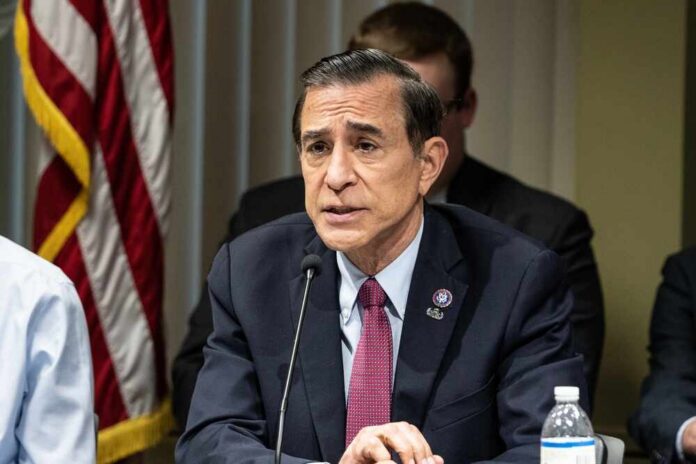
California’s latest Democrat‑engineered redistricting has now claimed one of the GOP’s toughest watchdogs, pushing Rep. Darrell Issa into retirement and leaving another key House seat exposed.
Story Snapshot
- Darrell Issa will retire after 2026, only months after vowing he was “not quitting” on California.
- His exit turns a gerrymandered 48th District into an open seat Democrats are eager to flip.
- California’s Proposition 50 map is helping Democrats force seasoned Republicans off the field.
- Issa’s departure weakens GOP oversight power and raises risks for the already narrow House majority.
Issa’s Reversal From “Not Quitting” To Retirement
Rep. Darrell Issa built his reputation as a fighter, telling conservatives early in 2026 that he would stay put in California, “hold this seat,” and was not quitting on his home state despite a hostile new congressional map. Months later, he announced he will retire at the end of his term and not seek reelection, a sharp reversal that stunned many supporters. The sequence underscores how aggressively California Democrats have tilted once-competitive districts against Republicans.
Issa’s announcement places his 48th District squarely in the crosshairs for Democrats, who have been steadily tightening their grip on California’s House delegation. For years, Issa’s personal wealth, name recognition, and record as a tenacious investigator helped keep GOP hopes alive in a state trending deep blue. His departure now removes that protective umbrella, leaving grassroots conservatives to wonder how many more experienced voices will be sidelined by engineered maps rather than honest debates at the ballot box.
How Proposition 50 Re‑Drew The Battlefield
The immediate backdrop to Issa’s decision is Proposition 50, a statewide measure approved in 2025 that reshaped California’s congressional lines in ways Republicans describe as a “historically corrupt gerrymander.” Under the new map, Issa’s once-manageable 48th District was reconfigured to lean much more Democratic, dramatically raising the cost and risk of another campaign. For conservatives, the episode is a textbook example of political cartography being used to silence dissenting voices rather than persuade voters on ideas and results.
Republicans argued from the start that Proposition 50 was less about fair representation and more about locking in progressive dominance for a generation. By corralling GOP voters into fewer, more lopsided districts and diluting others with urban liberal strongholds, Democrat strategists effectively turned senior Republicans like Issa into targets of structural elimination. Instead of losing on policy, Democrats are rewriting the game board, leaving many right-leaning Californians feeling that their votes count less every time Sacramento redraws the lines.
Texas Talk, National Stakes, And A Thin GOP Majority
As California’s new map took shape, some Texas Republicans floated an alternative: encourage Issa to run in a Lone Star district where his experience and fundraising prowess could bolster the party. Issa acknowledged considering Texas’s 32nd District, but publicly emphasized that California was his home and insisted he would stay in Congress from there. That alternative path was complicated when a federal court blocked Texas’s redistricting plan for 2026, closing off what might have been a softer landing for a veteran lawmaker.
Issa’s final choice to step aside comes as Republicans hold only a slim House majority and face a treacherous 2026 battlefield. Every open seat in a Democrat-leaning district becomes another pressure point that can flip control of the chamber and stall the conservative agenda President Trump is trying to advance. For readers who watched Democrats weaponize process during the Mueller years and the first Trump term, this pattern feels familiar: when they cannot win cleanly on ideas, they change rules, redraw lines, and rely on courts to secure the power they could not earn outright.
What Issa’s Exit Means For Oversight And Conservative Voters
Issa is not just another backbencher; he spent years chairing the House Oversight and Government Reform Committee and became one of the most visible Republican investigators of Obama‑era scandals. His retirement removes a seasoned hand who knows how to follow paper trails, grill witnesses, and keep bureaucrats nervous. As the second Trump administration confronts entrenched agencies over border security, spending, and lawfare, losing that institutional memory weakens conservatives’ ability to police the permanent government and defend constitutional limits.
For constituents in San Diego and Riverside counties, Issa’s departure means an open race in a district now tilted left, with Democrats eyeing a pickup that would further erode California’s already thin Republican bench. For conservatives nationwide, it is another reminder that the fight for the House is not just about turning out voters; it is about confronting the structural games being played with district lines, defending genuine representation, and recruiting new candidates willing to stand where Issa once did and refuse to let one‑party rule go unchallenged.
Sources:
Another lawmaker from California isn’t seeking re-election
California GOP Rep makes re-election decision after considering running in Texas