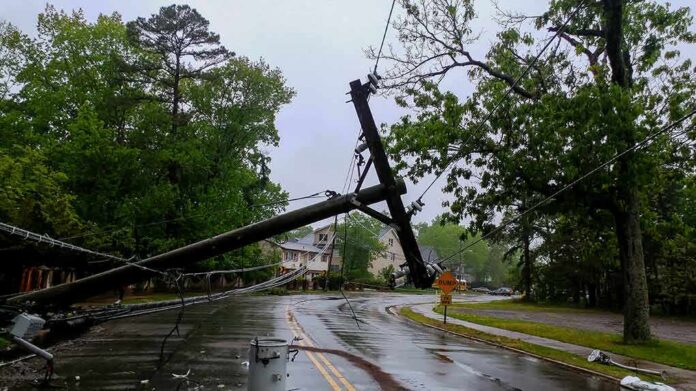
Officials warned that fierce winds could snap power lines and trigger widespread outages across parts of the West.
Story Snapshot
- National Weather Service warned of damaging winds and possible widespread power outages in several Western states.
- Forecast gusts reached 75 miles per hour in some areas, with 60–70 miles per hour in others.
- Pacific Gas and Electric advised customers to gather flashlights and fresh batteries ahead of possible outages.
- More than 50,000 California customers were already without power as the system moved through.
What Forecasters Said About The Threat
National Weather Service forecasters warned that damaging winds could down trees, snap power lines, and cause property damage. They said widespread power outages were possible as a strong system pushed across several states on November 18, 2026. The warnings covered California, Nevada, Montana, Colorado, and South Dakota. Forecast maps pointed to fierce gusts linked to a Pacific low-pressure system along the West Coast and a separate cold front driving winds over the Northern Plains.
Forecast gusts were high enough to justify firm precautions. Parts of the region faced gusts up to 75 miles per hour, with 70 miles per hour in California’s East Bay Hills and 60 miles per hour across eastern Montana and western South Dakota. At those speeds, tree limbs can fall, trucks can sway, and weak lines can fail. That risk rises when soils are wet and hills funnel wind. Localized damage can cascade into larger grid trouble if multiple circuits trip at once.
Where The Wind Was Hitting And Why It Matters
California and Nevada faced wind, rain, and mountain snow from a Pacific low. Montana and South Dakota saw winds from a low-pressure center and an advancing cold front. Different hazards hit different places, but the common thread was wind strong enough to disrupt daily life. High-profile vehicles on open roads, older roofs, and shallow-rooted trees are weak links. Rural areas with long distribution lines tend to be more exposed than dense urban cores with underground cables.
California outages were already widespread as the system moved through. More than 50,000 customers had lost power on November 18, according to reported outage data. That figure showed the grid was under stress as winds rose. Outages can come from blown fuses, tripped relays, or lines taken down by debris. Crews must first make areas safe, then isolate damage, and only then restore power. That process can take hours when winds stay high or access is blocked.
What Utilities And Agencies Urged People To Do
Pacific Gas and Electric told customers to prepare flashlights and fresh batteries in case the lights went out. The National Weather Service office in Reno advised people to stock extra food and water, keep lighting sources with spare batteries, and have candles ready if needed. These simple steps help families ride out short outages without panic. They also reduce calls to already busy first responders and utility lines during peak restoration periods.
Basic readiness lowers risk for everyone. Charged phones keep families in touch and let them see official updates. Flashlights prevent injuries in dark halls and stairwells. Water and nonperishable food keep households stable if stores close or roads ice over. For people who rely on medical devices, backup power plans matter most. Neighbors who check on seniors and those with disabilities can save lives when heaters, elevators, or phone lines fail.
Why This Keeps Happening And How To Read Warnings
Weather has become a larger driver of outages across the country. A Climate Central analysis found major weather-related outages rose 67 percent in the most recent decade studied compared with the early 2000s, with increases in 34 states and Washington, D.C.. Another review reports that extreme weather and failures on local distribution systems are the top causes of outages, with customers averaging about six hours without power a year.
People on both the left and the right are tired of systems that fail when families need them most. Storms do not care about politics, and neither do downed lines. Clear warnings help people act in time, but too many alerts can dull attention. Research shows warning fatigue is real, so officials must be precise and practical in what they ask people to do. Today’s message was simple and specific: secure supplies, charge devices, and plan for wind-driven outages.
Sources:
dailymail.com, latitudemedia.com, opensky.ucar.edu