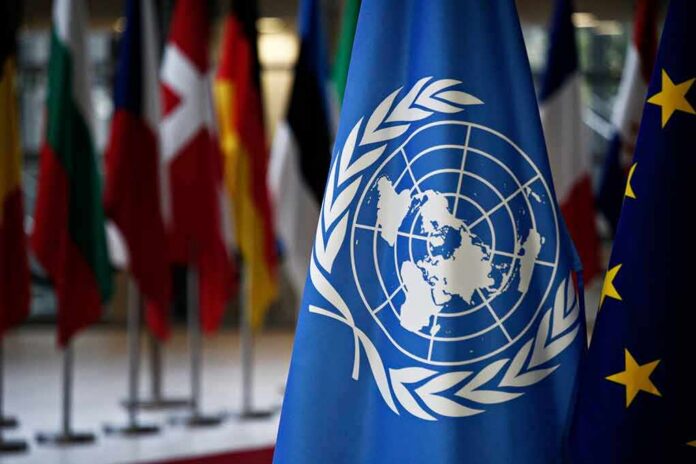
Iran’s president and Ukraine’s president took the UN stage on the same day, underscoring a world split by war, sanctions, and distrust.
Story Highlights
- Iran’s Masoud Pezeshkian traveled to New York to address the 81st UN General Assembly on Wednesday.
- Ukraine’s Volodymyr Zelenskyy was also slated to speak as headline leaders took the podium.
- The United States allowed Iran’s core delegation to attend under host-country rules, with limits.
- Coverage framed both speeches within active wars, sanctions, and tense great-power politics.
Leaders Converge at a Crowded UN General Debate
Regional and global outlets reported that Iran’s President Masoud Pezeshkian traveled to New York to attend the 81st United Nations General Assembly and was scheduled to speak Wednesday, September 23, 2026. Public broadcasters listed him alongside Ukraine’s President Volodymyr Zelenskyy as a headline speaker that day. Business media noted that nearly 130 heads of state and government were taking the podium during the week, placing both leaders within a packed, high-stakes agenda.
The United States confirmed that Iran’s core delegation could attend the high-level week under host-country obligations. Officials also said those delegates would face travel and purchase limits while in the country. This arrangement mirrors past practice. It shows how United Nations rules can require access even when relations are tense. This allowed Pezeshkian to be present in New York while sanctions and security pressures remained in force.
What Each Side Sought to Signal in New York
Iran-focused reporting said Pezeshkian aimed to “firmly defend” Iran’s positions and describe the “suffering” of Iranians under sanctions and broken promises, signaling a push to win sympathy and space for talks. State-linked coverage cited Iran’s official news agency saying he would deliver remarks at the session. Ukraine’s presidential office maintained an active speeches page during UN week, consistent with President Zelenskyy using the platform to rally support amid ongoing war.
Live coverage grouped these speeches with broader flashpoints that define this era: wars in Ukraine and the Middle East, sanctions, energy security, and unstable trade flows. This setting raised the profile of both addresses. It also increased the risk that message discipline, translation, and short clips would shape public takeaways more than full texts or records. That is common during UNGA, when attention is high and schedules are tight.
Why Verification Normally Flows Through UN Channels
United Nations guides explain that leaders register on an official speakers list, appear on the live webcast, and later in on-demand clips. The United Nations says recordings of each speaker are posted for playback, often with captions and transcripts, even if automated and imperfect. That process helps confirm attendance and remarks after the speeches end. It also creates a stable record once fast-moving live coverage gives way to analysis and debate.
In this case, much open reporting ahead of the event focused on schedules, travel, and goals rather than full texts. That is typical before and during the first days of the General Debate. The pattern matters for readers who want clear proof of what was said and when. The strongest confirmations usually appear in the United Nations Web TV archive and the formal speaker records soon after delivery.
Why This Moment Resonates at Home
Americans across parties are tired of leaders talking past each other while prices, wars, and border fights grind on. Seeing Iran’s leader and Ukraine’s leader share the spotlight in New York highlights a hard truth. The United Nations stage still shapes headlines, but it rarely fixes problems fast. The federal government must weigh security, costs, and alliances while defending basic freedoms and the rule of law. Voters want proof that policy, not posturing, drives results.
What to Watch Next
Watch for official United Nations on-demand video and records that time-stamp each speech and fix quotes. Look for any readouts from both presidencies that claim wins or signal talks. Track how the White House and Congress respond on sanctions, aid, and energy policy in the coming weeks. These steps will show whether the New York speeches were only theater, or the start of real moves that change lives beyond the cameras.
Sources:
youtube.com, president.gov.ua, pbs.org, dw.com, english.mathrubhumi.com, news.cgtn.com, cnbc.com, cnn.com