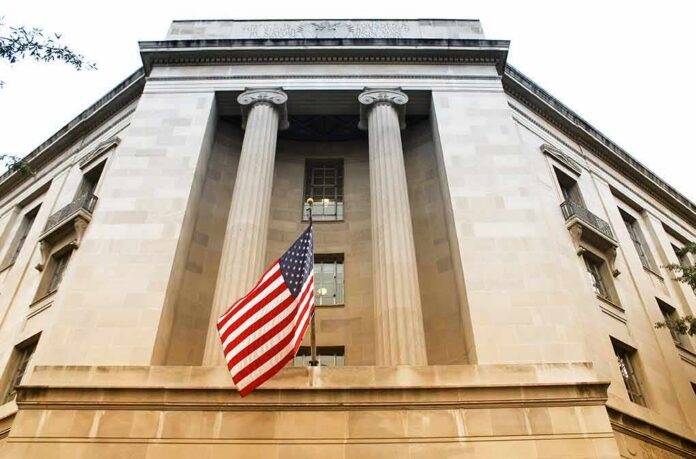
President Trump’s administration told a federal court that the Kennedy Center could be torn down if a $250 million renovation and his name on the building don’t move forward.
Quick Take
- Justice Department lawyers said in court papers the building could become “unsafe” and “required to be taken down” without renovation work.
- Trump denied wanting to demolish the center in February, then warned in September it “will end up being ripped down” without his recognition.
- A federal judge ordered 30 days’ notice before any demolition and ruled only Congress can put a new name on the memorial.
- Senators split sharply, with one calling demolition “the biggest affront to American history” and another calling the fight “drama and false crisis.”
Demolition Threat Enters Federal Court
The dispute moved beyond public statements in August 2026, when Justice Department lawyers filed court papers warning that blocking the renovation plan would let the Kennedy Center “deteriorate further into an unsafe, decrepit structure that will be required to be taken down.” Lawyers argued a judge’s ruling against the administration could leave demolition as the only remaining outcome. Congress had already set aside roughly $250 million for repair work.
Government attorneys also argued the financial stakes were real, not just legal posturing. They said blocking Trump’s recognition on the building would scare off donors, dry up contributions, and stop structural repairs already underway. That framing turned a naming dispute into an argument about the building’s physical survival, not just who gets credit for fixing it.
From Denial To Warning In Seven Months
Trump’s own words shifted sharply over the year. In February 2026, he told reporters, “I’m not ripping it down. I’ll be using the steel. So we’re using the structure,” while announcing a two-year closure for construction. By September, his tone had changed. He warned the center “will end up being ripped down” if he isn’t properly recognized for leading the renovation effort.
Judge Requires Advance Notice Before Any Teardown
Judge Christopher Cooper stepped in as the fight escalated. He ordered the administration to give 30 days’ notice before making any changes to the building, including “any ‘demolition’ of the Center’s main building.” Cooper also ruled that only Congress can approve a new name for the venue, which lawmakers created in 1964 as a living memorial to President John F. Kennedy. The Kennedy Center’s board then voted to close most of the facility right after that ruling.
Lawmakers Split Over What The Fight Really Means
Reaction on Capitol Hill broke along unexpected lines. One senator called demolition “the biggest affront to American history” and to Kennedy’s legacy, warned of “massive backlash,” and pushed Congress to use every tool available to stop it. Another senator pushed back, calling worries about the building’s name “kind of silly” and accusing both sides of “creating a lot of drama and false crisis” instead of solving real problems.
The clash raises a question that goes beyond one building. A structure Congress designated as a national memorial is now caught between a president’s demand for personal recognition and a legal fight over who controls it. No public engineering report has confirmed demolition is actually necessary, and the threat has moved in step with the naming dispute rather than a documented safety finding. Whether this ends in renovation, closure, or something more permanent likely depends on how the court case unfolds.
Sources:
youtube.com, bbc.com, theguardian.com, cnn.com, nytimes.com, nbcwashington.com, deadline.com, apnews.com