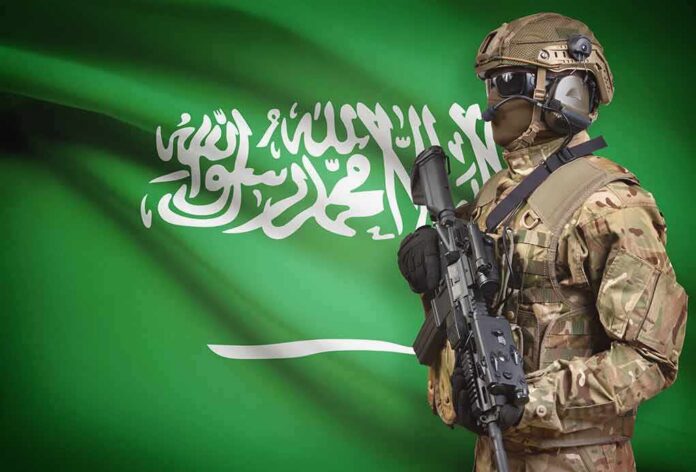
Pakistan says it will defend Saudi Arabia “to any extent,” and has already sent fighter jets under their new mutual defense pact.
Story Snapshot
- Pakistan and Saudi Arabia signed a mutual defense pact that treats an attack on one as an attack on both.
- Pakistan’s military and foreign ministry pledged unconditional support for Saudi security.
- Saudi Arabia said Pakistan deployed fighter jets and forces to the kingdom under the pact.
- The pact formalizes decades of defense ties and aims to strengthen deterrence.
What Pakistan and Saudi Arabia Agreed To
Saudi Arabia and Pakistan signed a Strategic Mutual Defense Agreement in September 2025. The key clause states that any aggression against either country will be considered aggression against both, according to the Pakistani prime minister’s office and reporting by a major international news agency. Saudi statements said the pact aims to deepen defense cooperation and strengthen joint deterrence. Officials did not release a full legal text, but both governments framed the deal as a formal pledge to respond together to external threats.
Pakistan’s foreign ministry called the pact defensive and said it is not aimed at any third country. The ministry repeated that any attack on one would be treated as an attack on both, and that the deal builds on an older security relationship between the two states. Pakistan’s military spokesman went further in public remarks, saying Islamabad would go “to any extent” to defend the kingdom if it came under attack. He described Pakistan’s commitment to Saudi security as unconditional.
What Has Happened Since The Pact
Saudi Arabia’s defense ministry said in April 2026 that Pakistan had sent fighter jets and other forces to the kingdom under the agreement. The deployment aimed to boost Saudi security as regional tensions rose. The same report noted that Pakistan was also hosting talks aimed at ending the wider Iran war. The announcement showed that the pact is already shaping real-world military moves, not just statements on paper.
Analysts say the agreement formalizes a pattern that goes back decades. Pakistan trained Saudi forces and stationed troops in the kingdom at different points since the late twentieth century. The new pact signals a stronger, more predictable frame for how they work together in both peace and crisis. It uses language that sounds like the North Atlantic Treaty Organization’s Article 5, but it leaves room for leaders to decide specific steps in each case.
Why This Matters For Americans
This pact shifts risk and leverage across the Middle East and South Asia. When two nuclear-capable partners draw closer, it raises the stakes for any regional fight. It also shows that countries are building their own security plans while the United States debates its role. Some see that as smart burden sharing. Others see a warning that Washington’s influence is slipping, and that new deals may pull America into crises without clear debate at home.
**UPDATE**
Saudi-Houthi Strategy Watch
Material change in Saudi allied military backing: Pakistan’s military has now moved from conditional language to an explicit public commitment to physically defend Saudi Arabia against attack “to any extent.”
Pakistan’s military…
— Brilho do Norte (@BrilhoDance) September 17, 2026
For readers frustrated by endless wars, high costs, and energy shocks, the link is direct. A wider fight that hits oil routes can drive up gas and food prices here. Defense deals can also lead to requests for U.S. support, money, or arms. Leaders in both parties say they defend U.S. interests. Yet many Americans feel left out of the choices that raise prices and risk. Clear goals, limits, and oversight matter if our families will pay the bill.
Sources:
aljazeera.com, arabnews.jp, thenews.com.pk, english.ahram.org.eg