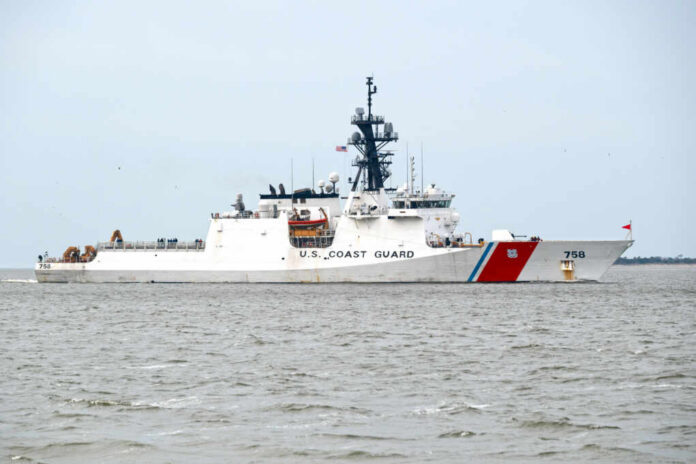
As the Coast Guard celebrates a $63 million drug haul off Venezuela, many Americans are asking whether this is real progress or just another costly move in a failing war on drugs.
Story Snapshot
- A Coast Guard patrol seized about 7,700 pounds of cocaine and 4,000 pounds of marijuana in the Caribbean, valued near $63 million.[6]
- This bust is part of record-setting operations that have seized hundreds of thousands of pounds of narcotics in recent years.[4][7][9]
- Officials link many recent seizures to vessels tied to Venezuela, even as federal data show that country is mainly a transit point, not a main source.[1][11]
- Supporters see these operations as vital defense against cartels; critics see mission creep, militarization, and a federal system that keeps spending while communities still struggle.[4][9][15]
What Happened In The $63 Million Drug Bust
U.S. Coast Guard officials say a recent patrol stopped two suspected smuggling trips in international waters, seizing nearly 4,000 pounds of cocaine and about 5,400 pounds of marijuana worth more than $57 million.[6] In similar cases, crews describe fast “go-fast” boats with no tracking devices, no fishing gear, and heavy loads.[6] Boarding teams report finding triple-sealed bundles of cocaine in cargo holds, wrapped in plastic and burlap and marked with symbols used by trafficking groups.[6]These details match long-standing Coast Guard tactics against narco-traffickers in the Eastern Pacific and Caribbean Seas.
Record Drug Seizures And The Big Numbers Game
In 2025, the Coast Guard reported a record year, seizing more than 511,000 pounds of illegal drugs worth about $3.8 billion, and claiming roughly $10 billion in “avoided costs” to society, including health care savings.[4] One historic offload in August 2025 moved about 61,740 pounds of cocaine and 400 pounds of marijuana, valued at $473 million, from 19 separate interdictions.[9] Officials said that haul alone equaled about 23 million potentially fatal doses of cocaine, enough to “overdose the entire population of Florida.”[5] These huge figures grab headlines, but they also raise questions about how value and “saved” costs are calculated and used to justify budgets.[4]
Venezuela, The Caribbean, And A Quiet Shift Toward Militarization
Many recent drug offloads involve boats tied to routes near Venezuela, and one Coast Guard release says vessels from Venezuela were linked to roughly $2.2 billion in drugs seized at sea in 2025.[1] At the same time, federal analysis from the Drug Enforcement Administration and United Nations shows Venezuela is mainly a transit corridor, with only about five percent of Colombian cocaine passing through it and much of that headed to Europe or the wider Caribbean.[11] As U.S. forces increase strikes and interdictions near Venezuela, critics warn this moves drug work from law enforcement into something closer to military action, with greater risk for innocent crews and foreign tensions.[3][15][17]
How Often Does The Coast Guard Get It Wrong?
Supporters often point to big hauls as proof the system works, but federal data show a more mixed picture. A 2024 Coast Guard report, highlighted by fact-checkers, found that about 73 percent of boat boardings during that year found drugs, meaning around 27 percent did not.[15] Senator Rand Paul used that number to argue that a “shoot first” policy at sea could end up killing innocent people if suspicion alone is treated as proof.[15] New York Times reporting has also shown how routine boardings rely on fast decisions made far from public view, with limited outside oversight. This raises concerns for both conservatives wary of unchecked federal power and liberals worried about human rights.[15]
Are These Busts Making America Safer?
Coast Guard leaders and Drug Enforcement Administration officials argue that every major seizure keeps dangerous drugs out of U.S. neighborhoods and weakens transnational criminal organizations.[4][9] They stress teamwork with Navy ships and foreign partners as a way to hit cartels before cargo can move inland.[8][12] Yet independent analysts note that most U.S. cocaine still enters through Mexico and Central America by land routes, not Caribbean sea lanes near Venezuela.[11] Despite billions in seized narcotics, overdose deaths and addiction remain high at home, feeding the sense on both the right and the left that Washington spends heavily on distant missions while failing to fix the root problems in American communities.[11]
Money, Power, And The Deep State Question
For many Americans, the deeper worry is not one specific bust but the system behind it. The Department of Homeland Security has asked for huge funding packages, and critics in Congress and think tanks warn that such money often goes out with weak oversight.[4][15] Each record offload is followed by press events, big dollar figures, and claims of taxpayer “savings,” but there is little public access to after-action reports, chain-of-custody records, or detailed audits.[4][7] That lack of transparency feeds a shared fear that the permanent security bureaucracy—the “deep state,” as some call it—protects its budgets first and measures success mainly by how many pounds it can stack on a pier, not by whether ordinary Americans are any closer to safety or the American Dream.
💥💥💥‼️‼️‼️US Coast Guard has seized over 225,000 pounds of cocaine in eastern Pacific https://t.co/EsbQkG3QRI
— CHRISTIAN CONSERVATIVE FIGHTERS FOR FREEDOM !!! (@timlatimer365) June 21, 2026
At the same time, Venezuelan officials and some international observers frame U.S. operations as illegal aggression rather than law enforcement, warning that shootings and strikes at sea could spark wider conflict.[3] Major platforms and networks often focus on the geopolitical drama while giving less space to quiet questions about evidence, mistaken raids, or the real impact on supply.[3][6] For citizens across the political spectrum, the $63 million haul is a reminder of a larger dilemma: a federal government that seems very good at dramatic shows of force far from shore, but far less effective at building trust, reducing demand, and giving struggling families real paths out of addiction and poverty.
Sources:
[1] Web – Coast Guard’s $63M Drug Haul Includes 7,700 Pounds of Cocaine, 4K …
[3] Web – U.S. Forces Seize Sixth Oil Tanker Linked to Venezuela
[4] YouTube – U.S. Coast Guard led seizure of oil tanker near Venezuela with Navy …
[5] Web – Coast Guard Seized $4 Billion Worth of Narcotics in Record-Setting …
[6] Web – Trump says US still actively pursuing oil tanker linked to Venezuela …
[7] YouTube – U.S. Coast Guard intercepts second vessel off Venezuelan coast
[8] Web – EXCLUSIVE: Never-before-seen photos following the U.S. seizure of …
[9] Web – Tanker has been evading interception since the US Coast Guard …
[11] Web – Coast Guard offloads over $141 million in illicit drugs interdicted in …
[12] Web – Coast Guard admiral, DEA administrator defend strikes on alleged drug …
[15] Web – U.S. Coast Guard seizes over 1,200 pounds of cocaine from “narco …
[17] Web – Coast Guard offloads nearly $510 million in illegal narcotics …