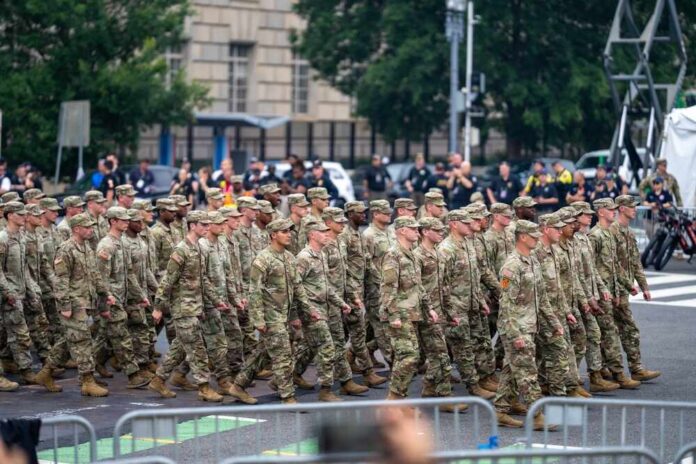
A half-billion-dollar National Guard mission inside America’s cities is colliding with court limits, Pentagon budget strain, and a base that’s tired of “forever wars” abroad and open borders at home.
Quick Take
- CBO estimated Trump-era National Guard deployments to six major cities for immigration-related missions cost about $496 million through the end of 2025, with potential ongoing costs of roughly $93 million per month if continued.
- The Guard deployments expanded beyond border support into interior-city operations tied to immigration enforcement and protection of federal personnel, drawing protests and legal scrutiny.
- A Supreme Court ruling drove withdrawals from Chicago, Los Angeles, and Portland in December 2025, underscoring limits on using military forces for domestic law enforcement.
- The Pentagon has diverted more than $2 billion from military projects to support DHS and is seeking another $5 billion for 2026 immigration-related support, fueling questions about readiness and transparency.
What the CBO cost figure tells taxpayers
The Congressional Budget Office reported that National Guard deployments ordered by the Trump administration to Los Angeles, Chicago, New Orleans, Memphis, Portland, and Washington, D.C. cost about $496 million through the end of 2025. CBO also estimated the burn rate could reach roughly $93 million per month if missions continue. That dollar figure matters to voters watching inflation and energy costs, because it puts a hard price tag on interior deployments—not just border security.
Troops were first sent in June 2025 to multiple cities amid protests tied to immigration operations and protection of federal personnel. In August 2025, Washington, D.C. saw an additional deployment connected to a crime crackdown. By December 2025, withdrawals began in Chicago, Los Angeles, and Portland after a Supreme Court ruling against the administration’s legal authority for military involvement in Illinois law enforcement.
Legal constraints: Title 32, Posse Comitatus, and the Insurrection Act pressure point
Reporting and legal analysis describe an approach that leaned on Title 32 status to keep Guard troops under state control while supporting federal priorities, a method used to avoid direct conflict with the Posse Comitatus Act’s restrictions on military law enforcement. The legal lines still tightened as courts reviewed how close “support” roles came to policing. The administration also signaled it could consider the Insurrection Act if courts blocked deployments, raising the stakes for constitutional checks and balances.
The constitutional concern for many conservatives is not the goal of enforcing immigration law, but the precedent set when soldiers become routine tools in political fights between Washington and local governments. Limited-government voters generally prefer clearly authorized, narrow missions with firm end dates and transparent oversight. The end-2025 rollback after the Supreme Court ruling is a reminder that even a popular enforcement agenda can run into the hard edges of separation of powers and statutory limits.
DHS funding battle and Pentagon diversion: readiness versus enforcement
The deployments unfolded amid a funding struggle in which the Department of Defense diverted more than $2 billion from military projects to support DHS, despite DHS operating with a very large overall budget. Pentagon figures cited in congressional material include $1.3 billion committed to border support and $258 million tied to troops in cities. Lawmakers pressing the issue argue the diversions hit readiness and quality-of-life items, including construction and barracks needs, while reimbursement details remain unclear.
Another detail drawing attention is the Pentagon plan to reassign about 600 Judge Advocate General officers as immigration judges. That idea reflects how stretched the system has become: instead of simply adding civilian capacity, the federal government is looking to repurpose uniformed legal personnel for a domestic administrative backlog. Conservatives who want strong borders but also want a focused, lethal military are left asking where the mission ends—especially while the country is already engaged overseas and defense priorities are competing for the same dollars.
Why the politics are messy inside MAGA right now
The political split inside Trump’s coalition is real and explainable. Many supporters want aggressive action against illegal immigration and reject amnesty-style outcomes, especially after years of border chaos and “sanctuary” policies. At the same time, the same voters are increasingly hostile to expensive, open-ended operations—whether they are foreign conflicts or domestic deployments that look like federalized policing. With the Iran war already straining attention and budgets, the appetite for another long-running commitment is thin.
Trump Ponders National Guard Deployment, Rejects Amnesty Amid DHS Funding Battlehttps://t.co/6vMT01PYwL
— PJ Media (@PJMedia_com) March 26, 2026
The CBO cost estimate, the end-2025 withdrawals after the Supreme Court ruling, and the broader DHS-DoD funding tensions. They do not confirm a specific new 2026 deployment order. For voters, the practical takeaway is to watch for concrete legal authorities, defined troop roles, and a clear funding trail—because those details determine whether enforcement stays constitutional and accountable.
Sources:
Trump’s National Guard Deployments Cost Taxpayers Nearly $500M, Report Reveals
New Report: Rep. Garamendi and Sen. Warren Reveals Trump Admin Took $2 Billion
How Trump Could Deploy the Military for Mass Deportation
Trump’s National Guard deployments aren’t random. They were planned years ago