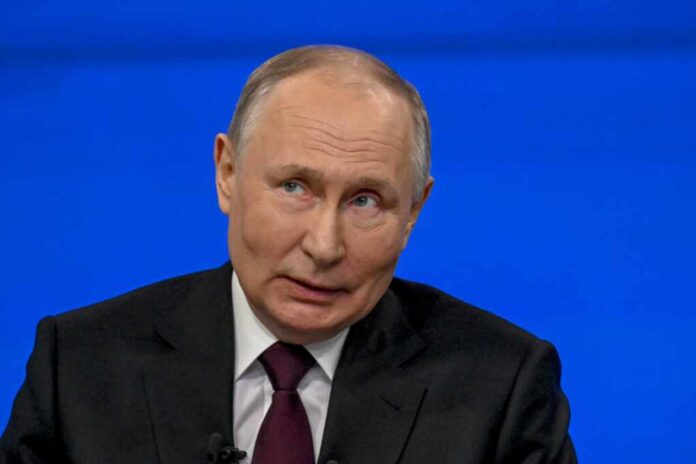
President Trump says a single phone call may buy freezing Ukrainians a week of relief—yet the Kremlin’s silence leaves the world watching for proof. Trump told his Cabinet on Jan. 29 that Vladimir Putin agreed to pause strikes on Kyiv and other Ukrainian cities for one week amid extreme cold to allow for humanitarian aid, given that recent attacks on energy infrastructure have left millions without heat, power, and water. While Ukraine’s President Volodymyr Zelensky publicly welcomed the statement, no Kremlin confirmation has been reported, and ongoing strikes elsewhere underscore the uncertainty of compliance with the claimed pause.
Story Highlights
- Trump told his Cabinet on Jan. 29 that Vladimir Putin agreed to pause strikes on Kyiv and other Ukrainian cities for one week amid extreme cold.
- The request was framed as humanitarian: recent attacks on energy infrastructure have disrupted heat, power, and water for millions, including more than 1,300 Kyiv apartment buildings without heat.
- Ukraine’s Volodymyr Zelensky publicly welcomed Trump’s statement and urged follow-through, tying the pause to broader de-escalation talks.
- No Kremlin confirmation was reported, and strikes elsewhere in Ukraine were still reported the same day, underscoring uncertainty about compliance.
Trump’s claim: a one-week pause to blunt a winter humanitarian crisis
President Donald Trump said Jan. 29, during a White House cabinet meeting, that he personally asked Russian President Vladimir Putin to halt strikes on Kyiv and other Ukrainian cities for one week because extreme cold is compounding a humanitarian crisis. Trump described the weather as “record-setting” and said disruptions to heating, electricity, and water were hitting millions after attacks on Ukraine’s energy system. Trump added that Putin agreed to the request, calling it a “very good thing.”
The practical stakes are straightforward: energy infrastructure is not an abstract target in January. Reporting around the announcement said recent strikes left large sections of Kyiv struggling to keep buildings heated, with more than 1,300 apartment buildings without heat. That is the kind of hardship that turns geopolitical conflict into immediate civilian danger, especially for older residents and families with young children. The claimed pause is narrowly tailored—short, weather-driven, and aimed at preventing conditions from worsening quickly.
President Putin agreed not to strike Kiev for a week due to the record-cold winter — President Trump
“I personally asked Putin not to bomb Kyiv and other cities for a week, and he agreed to this,” pic.twitter.com/0UH9O9pbyC
— Chay Bowes (@BowesChay) January 29, 2026
What’s verified—and what remains unconfirmed
Multiple outlets reported Trump’s statement and Zelensky’s response, but the central weakness is verification. As of Jan. 29–30 reporting, there was no public Kremlin confirmation that a one-week pause had been accepted or when it would start. Trump also did not specify the exact timing of the call or the schedule for the halt. The same day Trump announced the agreement, reports noted continued Russian strikes in central and southern Ukraine that killed six, complicating any claim of an immediate nationwide pause.
That gap matters for anyone trying to separate public diplomacy from real battlefield changes. A one-week halt limited to Kyiv strikes, or limited to certain categories of attacks, would look different from a broad pause across major cities. The available reporting also did not establish whether the request covered energy facilities specifically, all strikes on cities, or some narrower operational definition. With the Kremlin not publicly validating the deal, the only responsible conclusion is that the pause is asserted by U.S. and Ukrainian statements but not independently confirmed in the cited reporting.
How the Abu Dhabi talks and U.S. envoys fit into the picture
The announcement landed amid ongoing U.S.-brokered diplomacy. Reports described trilateral talks in Abu Dhabi around Jan. 24–25 involving U.S. envoys Steve Witkoff and Jared Kushner, Ukrainian and Russian representatives, and even five Russian generals. The discussions reportedly covered security protocols, “prosperity” arrangements, and the contours of a possible territorial “land deal,” though public details were limited. Witkoff described progress and indicated another round could follow in roughly a week.
Those talks provide context for why a weather-based pause is more than a humanitarian gesture—it’s also a test of whether any channel can produce measurable de-escalation. Zelensky’s response reflected that logic: he thanked Trump and emphasized that steps toward de-escalation can contribute to real progress, while also signaling that enforcement and follow-through matter. For Americans wary of endless foreign commitments, the key question is whether diplomacy reduces civilian suffering and moves toward a durable settlement without drifting into open-ended, blank-check escalation.
Why conservatives are watching the “enforcement” question closely
Trump’s approach highlights a classic debate: leadership through direct negotiation versus bureaucratic, slow-moving international consensus. The reporting presents Trump’s personal contact as the mechanism for a near-term humanitarian result, while also acknowledging the risk if the claim is not honored. Zelensky’s public emphasis on U.S. enforcement signals that Ukraine expects Washington to apply leverage if Russia does not comply. Without clear verification, Americans are left evaluating credibility in real time—especially after years when global institutions often promised results but delivered stalemate.
https://twitter.com/
The other pressure point is what comes next if the pause holds. A temporary halt during extreme cold could build confidence for broader agreements, but it could also become a public-relations moment that fades without structural change. Witkoff’s mention of a “land deal” underscores why clarity matters: territorial arrangements carry long-term consequences, and the public record in this reporting does not define what concessions, if any, are being discussed. For now, the facts support a limited conclusion: the U.S. claims a short-term humanitarian pause, Ukraine welcomes it, and independent confirmation from Moscow was not reported.
Watch the report: Trump says Putin agreed to not fire on Kyiv for a week during extreme cold
Sources:
- Trump says Putin agrees to pause Kyiv strikes amid harsh cold
- Trump says Putin agreed halt Kyiv strikes one week amid harsh cold
- Trump says Putin agreed not to attack freezing Kyiv for a week
- Trump claims Putin agreed not to strike Kyiv, Ukrainian cities for a week
- Trump personally asked Putin not to strike Kyiv during extreme cold